
How to Evaluate Engineering Expertise in an Automatic Car Wash Manufacturer?
2026 Technical Buyer’s Guide to Mechanical Design, PLC Controls, Safety Engineering, Hydraulic Systems, Quality Testing, Customization, and International Equipment Procurement
Introduction: Why Engineering Expertise Matters When Choosing a Car Wash Manufacturer
Choosing an automatic car wash manufacturer is a major business decision. The machine you buy may operate every day, handle many vehicles, and remain part of your business for years.
However, not all equipment manufacturers have the same engineering capabilities.
Some companies develop their own mechanical systems and control software. Others assemble equipment using designs or components supplied by outside partners. Both approaches can produce useful products, but the level of technical responsibility may differ.
Therefore, buyers should understand the engineering work behind the finished machine.
A well-designed automatic car wash system needs more than motors, brushes, pumps, and a control panel.
Its structure must support the intended loads. Its moving parts must operate in a controlled way. Its water system must deliver the required flow and pressure. Its sensors must provide accurate information. Its safety functions must address foreseeable risks.
Furthermore, these systems must work together.
A powerful pump cannot correct poor nozzle placement. An advanced PLC cannot compensate for an unsuitable mechanical design. Likewise, expensive components do not guarantee reliable performance without proper integration.
This is why evaluating automatic car wash manufacturer engineering should be part of every serious equipment purchasing process.
For buyers in the United States, Canada, the United Kingdom, and European Union, engineering evaluation also supports better installation planning and conformity assessment.
This guide explains how to assess a manufacturer’s mechanical, electrical, hydraulic, software, and safety capabilities.
It also provides practical questions, evidence requirements, and a supplier evaluation scorecard.
The goal is to help commercial buyers identify engineering strengths before committing to equipment purchases.
Quick Answer: How Do You Evaluate an Automatic Car Wash Manufacturer’s Engineering Expertise?
The most effective method is to evaluate actual engineering evidence rather than relying on promotional claims.
Start with technical drawings and model-specific specifications. Then review the manufacturer’s mechanical design, control architecture, safety assessment, component selection, and testing methods.
A strong evaluation should examine:
- Mechanical and structural design capability
- PLC programming and automation engineering
- Water pumps, piping, and hydraulic system design
- Sensor selection and machine positioning
- Electrical engineering and protective functions
- Risk assessment and safety validation
- Factory inspection and acceptance testing
- Installation and commissioning documentation
- Customization and engineering change control
- Spare parts, maintenance, and technical support
However, the quality of engineering cannot be judged from one certificate or a factory photograph.
A capable manufacturer should be able to explain how the equipment works, why key design decisions were made, and how the complete machine is tested.
1. Understand What Engineering Expertise Really Means
Engineering expertise is the ability to design, integrate, test, and support equipment for a defined application.

Machine Chain
For an automatic car wash machine, this includes several technical disciplines.
Mechanical engineers may design frames, shafts, guides, and moving assemblies.
Electrical engineers may develop power distribution and control arrangements.
Automation engineers may program PLCs and operator interfaces.
Meanwhile, process engineers may select pumps, nozzles, and chemical dosing components.
However, having engineers on staff does not automatically prove good engineering.
Buyers should examine design methods, project records, and completed technical work.
The focus should be on demonstrated capability.
2. Distinguish Engineering From Equipment Assembly
A company may assemble machines using standard components.
That does not necessarily indicate poor product quality.
However, assembly capability is different from original engineering capability.
For example, a company may be able to install a motor without designing the related drive system.
Another company may develop the drive arrangement, evaluate loads, select the motor, and verify performance.
Therefore, buyers should ask which activities are performed in-house.
Does the manufacturer create mechanical drawings?
Who writes PLC software?
Who approves changes to structural components?
Who performs design verification?
Clear answers help reveal the company’s actual role.
3. Review the Manufacturer’s Engineering Team
A manufacturer should be able to explain how technical responsibilities are organized.
For example, mechanical design may be handled by one team and automation by another.
However, team size alone does not determine quality.
A smaller experienced team may manage certain projects effectively.
A larger team may still have weak coordination.
Therefore, evaluate relevant expertise and project responsibilities.
Ask who approves the final machine configuration.
Also, determine whether the team supports installation and after-sales troubleshooting.
Engineering knowledge becomes more useful when it remains available after the equipment leaves the factory.
4. Ask for Model-Specific Technical Documentation

Touchless Car Wash Machine
Technical documentation is one of the easiest ways to begin an engineering assessment.
Request the machine’s approved specification sheet.
Also, ask for installation requirements, dimensions, utility connections, and operating limits.
However, a general catalog may not describe the actual equipment you intend to purchase.
Therefore, confirm the exact model and configuration.
If important options change, the documentation should be updated.
A reliable engineering process keeps technical information consistent across the quotation, drawings, and delivered machine.
This reduces misunderstandings during construction and installation.
5. Evaluate Mechanical Structure Design
The main frame supports the machine’s components and operating loads.
For a rollover car wash, the structure may also support moving gantry assemblies.
Therefore, structural design is an essential engineering discipline.
Ask how the manufacturer determines material specifications and load requirements.
Also, review the design of joints, supports, and moving interfaces.
However, a thick steel plate alone does not prove structural strength.
The design must consider geometry, loading, connections, and operating conditions.
Where appropriate, qualified engineers should evaluate structural calculations and design assumptions.
6. Check Materials and Corrosion Protection
Automatic car wash equipment operates in wet and chemically exposed environments.
Therefore, material selection affects long-term maintenance.
Manufacturers may use galvanized steel, stainless steel, coatings, or other materials according to the design.
However, no single material is ideal for every component.
For example, corrosion resistance depends on the chemical environment and exposure conditions.
Ask how the manufacturer selects protective finishes.
Also, request information about maintenance requirements.
A good engineering team should explain the intended operating environment and any important material limitations.
Do not treat appearance as proof of corrosion resistance.
7. Inspect Mechanical Motion Systems
Moving car wash equipment requires suitable guidance and drive systems.
Depending on the machine, these may include rails, wheels, chains, belts, shafts, and gear reducers.
However, components must be designed as a complete system.
For example, poor alignment may cause repeated bearing or chain wear.
An unsuitable gear reducer may not match the required operating duty.
Therefore, examine the manufacturer’s design process.
Ask how mechanical loads and operating speeds are determined.
Also, review lubrication and inspection requirements.
A strong manufacturer should understand failure causes, not simply replace worn parts.
8. Evaluate Motor and Drive Selection
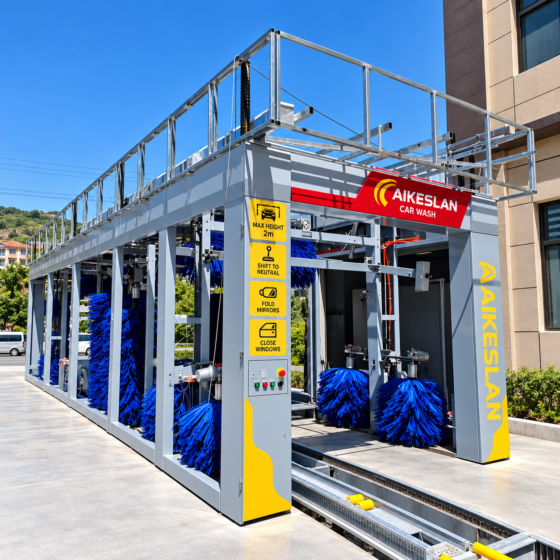
Tunnel Car Wash Machine
Motors influence movement, positioning, and cleaning processes.
However, motor power alone does not establish system performance.
The manufacturer should select motors based on load, duty, operating environment, and control requirements.
Ask how drives are matched to mechanical systems.
Where variable-speed control is used, confirm compatibility and protection arrangements.
Also, consider starting and stopping behavior.
For example, a moving assembly must operate within approved mechanical limits.
A capable engineering team should explain the relationship between motor selection, drive control, and machine performance.
9. Check Gear Reducer Engineering
Gear reducers help match motor output to the required mechanical speed and torque.
However, correct selection depends on the specific application.
The manufacturer should consider loading, speed, operating duty, lubrication, and environmental conditions.
Ask whether the gear reducer is appropriately rated.
Also, confirm maintenance and replacement requirements.
An unsuitable reducer can affect performance and service life.
Therefore, buyers should not judge the component by brand name alone.
The engineering value lies in selecting and integrating the correct part for the machine.
10. Assess Brush System Engineering
Brush-based machines require suitable mechanical positioning and controlled contact.
However, cleaning performance depends on the complete design.
Brush materials, rotational speed, movement, and vehicle detection can all affect operation.
Therefore, ask how the manufacturer selects brush assemblies.
Also, review the method used to control movement around vehicles.
A more aggressive cleaning action is not automatically better.
The machine must operate within its approved vehicle compatibility and safety requirements.
A strong engineering team should be able to explain the intended cleaning process and maintenance needs.
11. Evaluate Touchless Washing Engineering
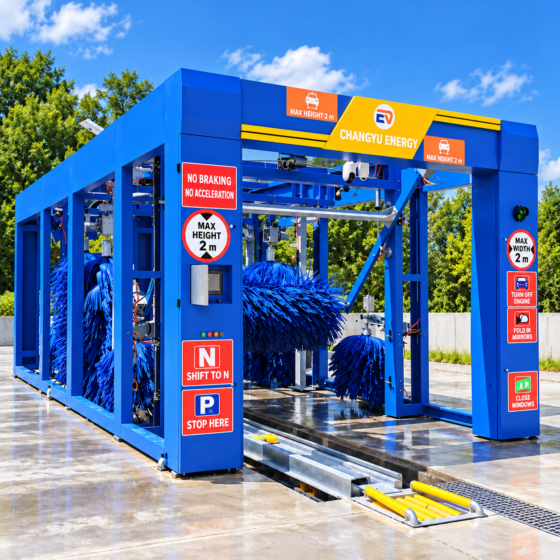
Tunnel Car Wash Machine
Touchless washing depends on coordinated water delivery, chemistry, movement, and control.
However, high pressure alone does not guarantee better results.
Nozzle placement, flow, spray coverage, and chemical application are also important.
Therefore, ask how the manufacturer develops its cleaning process.
Does the design account for different vehicle surfaces and positions?
How are operating limits established?
What testing supports the proposed wash programs?
A capable supplier should explain the relationship between pressure, flow, coverage, and washing performance.
Buyers should assess the complete system rather than isolated components.
12. Review Water Pump Selection
Water pumps must operate within suitable conditions.
The manufacturer should consider required flow, operating pressure, inlet conditions, and expected duty.
However, pump performance also depends on the surrounding system.
For example, inadequate water supply can affect operation.
Therefore, request the relevant pump specifications.
Also, ask about filtration, pressure protection, and maintenance.
A powerful pump may create additional problems if piping and nozzles are not compatible.
A good engineering process starts with system requirements and then selects suitable components.
13. Check Nozzle and Spray Coverage Design
Spray nozzles affect how water reaches the vehicle.
However, the selected nozzle must work with available pressure and flow.
Nozzle arrangement also influences coverage.
Therefore, ask how the manufacturer establishes spray positions.
Are nozzles selected for the intended cleaning stage?
How are blocked or worn nozzles maintained?
Can technicians identify suitable replacements?
A manufacturer should provide relevant technical specifications.
However, spray pattern claims should be supported by testing under defined conditions.
Proper nozzle engineering is part of the complete cleaning process.
14. Evaluate Chemical Dosing Systems
Chemical application needs suitable dosing equipment and compatible materials.
For example, pumps, seals, tubing, and fittings must suit the selected chemicals.
However, chemical performance also depends on concentration, water quality, and contact time.
Therefore, ask about approved operating conditions.
The manufacturer should explain how chemical delivery is controlled.
Also, confirm whether the system provides alarms or other monitoring features.
A reliable design should make dosing adjustments manageable for authorized personnel.
Chemical compatibility and safe handling must be reviewed before operation.
15. Consider Water Recycling Integration
Some commercial sites use water reclaim or treatment equipment.
However, not every automatic wash system has identical water quality needs.
Therefore, ask whether the manufacturer can provide integration requirements.
For example, treated water may be suitable for some wash stages but not others.
The design should address filtration, water quality, storage, and required flow.
However, local water and wastewater rules must also be considered.
A good manufacturer should identify the machine’s needs clearly.
Local water-treatment specialists may still be required to design the complete system.
16. Review Electrical System Design
An automatic car wash machine relies on electrical power and controls.
Therefore, electrical engineering is an important supplier capability.
Ask whether the manufacturer provides electrical drawings.
Also, review the approved supply voltage, frequency, connected load, and protection requirements.
However, the electrical design must suit the destination market.
Equipment intended for one national electrical system may need additional assessment before installation elsewhere.
Therefore, involve qualified local professionals.
A capable supplier should provide accurate technical information and cooperate with the installation team.
17. Evaluate PLC Programming Expertise
The programmable logic controller, or PLC, manages many automated machine functions.
Depending on the system, it may coordinate motors, pumps, sensors, and wash sequences.
However, PLC hardware alone does not prove advanced automation capability.
The manufacturer must also develop suitable control logic.
Ask whether PLC programming is performed in-house.
Also, inquire about version control, software testing, and technical documentation.
A strong engineering team should explain how the controller handles normal operation and foreseeable faults.
Safety-related control functions require additional verification.
18. Assess HMI Design and Usability
The human-machine interface, or HMI, allows operators to view machine information and control permitted functions.
However, an attractive touchscreen is not enough.
Operators need clear instructions and useful fault information.
Therefore, evaluate the HMI from a practical perspective.
Are alarms understandable?
Can staff identify the affected system?
Are important functions protected against unauthorized changes?
Also, ask whether the interface supports suitable languages.
Good HMI engineering reduces confusion and helps trained personnel operate the machine more consistently.
19. Evaluate Sensor Integration
Sensors may detect vehicle presence, movement, position, pressure, or other operating conditions.
However, sensor reliability depends on correct selection and installation.
For example, a suitable device must match the intended range and environmental conditions.
It must also work with the controller.
Therefore, ask how the manufacturer selects sensors.
How are signals checked?
What happens when a sensor fails or provides inconsistent information?
Safety-related sensing functions require suitable engineering analysis.
A capable manufacturer should understand sensor behavior within the complete control system.
20. Review Fault Detection and Diagnostics
Good diagnostics can help technicians identify problems efficiently.
However, fault detection features vary across machine models.
A manufacturer should explain which operating conditions are monitored.
For example, the machine may provide alarms for selected drive, sensor, or water-system faults.
However, buyers should not assume every machine includes advanced remote monitoring.
Ask to see actual diagnostic functions.
Also, review how faults are recorded and explained.
A reliable system should help technicians identify problems without encouraging unsafe troubleshooting practices.
21. Evaluate Remote Technical Support Capability
Remote assistance may help diagnose selected equipment faults.
However, it depends on the machine’s architecture and available communication tools.
Ask whether the manufacturer can review approved diagnostic information.
Also, confirm the support process.
Who receives fault reports?
What details are required?
When is local inspection necessary?
If remote control access is available, suitable cybersecurity and authorization measures are important.
The supplier should explain these arrangements.
Remote support is useful when it is supported by clear procedures and qualified technicians.
22. Check Cybersecurity in Modern Control Systems
Connected industrial equipment can introduce cybersecurity risks.
Therefore, buyers should ask how the manufacturer manages remote access.
For example, who can connect to the control system?
Can access permissions be revoked?
Are software updates controlled?
What happens if connectivity fails?
However, a secure system requires more than a password.
The overall approach may involve network design, access control, software maintenance, and operational procedures.
A qualified supplier should explain the cybersecurity responsibilities shared between manufacturer, installer, and operator.
23. Evaluate Machinery Safety Engineering
Machinery safety must be considered during design.
For example, moving assemblies and electrical equipment can create hazards.
A good engineering process identifies foreseeable risks and selects suitable protective measures.
Internationally, ISO 12100 provides a recognized framework for machinery risk assessment and risk reduction.
However, using a standard’s name in marketing does not prove compliance.
Buyers should request relevant safety documentation.
Also, confirm who performs the assessment.
The required measures depend on the actual machine and its intended use.
24. Review Emergency Stop and Protective Functions
Emergency stop functions can be part of a machine’s safety system.
However, they do not replace all required safeguards.
Depending on the design, other protective measures may be needed.
These could include guarding, interlocks, protective sensing, or controlled stopping functions.
Therefore, ask how the manufacturer determines safety requirements.
Also, confirm how the relevant functions are tested.
A safety device should not be judged only by appearance.
Its integration and performance must be appropriate to the identified risks.
25. Examine Hazardous Energy Control
Maintenance may expose technicians to electrical, mechanical, hydraulic, or pneumatic energy.
Therefore, a manufacturer should provide suitable information about energy isolation.
For example, technicians need to understand how equipment can be safely shut down and secured for service.
However, site-specific procedures are also the operator’s responsibility.
In covered US workplaces, OSHA requirements may apply to hazardous-energy control during servicing.
A capable manufacturer should provide information that helps qualified personnel develop appropriate procedures.
Do not accept advice to bypass safeguards during maintenance.
26. Assess Pneumatic System Engineering
Some automatic car wash equipment uses pneumatic components.
These may include cylinders, solenoid valves, regulators, or other devices.
However, actual applications depend on the machine design.
The manufacturer should select components based on load, pressure, duty, and environmental conditions.
Ask about air supply requirements and maintenance.
Also, review what happens if air pressure is lost.
Where the pneumatic system affects movement or safety, its behavior should be assessed as part of the overall machine.
Correct engineering matters more than the number of pneumatic components installed.
27. Review System Integration Capability
Individual components may function correctly but still create problems when connected.
For example, a new pump may require changes to valves and controls.
A different sensor may affect machine timing.
Therefore, system integration is a key engineering skill.
Ask how mechanical, electrical, hydraulic, and software teams coordinate.
Also, review the process used to approve design changes.
A strong manufacturer should evaluate interactions between systems.
The goal is a machine that operates as an integrated product, not simply a collection of purchased components.
28. Evaluate Engineering Change Management
Commercial equipment projects may involve configuration changes.
For example, the buyer may request a different wash program or installation arrangement.
However, changes can affect cost, performance, and safety.
Therefore, a manufacturer should use a documented change process.
Ask who reviews proposed modifications.
How are affected drawings updated?
Are additional tests required?
Do production and installation teams receive revised information?
A disciplined change process helps prevent errors.
It also creates a reliable record for future maintenance and spare-parts orders.
29. Understand Design Verification and Validation
Verification checks whether a design meets its specified requirements.
Validation evaluates whether the completed system is suitable for its intended use.
However, these activities may involve different tests and evidence.
For example, an engineering team may review component ratings before production.
Later, the completed machine may be tested under defined operating conditions.
Therefore, ask how the manufacturer verifies and validates its designs.
Also, request relevant test summaries.
A machine should not be considered reliable simply because it completes one demonstration cycle.
30. Evaluate Factory Quality Control
Factory quality processes help identify production problems.
However, broad claims about quality are not enough.
Ask what inspections are performed and recorded.
For example, the manufacturer may check mechanical assembly, wiring, component identification, and selected operating functions.
However, test methods vary by machine.
Therefore, request the proposed inspection scope.
Also, ask how nonconforming items are handled.
A good quality system should include clear acceptance criteria and corrective actions.
Buyers should evaluate evidence, not slogans.
31. Factory Acceptance Testing
Factory acceptance testing, or FAT, may help confirm that agreed functions have been demonstrated before shipment.
However, some operating conditions cannot be fully reproduced at the factory.
Therefore, the FAT scope must be defined in advance.
Ask whether the buyer can review test reports or participate in agreed inspections.
What happens if a test fails?
Will the supplier correct the issue before dispatch?
Are results linked to the machine serial number?
A clear FAT process can reduce uncertainty.
However, on-site commissioning remains necessary.
32. Evaluate Installation Engineering
A manufacturer should understand the site requirements of its equipment.
For example, the machine may require a suitable foundation, electrical supply, water connections, and maintenance clearance.
However, site engineering responsibilities must be clear.
Ask for installation drawings and utility requirements.
Also, identify who will verify site readiness.
International projects often involve local contractors.
Therefore, coordination is important.
A capable manufacturer should explain its equipment requirements and support qualified installers with accurate documentation.
33. Site Acceptance Testing and Commissioning
Site acceptance testing confirms agreed performance after installation.
However, the exact procedure depends on the contract and machine configuration.
Tests may include control functions, mechanical movement, water systems, and protective measures.
Therefore, define acceptance criteria before the equipment arrives.
Also, establish who is responsible for correcting installation issues.
The manufacturer should provide relevant testing instructions.
Where safety-related functions are involved, appropriate validation is required.
A documented commissioning process helps operators begin service with clearer technical records.
34. Assess Equipment Reliability Engineering
Reliability is not established by marketing claims alone.
A manufacturer may use maintenance data, component failure analysis, and engineering improvements to support reliability.
However, buyers should ask what information is available.
For example, are recurring failures investigated?
How are corrective actions introduced?
Are design revisions documented?
A strong engineering team should understand why components fail.
It should also explain how the equipment is maintained.
Reliability assessment should consider the complete machine under realistic operating conditions.
35. Review Spare Parts and Maintainability
Good engineering considers maintenance from the beginning.
For example, technicians need access to components that require inspection or replacement.
Therefore, buyers should review service clearances and maintenance documentation.
Ask whether common wear parts can be identified accurately.
Also, confirm the availability of suitable replacements.
However, easy access should not compromise machine safety.
A maintainable design supports practical service while preserving required protections.
Long-term parts availability should be discussed before purchase.
36. Evaluate Custom Engineering Capability
Some businesses require site-specific modifications.
For example, a gas station may have limited building height.
A fleet washing facility may need different vehicle dimensions.
However, not every request can be completed safely.
A manufacturer should assess feasibility before promising customization.
Ask for drawings and technical review.
Also, clarify development costs and additional testing.
A strong engineering team should know when to recommend an alternative design.
Professional engineering includes recognizing unsuitable requests, not simply accepting every modification.
37. Engineering for Rollover Car Wash Machines
Rollover machines require coordinated mechanical movement and vehicle positioning.
Therefore, gantry structure, travel systems, sensors, and control sequences are important.
Ask how the manufacturer handles machine positioning.
Also, review motor and guide arrangements.
However, actual design solutions vary.
A capable supplier should explain the technical advantages and limitations of its chosen approach.
Buyers should also review maintenance requirements.
For compact gas station installations, the complete machine must fit the available space and operating conditions.
38. Engineering for Touchless Car Wash Machines
Touchless systems depend on water delivery, chemical application, and controlled spray movement.
Therefore, evaluate the interaction between pumps, nozzles, valves, sensors, and control software.
Ask about operating conditions and approved wash programs.
Also, examine water quality requirements.
However, no machine can guarantee identical cleaning results for every type of dirt or vehicle.
A credible engineering team should describe realistic performance boundaries.
It should also explain the maintenance needed to preserve the intended cleaning process.
39. Engineering for Tunnel Car Wash Systems
Tunnel systems combine multiple functions while vehicles move through the line.
Therefore, control coordination and mechanical integration are important.
Ask how the manufacturer designs conveyor movement and connected wash stages.
Also, confirm the relationship between speed, vehicle spacing, and operating capacity.
However, actual throughput depends on the site and operating process.
A high stated capacity is not enough.
Buyers should request a suitable system configuration and realistic operating assumptions.
Installation, commissioning, and maintenance capabilities are particularly important for larger projects.
40. Evaluate High-Volume Operating Requirements
Commercial wash facilities may operate many hours each day.
However, equipment duty requirements differ.
Therefore, buyers should define expected daily and peak-hour demand.
The manufacturer should consider appropriate component ratings and maintenance needs.
Ask whether relevant duty assumptions are documented.
Also, review cooling, lubrication, service access, and spare-parts planning.
A reliable high-volume design requires more than stronger-looking components.
The complete system should be evaluated for the intended operating conditions.
41. Technical Requirements for North American Buyers
US and Canadian buyers should evaluate electrical, machinery safety, and installation requirements for the destination.
However, requirements vary across states, provinces, and local authorities.
Therefore, ask whether the supplier can provide the documents needed for local review.
Relevant electrical product certification or field evaluation may be required depending on the equipment and jurisdiction.
Do not assume that a European conformity mark automatically meets North American requirements.
The buyer should consult qualified local professionals.
Engineering documentation should support this process.
42. Technical Requirements for European Buyers
EU buyers should verify the conformity framework applicable to the equipment.
Machinery safety, electrical matters, and relevant technical documentation may all be important.
Regulation (EU) 2023/1230 generally applies from January 20, 2027.
Therefore, projects in 2026 must be assessed under the requirements applicable at the time.
Ask the manufacturer about conformity responsibilities and supporting records.
However, a certificate from an unrelated testing organization is not automatically proof of compliance.
A proper review should consider the complete machine and its intended market.
43. Review International Project Experience
International project experience may help a manufacturer understand overseas installations.
However, a list of export countries is not enough.
Ask whether the supplier can provide relevant project examples.
For example, has it supported a machine with similar utilities and site conditions?
Were local installation partners involved?
What technical problems arose?
How were they handled?
Customer confidentiality should be respected.
Verified experience with comparable projects is more meaningful than broad claims about global market coverage.
44. Ask for Engineering Case Studies
A useful engineering case study explains a technical problem and how it was addressed.
For example, a site may have limited installation height.
The manufacturer could describe the approved design response and the testing performed.
However, case studies should use genuine project information.
Ask for drawings, photographs, or technical summaries where available.
Avoid relying only on promotional images.
A credible case study should explain the original requirement, design decisions, and verified outcome.
This helps buyers assess practical engineering capability.
45. Evaluate Engineering Communication
Technical expertise must be communicated clearly.
For international projects, accurate English documentation may be important.
Therefore, ask to speak with a qualified engineer before ordering.
Can the team explain equipment limitations?
Does it answer technical questions precisely?
Are proposed changes documented?
Can it distinguish confirmed specifications from optional features?
Strong communication reduces misunderstandings.
However, clear sales language alone is not proof of engineering quality.
Buyers should evaluate both explanation and supporting evidence.
46. Manufacturer Engineering Evaluation Scorecard
A weighted scorecard can help buyers compare different suppliers.
Use a score from 1 to 5 for each category.
| Evaluation Category | Suggested Weight |
|---|---|
| Mechanical and structural engineering | 15% |
| PLC and electrical engineering | 15% |
| Hydraulic and cleaning process design | 15% |
| Safety engineering and documentation | 15% |
| Factory testing and quality control | 15% |
| Customization and system integration | 10% |
| Installation and commissioning | 10% |
| Technical support and maintainability | 5% |
| Total | 100% |
These weights are illustrative.
A buyer should adjust them according to the machine type and project risks.
47. How to Use the Engineering Scorecard
First, define what evidence is required for each category.
For example, mechanical engineering might be supported by drawings and design review records.
Automation capability may be supported by control documentation and demonstrated diagnostics.
Then assign scores.
A score of 1 may indicate limited evidence.
A score of 5 may indicate strong, verified capability.
Multiply each score by its weight and calculate the total.
However, high scores should not override critical safety or regulatory failures.
Mandatory requirements must be met before commercial comparisons begin.
48. Warning Signs of Weak Engineering Capability
Several warning signs deserve further investigation.
For example, a supplier may refuse to provide basic installation dimensions.
It may claim that one machine configuration suits every site.
Another may promise major control modifications without reviewing safety effects.
A supplier may also provide inconsistent technical data.
However, one incomplete answer does not prove poor engineering.
Request clarification.
The main concern is repeated inability to explain design choices, confirm specifications, or provide relevant evidence.
49. Engineering Questions to Ask Before Buying
Before purchasing, ask:
- Who designs the mechanical structure?
- Is PLC programming completed in-house?
- Can you provide model-specific technical drawings?
- How do you verify motor and pump selection?
- What engineering review supports customization?
- How are safety risks assessed?
- Which factory tests are completed?
- Can we review acceptance criteria?
- How are technical changes controlled?
- What commissioning support is included?
- Which technical documents are supplied?
- How are recurring failures investigated?
- Are spare parts traceable by machine model?
- What support is available for overseas installations?
- Who takes technical responsibility for the completed machine?
These questions help identify real capabilities.
50. Frequently Asked Questions
What engineering skills should an automatic car wash manufacturer have?
The relevant skills may include mechanical design, electrical engineering, PLC programming, hydraulic design, safety assessment, system integration, and testing.
Is it better to buy from a manufacturer with its own engineering team?
It may provide advantages, but buyers should still verify design capability, production quality, and support arrangements.
How can I verify a manufacturer’s mechanical engineering expertise?
Request model-specific drawings, component information, engineering explanations, and relevant test records.
Why is PLC engineering important?
PLC software coordinates machine functions and influences operating behavior, fault handling, and integration with other systems.
Does a good PLC guarantee a reliable car wash machine?
No. Reliability depends on mechanical design, electrical systems, components, software, maintenance, and operating conditions.
How can I assess a car wash pump system?
Review flow, pressure, pump specifications, water supply requirements, filtration, piping, and control arrangements.
What is factory acceptance testing?
FAT is an agreed process for testing selected equipment functions before shipment.
Is CE marking proof that every engineering requirement has been met?
No. Buyers must evaluate the correct conformity obligations and supporting documentation for the specific machine.
What documents should a commercial car wash manufacturer provide?
Typical documents may include specifications, installation drawings, operating instructions, maintenance guidance, and relevant safety documentation.
Can a manufacturer customize a car wash machine?
Some manufacturers offer custom engineering. Feasibility depends on design, testing, safety requirements, and project scope.
What is the difference between engineering and manufacturing?
Engineering concerns designing and validating the product. Manufacturing concerns producing and assembling it.
How important is safety engineering?
It is essential. Machine hazards must be identified and addressed through appropriate protective measures.
Can a manufacturer help with overseas installation?
Some can provide drawings, technical guidance, commissioning support, or local service arrangements.
How can I compare two car wash manufacturers?
Use common specifications, documented engineering evidence, factory testing records, support terms, and a weighted evaluation scorecard.
What is the biggest mistake when evaluating engineering expertise?
One major mistake is judging engineering capability from machine appearance or marketing claims without reviewing technical evidence.
Conclusion: Choose Proven Engineering Capability
Selecting an automatic car wash manufacturer should involve more than comparing equipment prices.
Buyers need to understand how the machines are designed, integrated, tested, and supported.
Mechanical structure affects long-term operation.
Pump and spray engineering influence cleaning performance.
PLC programming coordinates machine functions.
Safety engineering addresses foreseeable hazards.
Factory testing and commissioning help verify the finished equipment.
Therefore, serious buyers should request technical evidence before ordering.
Ask for specifications and appropriate drawings.
Review the manufacturer’s engineering responsibilities.
Check factory testing procedures and technical support arrangements.
For overseas projects, confirm applicable regulatory and installation requirements.
The best engineering partner is not the manufacturer making the biggest technical claims. It is the supplier that can demonstrate suitable design methods, responsible testing, clear documentation, and dependable technical support.
Request a Technical Evaluation From an Automatic Car Wash Manufacturer
Are you comparing manufacturers for a gas station, commercial car wash, fleet facility, or equipment distribution project?
Prepare the following project information:
- Installation country and city
- Business type
- Required machine category
- Available site dimensions
- Target vehicle dimensions
- Expected daily wash volume
- Water supply conditions
- Electrical supply details
- Desired wash programs
- Control and automation requirements
- Customization requests
- Installation and service expectations
- Purchasing timeline
- Approximate equipment budget
Ask the manufacturer for a technical proposal, model specifications, installation requirements, available configurations, maintenance information, and relevant testing documentation.
Request a Technical Consultation | Compare Automatic Car Wash Engineering Solutions | Get an Equipment Quotation
Authoritative Technical References
ISO — ISO 12100:2010, Safety of Machinery: Risk Assessment and Risk Reduction
https://www.iso.org/standard/51528.html
European Union — Regulation (EU) 2023/1230 on Machinery
https://eur-lex.europa.eu/eli/reg/2023/1230/oj
OSHA — Control of Hazardous Energy, 29 CFR 1910.147
https://www.osha.gov/laws-regs/regulations/standardnumber/1910/1910.147
Google Search Central — Creating Helpful, Reliable, People-First Content
https://developers.google.com/search/docs/fundamentals/creating-helpful-content
Google Search Central — AI Search Optimization Guidance
https://developers.google.com/search/docs/fundamentals/ai-optimization-guide
Disclaimer: This article provides general guidance for evaluating machinery engineering and commercial equipment suppliers. It is not a certification, design approval, safety assessment, or legal determination. Technical requirements, applicable standards, and conformity obligations depend on the equipment and installation jurisdiction. Buyers should verify all manufacturer claims, request relevant technical documentation, and obtain qualified professional advice when necessary.