
What Is an Automatic Car Wash Machine?
What Is an Automatic Car Wash Machine? A Complete Guide for B2B Buyers
Meta Title: What Is an Automatic Car Wash Machine? Complete B2B Guide
Meta Description: Learn what an automatic car wash machine is, how it works, the main types, key technologies, benefits, costs, maintenance needs, and how to choose the right system for your car wash business.
Primary Keyword: automatic car wash machine
Secondary Keywords: automatic car wash system, automatic car wash equipment, commercial car wash machine, automatic vehicle wash system, touchless car wash machine, rollover car wash machine, tunnel car wash system, in-bay automatic car wash, car wash equipment manufacturer
Long-Tail Keywords:
what is an automatic car wash machine

Automatic Car Wash
how does an automatic car wash machine work
best automatic car wash machine for business
automatic car wash machine for commercial use
touchless automatic car wash machine
automatic car wash equipment for gas stations
automatic car wash machine for car dealerships
automatic car wash system for fleet vehicles
how to choose an automatic car wash machine
automatic car wash machine cost and maintenance
automatic car wash machine for Europe and North America
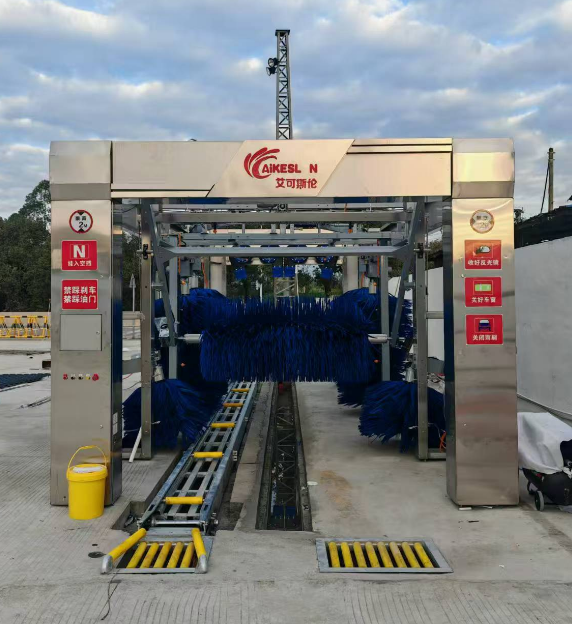
What Is an Automatic Car Wash Machine?
An automatic car wash machine is a mechanical system that cleans a vehicle with little or no manual labor. Instead of washing a car by hand, the machine uses a programmed sequence of water, cleaning chemicals, brushes, high-pressure jets, dryers, and other wash tools.
In simple terms, an automatic car wash system takes the work out of vehicle washing.
A customer drives the vehicle into a wash bay or onto a conveyor. Then, sensors detect the vehicle and the control system starts a selected wash program. Depending on the machine design, the system can apply foam, wash the vehicle, clean the wheels, rinse the body, apply wax or other finishing products, and dry the vehicle.
As a result, automatic car wash equipment can help businesses provide a more consistent wash while reducing the amount of manual work needed.
Today, automatic car wash machines are used in many commercial settings. These include:
Stand-alone car wash sites
Gas stations and fuel stations
Convenience stores
Car dealerships
Rental car companies
Fleet service centers
Bus and coach operators
Logistics companies
Commercial vehicle wash sites
Automotive service centers
The basic idea is simple. However, modern automatic car wash systems are much more advanced than a basic washing machine.
Newer systems can combine multiple wash methods, automatic chemical dosing, high-pressure cleaning, wheel washing, advanced drying, digital monitoring, and remote maintenance. Some systems are also designed for larger vehicles, such as vans, buses, trucks, and other commercial vehicles. Current equipment ranges include rollover, tunnel, touchless, and heavy-duty drive-through solutions.
So, if you are planning to buy an automatic car wash machine for business use, it is important to understand not only what the machine does, but also how the different system types fit different sites and vehicle groups.
How Does an Automatic Car Wash Machine Work?
The working process of an automatic car wash machine is usually based on a series of programmed steps.
Although each manufacturer uses different designs, the general process is similar.
1. Vehicle Positioning
First, the driver positions the vehicle inside the wash area.
In an in-bay automatic system, the vehicle normally stays in one position while the machine moves around it. In a tunnel system, the vehicle moves through the wash area on a conveyor.
This is one of the main differences between a rollover automatic car wash and a tunnel car wash system. A rollover machine moves its washing equipment around a stationary vehicle, while a tunnel system moves the vehicle through a series of fixed wash modules.
Correct vehicle positioning is important because sensors and programmed movements need to know where the vehicle is located.
2. Vehicle Detection
Next, sensors detect the vehicle.
Depending on the system, these sensors can help identify vehicle position, height, length, or other information needed by the wash program.
This allows the machine to adjust its movements and reduce the risk of unnecessary contact.
For example, some modern systems use photocells for automatic activation. Commercial vehicle systems can also use automated detection and programmed movement to cover vehicles with unusual shapes.
3. Pre-Wash
The next step is usually pre-washing.
Water and cleaning chemicals loosen dirt, mud, road salt, oil, and other deposits before the main wash starts.
This stage matters because hard dirt can increase the load on brushes or high-pressure equipment.
A good pre-wash can therefore improve the final cleaning result.
4. Foam and Chemical Application
The system may then apply foam, shampoo, detergent, wax, tire chemicals, or other products.
Modern automatic car wash equipment can use controlled chemical dosing. This helps the operator manage chemical consumption and maintain a repeatable wash process.
For commercial operators, this is important because chemical use directly affects operating cost.
5. Main Washing
The machine then performs the main cleaning stage.
There are two common methods:
Friction washing: Soft brushes or other contact materials physically clean the vehicle.
Touchless washing: High-pressure water and cleaning chemicals remove dirt without brushes touching the vehicle.
Some systems combine both methods. Hybrid equipment gives operators more flexibility when serving different customer needs.
For example, current rollover systems can be configured with brush, touchless, or hybrid wash functions.
6. Wheel Washing
Wheel washing is often included as an optional or standard function.
Wheels can collect brake dust, mud, road salt, and other difficult dirt. Dedicated wheel wash equipment can therefore improve the overall result.
Depending on the machine, wheel washing may use brushes, high-pressure nozzles, or rotating systems.
7. Rinsing
After the main wash, clean water is used to remove remaining foam and dirt.
Some commercial systems also include special rinse stages for premium wash packages.
8. Wax or Protective Treatment
A premium automatic car wash can include wax or other surface treatments.
These products can improve the visual finish and create an additional service option for the operator.
9. Drying
Finally, dryers remove water from the vehicle.
Drying is an important part of the customer experience. A good wash with poor drying can still leave water marks or reduce the perceived quality of the service.
Modern systems can use high-flow or rotating drying technologies. Some newer machines also include active drying power control to balance drying performance and electricity use.
Main Types of Automatic Car Wash Machines
There is no single automatic car wash machine that fits every business.
The best choice depends on site size, traffic, vehicle types, budget, labor model, expected throughput, and customer preferences.
The main categories include rollover systems, tunnel systems, touchless systems, friction systems, hybrid systems, and heavy-duty commercial vehicle systems.
1. Rollover Automatic Car Wash Machine
A rollover car wash machine, also called an in-bay automatic car wash system, is one of the most common commercial automatic wash solutions.
The vehicle enters the wash bay and stops. Then, the machine moves back and forth around the vehicle.
Because the machine does not require a long conveyor, the system can fit into a relatively compact site.
This makes rollover equipment suitable for:
Gas stations
Convenience stores
Small and medium car wash sites
Car dealerships
Service centers
Existing wash bays
A rollover system can include brushes, high-pressure water, foam, chemical application, wheel washing, wax, and drying.
Its main advantage is flexibility.
For example, some modern rollover systems can be configured as three-brush, five-brush, touchless, hybrid, or combination systems.
Therefore, a rollover automatic car wash machine can be a strong option when the site has limited space but still needs a professional automated wash.
2. Tunnel Car Wash System
A tunnel car wash system works in a different way.
Instead of the machine moving around a stationary vehicle, a conveyor moves vehicles through a series of wash stations.
These stations can include:
Pre-wash arches
Foam applicators
High-pressure arches
Side brushes
Top brushes
Wheel washers
Rinse arches
Wax application
Dryers
A tunnel can wash multiple vehicles in the same system at different positions.
For this reason, tunnel systems are usually considered when high throughput is a major business goal.
However, a tunnel normally requires more space and a more complex site layout than a rollover machine.
This means the higher potential throughput must be considered together with the initial investment, building requirements, utilities, traffic flow, and maintenance plan.
3. Touchless Automatic Car Wash Machine
A touchless automatic car wash machine cleans vehicles without direct brush contact.
Instead, it relies on cleaning chemicals and high-pressure water.
This design can be attractive to customers who prefer a no-contact washing process.
It can also be useful for certain vehicle types where contact cleaning may be less suitable.
Modern touchless systems can use fixed or oscillating high-pressure systems. Some advanced systems use rotating horizontal high-pressure equipment to improve coverage across the vehicle surface.
However, touchless does not automatically mean better for every situation.
Heavy dirt may require the right combination of chemical action, pressure, water flow, spray angle, dwell time, and rinse process.
Therefore, when comparing touchless car wash equipment, buyers should look beyond pressure alone.
4. Brush or Friction Car Wash Machine
A friction system uses brushes or other soft contact materials to physically remove dirt.
This can provide strong cleaning performance, especially when combined with a suitable pre-wash and chemical system.
The key issue is brush design and control.
A commercial automatic car wash machine should control brush movement and pressure carefully. The goal is to clean effectively while reducing unnecessary pressure on the vehicle surface.
For this reason, modern systems often focus on controlled movement, soft materials, accurate vehicle detection, and optimized chemical dosing.
5. Hybrid Automatic Car Wash System
A hybrid system combines different cleaning technologies.
For example, one machine may provide both brush washing and high-pressure touchless washing.
This gives operators more flexibility.
It can also help businesses create different wash packages for different customer groups.
A basic package could use one wash process. A premium package could add high-pressure cleaning, wheel washing, wax, or advanced drying.
For a B2B buyer, this flexibility can be valuable because customer demand can change over time.
Automatic Car Wash Machine vs. Manual Car Washing
Why should a business choose an automatic car wash machine instead of manual washing?
The main reason is repeatability.
Manual washing depends heavily on the worker.
Results can change from one employee to another. Wash time can also change based on the workload.
An automatic car wash system follows a defined program.
This can provide:
More consistent wash cycles
More predictable service time
Lower dependence on manual labor
Easier service standardization
Better control of water and chemical use
Easier integration with commercial operations
This does not mean that automatic washing removes every labor requirement.
Operators still need to inspect equipment, manage chemicals, maintain the wash area, handle customer issues, and perform or arrange maintenance.
However, automation can reduce the amount of direct labor needed during each individual wash.
This is especially important in markets where labor costs are high or where it is difficult to recruit enough staff.
Key Components of an Automatic Car Wash Machine
A commercial automatic car wash machine is not just one motor and a set of brushes.
It is a complete system made from several technical modules.
Control System
The control system manages the wash sequence.
It determines when different components start and stop.
Modern systems can also provide digital monitoring, remote management, data collection, and preventive maintenance functions.
For example, some newer automatic wash systems use connectivity tools to monitor equipment data, consumption, maintenance, and potential incidents remotely.
Sensors
Sensors help the machine detect the vehicle.
They can support automatic starting, positioning, and movement control.
Good sensor integration is important for both cleaning performance and operational safety.
Pumps
Pumps move water through the system.
High-pressure pumps are especially important in touchless and hybrid equipment.
The correct pump design depends on the pressure, flow rate, nozzle system, and wash program.
Brushes
Brush systems are common in friction-based automatic car wash equipment.
The number, position, movement, material, and control method can vary between systems.
Some commercial rollover machines can be configured with different numbers of brushes to meet different performance and throughput needs.
Chemical Dosing System
The chemical dosing system controls how much detergent or other product enters the wash process.
Accurate dosing can help reduce waste and keep wash quality more stable.
This is especially important for high-volume commercial operations.
Drying System
The drying system removes water after the wash.
Dryer design can affect drying quality, cycle time, noise, and electricity consumption.
Modern equipment may use multiple dryer configurations or active power control to balance performance and energy use.
What Makes a Good Automatic Car Wash Machine?
Not all automatic car wash equipment offers the same business value.
A good system should match the site’s real needs.
Here are the most important factors to review.
1. Cleaning Performance
The first priority is simple: the machine must clean vehicles well.
However, cleaning performance is not based on one specification.
Look at the complete wash process.
Consider:
Pre-wash performance
Chemical quality
Water pressure
Water flow
Brush movement
Vehicle coverage
Wheel cleaning
Rinse quality
Drying performance
A well-designed system balances all these elements.
2. Throughput
Throughput means how many vehicles the system can process in a given period.
A high-volume location may need a tunnel or a faster automatic rollover solution.
A smaller site may not need maximum capacity.
Instead, it may benefit more from a compact system with lower installation complexity.
The right target is not always the fastest machine.
The right target is the best match between capacity and actual customer demand.
3. Site Size
Available space has a major impact on equipment choice.
A rollover machine can be a strong option for compact locations because the wash equipment moves around the vehicle.
A tunnel requires a longer wash layout because the vehicle moves through multiple stages.
Therefore, measure the complete site before choosing the equipment.
Do not only measure the machine itself.
You should also consider:
Vehicle entry
Vehicle exit
Queue area
Equipment room
Chemical storage
Drainage
Water treatment
Electrical infrastructure
Maintenance access
Customer circulation
Water and Chemical Efficiency
Water use is becoming an important issue for commercial car wash operators.
This is especially true in regions where water cost, wastewater rules, or environmental targets are important.
An efficient automatic car wash machine should use water in a controlled way.
Modern equipment may optimize nozzle placement, water circuits, chemical dosing, and wash programs.
Some systems are also designed to work with water recycling and treatment systems.
Water recycling can reduce fresh water demand when the system is correctly designed and maintained.
However, recycling should not be treated as a simple add-on.
The complete water system should be designed around:
Water quality
Filtration
Oil separation
Wastewater treatment
Storage capacity
Fresh water supply
Local discharge rules
The exact requirements vary by location.
Therefore, operators in Europe and North America should confirm local environmental, wastewater, electrical, and building requirements before installation.
Automatic Car Wash Machines for Europe
The European B2B market has a wide range of vehicle wash applications.
These include retail car washes, service stations, dealerships, fleet operators, and commercial vehicle facilities.
For European buyers, several issues are especially important.
First, the equipment should fit the available site.
Second, energy and water efficiency can affect long-term operating cost.
Third, safety and local compliance requirements need to be reviewed before purchase.
Fourth, after-sales service matters.
A sophisticated automatic car wash machine is a long-term business asset. Therefore, spare parts availability, technical support, installation support, and maintenance training can be just as important as the machine’s headline specifications.
European equipment suppliers also increasingly focus on connectivity, efficiency, modular design, and flexible configurations.
For example, current high-end systems can combine wash and drying modules, advanced high-pressure systems, adjustable chemical circuits, and digital connectivity.
Automatic Car Wash Machines for North America
The North American market has its own operating needs.
Automatic wash equipment is widely used at:
Convenience stores
Fuel stations
Stand-alone wash sites
Car dealerships
Fleet facilities
Commercial vehicle operations
In this market, site throughput, reliability, customer experience, and equipment flexibility are often major purchasing factors.
Extended-height equipment can also be useful where operators need to wash larger vehicles such as high-roof vans and raised trucks.
For example, commercial rollover systems designed for the North American market have been developed with extended height options for larger vehicles.
In addition, modern North American systems increasingly emphasize connectivity and remote operation.
This can help operators manage multiple locations and reduce unnecessary site visits.
Automatic Car Wash Equipment for Gas Stations and Convenience Stores
Gas stations and convenience stores are an important application for automatic car wash machines.
The reason is simple.
The site already has vehicle traffic.
A car wash can therefore become an additional revenue service.
However, the machine must fit the existing business model.
A compact automatic rollover system may work well when space is limited.
A higher-throughput solution may be better for a busy location with a large customer base.
The operator should also consider the full customer journey.
The wash should be easy to enter.
The payment process should be simple.
The wash program should be easy to understand.
The exit should be clear.
And the equipment should be reliable enough to avoid unnecessary downtime.
In some cases, a compact conveyor or rail-based configuration can increase throughput without requiring the footprint of a full tunnel. Systems designed for this purpose have been positioned as a way to combine some tunnel-style throughput benefits with rollover equipment.
Automatic Car Wash Machines for Car Dealerships
Car dealerships have different needs.
A dealership may need to wash:
New vehicles
Used vehicles
Customer vehicles
Test-drive vehicles
Service vehicles
Trade-ins
Vehicle variety can therefore be high.
A flexible automatic car wash system can reduce the need for manual washing.
Extended-height systems can be especially useful for dealerships that handle SUVs, vans, raised trucks, and other larger vehicles.
The business benefit is not only cleaner vehicles.
A dealership can also reduce the time employees spend moving and washing cars.
This can help staff focus on sales, service, and customer support.
Automatic Car Wash Systems for Fleet Operators
Fleet washing is another major application.
Fleet vehicles often need regular cleaning rather than occasional customer washing.
Examples include:
Delivery vans
Rental vehicles
Company cars
Buses
Coaches
Service trucks
Waste trucks
Tankers
Municipal vehicles
For fleet operators, reliability and repeatability are especially important.
A fleet wash system should be designed around the actual vehicle mix.
A system for passenger cars may not be suitable for buses or irregular commercial vehicles.
Heavy-duty wash systems can use drive-through designs, high-pressure equipment, underbody washing, and specialized rotating spray systems.
Some current systems are specifically designed for irregular commercial vehicles such as tankers, waste trucks, and other heavy vehicles.
Automatic Car Wash Machine for Buses and Commercial Vehicles
Buses and coaches need different equipment from passenger cars.
They are larger.
They are taller.
They have different body shapes.
They can also have more difficult areas to clean.
For this reason, commercial vehicle wash systems may use large rollover machines or drive-through high-pressure systems.
Typical applications include:
City buses
School buses
Airport shuttles
Hotel shuttles
Tour buses
University buses
Long-distance coaches
A good bus wash system should be selected according to vehicle height, width, length, cleaning frequency, and available site space.
Commercial bus wash solutions today can include rollover, drive-through, touchless, underbody, and high-pressure options.
How Much Does an Automatic Car Wash Machine Cost?
One of the most common B2B questions is:
How much does an automatic car wash machine cost?
There is no single price.
The total investment depends on the machine type, capacity, configuration, site conditions, installation, water systems, payment system, drying system, chemical equipment, and optional features.
A basic in-bay automatic system and a full tunnel car wash are very different investments.
Likewise, a passenger car system and a heavy-duty commercial vehicle wash system may have very different costs.
Therefore, buyers should not compare machines based only on the equipment purchase price.
Instead, calculate the total cost of ownership.
This can include:
Equipment purchase
Site preparation
Installation
Electrical work
Plumbing
Water treatment
Drainage
Chemical systems
Maintenance
Spare parts
Labor
Electricity
Water
Chemicals
Downtime
A lower purchase price does not always mean a lower long-term cost.
For a commercial operation, reliability, service support, energy use, water use, chemical use, and throughput can have a major effect on the actual return on investment.
How to Choose the Best Automatic Car Wash Machine for Your Business
Before buying an automatic car wash machine, answer these questions.
What vehicles will you wash?
Passenger cars?
SUVs?
Pickup trucks?
Vans?
Buses?
Trucks?
The answer affects the required height, width, pressure, brush configuration, and wash layout.
How many vehicles do you expect to wash?
Estimate normal and peak demand.
Do not size the machine only for today’s traffic.
Also consider future growth.
How much space do you have?
Measure the complete wash site.
Include queueing, equipment, maintenance access, drainage, and vehicle movement.
Do you want touchless or friction washing?
Both can work well.
The choice depends on customer demand, vehicle types, local conditions, cleaning goals, and business positioning.
What level of automation do you need?
Some operators need a simple automatic wash.
Others may want:
Remote monitoring
Automatic chemical dosing
Digital payment
Data reporting
Preventive maintenance
Remote diagnostics
Multiple wash programs
What service support does the supplier provide?
This is one of the most important questions.
Ask about:
Installation
Commissioning
Operator training
Spare parts
Technical support
Warranty
Maintenance
Remote support
A reliable supplier can reduce the risk of long downtime.
Automatic Car Wash Machine Maintenance
Even the best automatic car wash equipment needs regular maintenance.
Preventive maintenance is usually better than waiting for a major failure.
Operators should check equipment based on the manufacturer’s maintenance schedule.
Typical maintenance areas include:
Brushes
Motors
Pumps
Nozzles
Sensors
Belts
Bearings
Chemical dosing components
Dryer systems
Water filters
Drainage
Safety devices
Electrical components
The wash bay itself should also remain clean.
Chemical residue, dirt, hard-water deposits, and debris can affect equipment performance.
In addition, chemical storage and dosing should be checked regularly.
Digital monitoring can make this process easier.
Newer connected systems can provide data about equipment operation, consumption, preventive maintenance, and incidents.
Why Remote Monitoring Matters
Remote monitoring is becoming more useful for commercial car wash operators.
Imagine owning several wash locations.
Without remote monitoring, a manager may need to visit each site to check equipment.
With connected equipment, some operating data can be reviewed remotely.
This can help operators:
Check machine status
Monitor consumption
Identify problems
Plan maintenance
Reduce unnecessary visits
Improve multi-site management
Remote connectivity does not replace skilled technicians.
Instead, it gives technicians better information before they arrive.
This can make troubleshooting faster and help reduce downtime.
Sustainability and Automatic Car Wash Systems
Sustainability is becoming an important part of B2B equipment selection.
An automatic car wash can support resource efficiency through controlled water use, chemical dosing, energy management, and water recycling.
However, sustainability should be measured across the whole system.
For example, a machine may use less water per wash but require inefficient dryers.
Another system may have strong drying performance but high electricity demand.
Therefore, buyers should review:
Water consumption per vehicle
Fresh water use
Recycled water ratio
Chemical consumption
Electricity consumption
Dryer efficiency
Equipment lifespan
Maintenance requirements
Some modern automatic wash systems are designed with water, chemical, and energy efficiency as core engineering goals.
What Is the Future of Automatic Car Wash Technology?
The automatic car wash industry is moving toward smarter, more connected, and more flexible equipment.
Several trends are important.
Smarter Automation
Sensors and software can help equipment make better decisions during the wash process.
Connected Equipment
Cloud and remote monitoring can provide operators with real-time information.
Flexible Wash Programs
Customers increasingly expect different wash levels.
A flexible machine can support basic, standard, and premium programs.
Lower Resource Use
Manufacturers continue to improve water, chemical, and energy efficiency.
More Vehicle Types
Equipment is also being designed for a wider range of vehicles.
This includes SUVs, vans, high-roof vehicles, buses, trucks, and other commercial vehicles.
Faster Wash Cycles
Higher throughput can improve site productivity.
Recent automatic rollover development shows how manufacturers are combining multiple wash stages and drying functions to reduce cycle time while maintaining wash quality. One 2026 system, for example, is specified for a complete wash and dry cycle of about 3 minutes and 30 seconds, depending on configuration.
Automatic Car Wash Machine: Common Buying Mistakes
Choosing equipment only by price is one of the biggest mistakes.
Here are other common problems.
Mistake 1: Buying Too Much Capacity
A high-throughput tunnel may sound attractive.
But if the site has low traffic, the extra capacity may not create enough value.
Mistake 2: Ignoring Vehicle Size
A system designed only for standard cars may not work well for vans or high-roof vehicles.
Always check the actual vehicle mix.
Mistake 3: Focusing Only on Machine Specifications
A powerful pump or large motor does not automatically mean better cleaning.
Look at the complete wash process.
Mistake 4: Ignoring Maintenance
A machine that is difficult to service can create higher long-term costs.
Ask about access to components and spare parts before purchase.
Mistake 5: Forgetting Site Infrastructure
Water, drainage, electricity, chemicals, and building layout all affect installation.
Mistake 6: Choosing a Supplier Without Local Support
A strong machine with poor after-sales support can become a business problem.
Choose a supplier with a clear service and parts strategy for your region.
Automatic Car Wash Machine FAQ
What is an automatic car wash machine?
An automatic car wash machine is equipment that cleans vehicles through a programmed process with limited manual labor. It can use brushes, high-pressure water, cleaning chemicals, wheel washers, rinsing systems, wax, and dryers.
How does an automatic car wash machine work?
The vehicle enters a wash bay or conveyor system. Sensors detect the vehicle. The machine then follows a programmed sequence that may include pre-wash, foam, main washing, wheel cleaning, rinsing, wax, and drying.
What is the difference between rollover and tunnel car wash equipment?
A rollover system moves the wash equipment around a stationary vehicle. A tunnel system moves vehicles through a series of fixed wash stations. Rollover systems generally need less space, while tunnels are designed for higher-volume operations.
Is a touchless automatic car wash better?
Not always.
Touchless washing reduces direct contact with the vehicle, but cleaning performance depends on chemical action, water pressure, flow, spray coverage, and the complete wash program.
The best choice depends on the business and vehicle types.
What type of automatic car wash machine is best for a gas station?
A rollover or compact automatic system is often suitable for sites with limited space. However, high-volume locations may benefit from a higher-throughput configuration.
The correct choice depends on traffic, site size, vehicle mix, and expected wash volume.
Can automatic car wash machines wash SUVs and vans?
Yes, but the machine must have suitable height and width specifications.
If a business serves high-roof vans or larger vehicles, an extended-height or commercial vehicle system may be more suitable.
Can an automatic car wash machine wash trucks and buses?
Yes.
However, passenger-car equipment is not automatically suitable for large commercial vehicles.
Truck and bus operations often require specialized high-pressure, rollover, or drive-through equipment.
How often should an automatic car wash machine be maintained?
Maintenance frequency depends on the machine design and usage level.
High-volume sites normally need more frequent inspection and service.
Operators should always follow the manufacturer’s maintenance schedule.
Does an automatic car wash save water?
It can.
Modern automatic wash systems can control water flow and use optimized nozzles and wash programs. Water recycling can further reduce fresh water demand when properly designed and maintained.
Actual savings depend on the equipment and site.
Is an automatic car wash machine a good business investment?
It can be, especially when the equipment matches local demand.
The business case should consider throughput, selling price, utilization, labor, water, chemicals, energy, maintenance, installation, and downtime.
A proper ROI model is more useful than looking only at the machine purchase price.
Final Guide: Choosing an Automatic Car Wash Machine
An automatic car wash machine is more than a device that sprays water on a vehicle.
It is a complete business system.
The right equipment can combine automation, controlled cleaning, efficient water and chemical use, reliable drying, flexible wash programs, and digital monitoring.
However, the best machine is not necessarily the most expensive machine.
It is the machine that fits the business.
For a small site, a compact rollover system may offer the right balance of footprint, investment, and performance.
For a busy high-volume site, a tunnel or higher-throughput solution may be more suitable.
For customers who prefer no-contact washing, a touchless system can be a strong option.
For mixed vehicle fleets, a hybrid or extended-height system may provide greater flexibility.
For buses, trucks, tankers, and other commercial vehicles, specialized heavy-duty equipment should be considered.
Most importantly, B2B buyers should evaluate the complete system.
Look at the machine.
Then look at the site.
Next, look at the vehicle mix.
After that, calculate operating costs.
Finally, evaluate the supplier’s technical support, spare parts, installation service, warranty, and long-term maintenance capability.
When these factors are considered together, it becomes much easier to choose an automatic car wash system that can deliver reliable cleaning, efficient operation, and long-term business value.
Looking for the Right Automatic Car Wash Equipment?
If you are planning a new car wash project, upgrading an existing wash bay, or building a commercial vehicle washing facility, start with your actual operating needs.
Share your vehicle types, expected daily wash volume, available site dimensions, target market, and preferred wash method with an experienced equipment supplier.
A professional supplier can then recommend the right combination of:
Automatic car wash machines
Rollover systems
Touchless wash equipment
Tunnel systems
High-pressure systems
Wheel wash systems
Dryers
Chemical dosing systems
Water recycling equipment
Digital monitoring solutions
Fleet and commercial vehicle wash equipment
The goal is not simply to buy an automatic car wash machine.
How many vehicles do you expect to wash?
Estimate normal and peak demand.
How much space do you have?
Do you want touchless or friction washing?
The choice depends on customer demand, vehicle types, local conditions, cleaning goals, and business positioning.
What level of automation do you need?
Others may want:
Remote monitoring
Automatic chemical dosing
Digital payment
Data reporting
Preventive maintenance
Remote diagnostics
Multiple wash programs
The goal is to build a reliable, efficient, scalable, and profitable vehicle wash solution that fits your market today and can support your business as it grows.