 するつもりです | 全自動洗車機メーカー
How Many Cars Can an Automatic Car Wash Machine Wash Per Hour?
Automatic car wash machine capacity depends on the equipment type, wash program, vehicle flow, and site layout. A typical single-bay automatic system may handle around 5–15 cars per hour, while selected conveyor tunnel systems are designed for roughly 20–120 cars per hour. These are broad supplier-published reference ranges, not guaranteed results for every machine or location.
For a commercial buyer, the number of cars washed per hour is one of the most important equipment specifications. It helps determine how many customers a business can serve, how long drivers may need to wait, and whether the system can support future growth.
However, maximum machine capacity is not the same as real-world performance.
A machine rated for 15 cars per hour may complete fewer washes when customers take longer to enter the bay. A tunnel rated for 100 cars per hour may also operate below that level because of limited demand, payment delays, vehicle spacing, or temporary interruptions.
Therefore, buyers should understand the difference between theoretical capacity, practical throughput, and actual customer demand.
This guide compares rollover, touchless, and tunnel car wash systems. It also explains how to calculate wash capacity, improve traffic flow, estimate hourly revenue, and choose suitable equipment for gas stations, independent car washes, and commercial sites.
The information is intended for car wash operators, equipment distributors, fuel station owners, and B2B buyers in the United States, Canada, the United Kingdom, and Europe.
1. What Does Automatic Car Wash Machine Capacity Mean?
Automatic car wash machine capacity describes how many vehicles a system can process within a defined period.
Manufacturers often express capacity as cars per hour, also called vehicles per hour or hourly throughput.
For example, if a system can complete one full wash every five minutes, its theoretical hourly capacity is:
60 ÷ 5 = 12 cars per hour
However, this calculation assumes the five-minute period includes every step needed before the next vehicle can begin.
If the wash program takes five minutes and the next customer needs another minute to enter and leave, the effective cycle becomes six minutes.
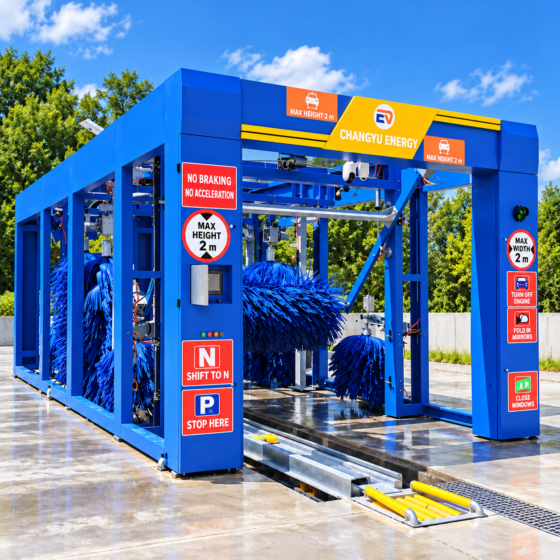
Tunnel Car Wash Machine
In that case:
60 ÷ 6 = 10 cars per hour
This difference matters for business planning.
Theoretical Capacity
Theoretical capacity is the rate a machine may achieve under specified conditions.
It may assume a particular wash program, vehicle spacing, or operating sequence.
Practical Throughput
Practical throughput measures the vehicles a site can actually complete during normal operation.
It reflects customer behavior, wash selection, payment, loading, unloading, and small delays.
Customer Demand
Customer demand is the number of drivers who want to purchase a wash.
Even a machine that can wash 60 cars per hour will not complete 60 washes when only 15 customers arrive.
Therefore, equipment capacity should be matched with realistic demand.
2. Automatic Car Wash Machine Capacity by Equipment Type
Different wash systems use different operating methods.
As a result, their capacity can vary significantly.
| Equipment Type | Illustrative Supplier-Published Capacity | Common Application |
|---|---|---|
| Single-bay rollover or gantry | 5–15 cars/hour | Gas stations and small commercial sites |
| Compact conveyor tunnel | 20–30 cars/hour | Smaller dedicated wash facilities |
| Mid-size conveyor tunnel | 50–60 cars/hour | Busy fuel stations and car wash businesses |
| Large express conveyor tunnel | 100–120 cars/hour | High-volume commercial operations |
These ranges reflect examples published by equipment suppliers, including KKE Wash Systems. They should not be applied to a specific product without checking its official technical specifications.
Why Capacities Differ
A rollover system usually completes one vehicle before the next can enter the same wash bay.
A tunnel system moves several vehicles through different washing stages at the same time.
Therefore, the operating method has a major effect on hourly throughput.
Machine capacity also depends on program length, loading time, conveyor speed, vehicle spacing, and site conditions.
3. How Many Cars Can a Rollover Car Wash Wash Per Hour?
A rollover car wash is also called a gantry or in-bay automatic car wash.
In this system, the vehicle remains stationary while the machine moves around it.
The wash may include pre-soak, high-pressure cleaning, brushes, rinsing, and drying, depending on the configuration.

Rendering of a gas station
How the Cycle Works
First, the driver enters the wash bay.
Next, the vehicle is positioned correctly.
Then, the machine completes the selected cleaning program.
Finally, the driver exits so the next vehicle can enter.
Because these steps take place in a shared bay, they affect total throughput.
Example of Rollover Capacity
Suppose a rollover machine takes four minutes to complete the wash program.
The average combined entry and exit time is one minute.
The full cycle is five minutes.
Therefore:
60 ÷ 5 = 12 cars per hour
This is the theoretical steady operating rate under those assumptions.
If drivers take longer to position their vehicles, actual capacity may fall.
Suitable Business Applications
Rollover machines can be suitable for gas stations, compact commercial properties, and sites with moderate customer demand.
They may also be attractive when an existing wash bay can be reused.
However, owners should confirm whether the machine can handle peak demand without creating excessive queues.
4. How Many Cars Can a Touchless Car Wash Wash Per Hour?
A touchless car wash uses water pressure and cleaning chemicals without brushes directly contacting the vehicle body.
Touchless systems are available in different designs, so their hourly capacity depends on the specific machine.
Touchless Wash Programs
A program may include pre-soak, high-pressure cleaning, chemical treatment, rinsing, and drying.
Each stage adds time.
For example, an illustrative four-minute program plus one minute for entry and exit produces a five-minute total cycle.
That gives a theoretical capacity of 12 cars per hour.
However, another machine may use a different cleaning process or cycle length.
Cleaning Quality vs. Speed
Shorter programs may increase throughput.
However, the business must still deliver the cleaning result it advertises.
Water pressure, chemical application, vehicle condition, and rinse performance matter.
Therefore, a shorter wash is not always a better wash.
When Touchless Systems Make Sense
Touchless equipment may appeal to customers who prefer non-contact washing.
For gas stations and compact commercial sites, it can be one option among several automated technologies.
Before buying, compare actual program times, water consumption, chemical requirements, and customer expectations.
5. How Many Cars Can a Tunnel Car Wash Wash Per Hour?
A tunnel car wash operates differently from a single-bay machine.
Instead of washing one stationary vehicle at a time, a conveyor moves vehicles through a series of cleaning stages.

タッチレス洗車機
These stages may include pre-wash, foam application, brushing, rinsing, finishing, and drying.
Because several vehicles can move through the system together, tunnel equipment can achieve higher hourly capacity.
Compact Tunnel Systems
Some compact tunnels are rated around 20–30 cars per hour.
They may suit locations with steady demand and limited space.
Mid-Size Tunnel Systems
Selected mid-size systems are rated around 50–60 cars per hour.
This format may suit a busy commercial wash or larger fuel retail location.
Express Tunnel Systems
High-capacity express tunnel systems may be rated for approximately 100–120 cars per hour or more, depending on the design.
However, these systems require a suitable site, safe loading conditions, enough vehicle spacing, and steady customer demand.
Why Tunnel Length Matters
Tunnel length affects how many cleaning stages can fit inside the equipment.
It also influences how long a vehicle remains inside the wash.
However, tunnel length alone does not determine cars per hour.
The conveyor operating speed and the distance between vehicles are critical.
6. How to Calculate Cars per Hour for an In-Bay Automatic Car Wash
For a single-bay system, the basic calculation is simple.
Cars per Hour = 60 ÷ Total Cycle Time in Minutes
The total cycle should include the time needed to process one vehicle and make the bay ready for the next.
Capacity by Total Cycle Time
| Full Cycle Time | Theoretical Capacity |
|---|---|
| 3 minutes | 20 cars/hour |
| 4 minutes | 15 cars/hour |
| 5 minutes | 12 cars/hour |
| 6 minutes | 10 cars/hour |
| 8 minutes | 7.5 cars/hour |
| 10 minutes | 6 cars/hour |
The table is a mathematical illustration, not a list of verified model specifications.
What Is Included in the Cycle?
The answer depends on how the manufacturer defines the cycle.
Some figures describe only the active wash program.
Others may include vehicle entry and exit.
For this reason, buyers should ask:
Does the quoted cars-per-hour rating include loading, positioning, washing, drying, and clearing the bay?
If not, the published figure may overstate the throughput the site can achieve.
7. How to Calculate Tunnel Car Wash Throughput
Tunnel capacity is based on a continuous vehicle flow.
A useful simplified formula is:
Cars per Hour = Conveyor Speed × 60 ÷ Vehicle Pitch
In this formula, conveyor speed is measured in distance per minute, and vehicle pitch is the distance between equivalent points on consecutive vehicles.
Both measurements must use the same distance unit.
Example
Suppose a conveyor travels at 12 meters per minute.
The average vehicle pitch is 15 meters.
The theoretical loading rate is:
12 × 60 ÷ 15 = 48 cars per hour
This assumes the conveyor can maintain that speed and spacing without interruption.
Why Vehicle Pitch Matters
Vehicle pitch includes vehicle length and the gap allowed between vehicles.
If vehicles need more separation, hourly capacity decreases.
If the equipment uses a different approved loading distance, the throughput changes.
However, spacing must always follow the equipment manufacturer’s safety requirements.
Practical Limits
Conveyor speed cannot simply be increased without considering the complete tunnel design.
The cleaning stages, controls, drying equipment, loading system, and safety functions must support the operating speed.
Therefore, a capacity increase should be evaluated by the manufacturer or a qualified technical team.
8. Wash Cycle Time vs. Total Customer Time
Wash cycle time and customer time are different measurements.
The wash cycle describes the machine’s operation.
Total customer time may include payment, waiting, loading, washing, and exit.

Tunnel Car Wash Machine
Example
Suppose an in-bay machine completes a four-minute wash program.
The driver spends one minute entering and leaving the bay.
The effective processing time is five minutes.
The machine can theoretically complete 12 vehicles per hour.
However, if five cars are waiting ahead of a customer, that customer may spend much longer at the facility.
Why Customers Care
Drivers often value a predictable visit.
A short wash program is less helpful when the payment system is confusing or the queue is poorly managed.
Therefore, operators should improve both machine performance and the customer journey.
Track Separate Measures
Record average wash-cycle time, vehicle loading time, queue length, and the total customer visit.
These measures can reveal different operational problems.
9. What Factors Reduce Actual Car Wash Throughput?
Real-world wash capacity is often lower than the theoretical maximum.
Several factors can reduce the number of cars processed per hour.
Payment Delays
Customers may take time to select a package, enter a code, or complete payment.
Vehicle Positioning
Some drivers need extra time to enter a narrow bay or align with the equipment.
Different Wash Programs
Premium washes may use more cleaning stages and take longer.
Customer Behavior
Drivers may hesitate, stop in the wrong place, or leave slowly.
Machine Interruptions
Sensors, controls, or mechanical components may pause operations when a fault occurs.
Maintenance
Cleaning and service work may temporarily reduce equipment availability.
Site Traffic
A poor entry or exit layout may limit vehicle movement even when the wash machine is ready.
As a result, buyers should plan for realistic operating conditions rather than assume every hour will run at the maximum rating.
10. Automatic Car Wash Machine Capacity and Wash Program Selection
Many automatic systems offer more than one wash program.
A basic wash may take less time than a premium program.
Therefore, the mix of programs customers choose can affect average capacity.
Example of Mixed Wash Programs
Suppose a single-bay site completes:
- 50% basic washes, each with a five-minute full cycle
- 30% standard washes, each with a six-minute full cycle
- 20% premium washes, each with an eight-minute full cycle
The average cycle is:
(0.50 × 5) + (0.30 × 6) + (0.20 × 8) = 5.9 minutes
The approximate theoretical throughput is:
60 ÷ 5.9 = 10.2 cars per hour
This is lower than the 12 cars per hour possible with the five-minute program alone.
Why the Program Mix Matters
Premium packages may generate more revenue per wash.
However, they may also reduce the number of vehicles the machine can complete during a busy hour.
Therefore, operators should compare revenue and contribution per hour, not only the number of cars washed.
11. How to Choose Car Wash Capacity for a Gas Station
A gas station often has several competing uses for its property.
Drivers need access to fuel pumps, convenience stores, parking areas, and other services.
Therefore, the car wash must fit the overall traffic flow.
Estimate Existing Demand
Review the number of vehicles visiting the station.
However, not every fuel customer will buy a wash.
Use local surveys, existing wash sales, or a realistic conversion assumption.
Identify Peak Periods
Demand may be concentrated during weekends, evenings, or specific weather conditions.
Check Available Space
The property must provide safe entry, waiting, washing, and exit areas.
Compare Equipment Formats
An in-bay rollover or touchless system may be practical for moderate demand.
A conveyor tunnel may make sense for a site with higher demand and enough land.
Avoid Blocking Fuel Customers
Wash queues should not interfere with fuel sales, deliveries, or emergency access.
The best machine is one that serves realistic demand without harming the rest of the gas station.
12. Automatic Car Wash Capacity for Independent Car Wash Businesses
An independent commercial wash may have different priorities from a gas station.
Washing vehicles is its main service.
Therefore, throughput can play a larger role in revenue planning.
Study Local Traffic
Review nearby roads, access points, residential areas, and competing washes.
Forecast Paid Washes
Estimate how many drivers are likely to purchase a wash, not merely how many vehicles pass the property.
Plan for Peak Demand
Busy periods may require more capacity than average weekday demand suggests.
Compare Investment
Higher-capacity equipment may require more land, construction, utilities, and capital.
Consider Future Growth
A growing business may need room for added services or higher throughput.
However, future demand should be supported by a clear business plan.
A larger machine is only valuable when customers and the operating model can make effective use of it.
13. Is Higher Car Wash Capacity Always Better?
Higher capacity can reduce queues and support more sales during busy periods.
However, it can also require a larger investment.
For a smaller operation, the extra capacity may remain unused.
Example
Business A expects about 80 paid washes per day.
It considers a machine rated for 12 cars per hour.
Business B expects 600 paid washes per day.
It considers a higher-capacity tunnel.
Both businesses may have a valid equipment strategy.
The correct choice depends on the hours when customers arrive, the site’s operating schedule, and available capital.
Demand Before Capacity
It is important to calculate expected customer demand before purchasing.
If demand is low, faster equipment may not generate additional revenue.
If demand is high, a slow machine may create queues and lost sales.
Therefore, capacity should be based on the needs of the business.
14. How Does Car Wash Capacity Affect Hourly Revenue?
Machine capacity sets a possible upper limit on paid wash volume.
However, the revenue generated depends on actual customers and the average selling price.
A simple formula is:
Hourly Wash Revenue = Paid Washes per Hour × Average Revenue per Wash
Example Revenue Scenarios
Assume an average price of $12 per paid wash.
| Completed Paid Washes | Gross Revenue per Hour |
|---|---|
| 8 | $96 |
| 12 | $144 |
| 20 | $240 |
| 30 | $360 |
| 60 | $720 |
| 100 | $1,200 |
These are hypothetical calculations.
They do not represent verified market averages, typical machine performance, or net profit.
Revenue Is Not Profit
Water, power, chemicals, maintenance, labor, property, and other costs must still be considered.
A higher sales rate may also require more staff or a more expensive facility.
Therefore, operators should calculate operating contribution and long-term cash flow before selecting a system.
15. Car Wash Capacity and Return on Investment
Return on investment is an important part of commercial equipment selection.
A machine that processes more vehicles may have higher revenue potential.
However, it may also require more capital and operating expenses.
Example Investment Question
Suppose two machines are being considered.
Machine A has a lower purchase price and a theoretical capacity of 12 cars per hour.
Machine B costs more and has a theoretical capacity of 50 cars per hour.
Which machine is the better investment?
The answer depends on how many customers the site can realistically attract.
If the location rarely receives more than eight wash customers per hour, Machine B may not create much additional revenue.
However, if the site regularly has long queues, higher capacity may support meaningful extra sales.
Consider Total Ownership Cost
Compare equipment, construction, water, electricity, chemicals, maintenance, payment systems, and staff costs.
Then build realistic revenue and cash flow scenarios.
The machine with the highest capacity is not automatically the one with the best financial return.
16. How Many Cars Can an Automatic Car Wash Wash Per Day?
Daily capacity depends on the number of hours the machine operates and the rate it can maintain.
A basic calculation is:
Daily Theoretical Capacity = Cars per Hour × Operating Hours
For example, a machine rated for 12 cars per hour has a theoretical capacity of 120 cars during a 10-hour period.
However, it may not operate continuously at that rate.
Example Planning Table
| Rated Capacity | Operating Hours | Theoretical Daily Capacity |
|---|---|---|
| 10 cars/hour | 8 | 80 cars |
| 12 cars/hour | 10 | 120 cars |
| 30 cars/hour | 10 | 300 cars |
| 60 cars/hour | 10 | 600 cars |
| 100 cars/hour | 10 | 1,000 cars |
These are theoretical calculations, not predicted sales.
Daily actual volume may be much lower because of demand, wash program selection, downtime, and operating delays.
Do Not Confuse Capacity With Demand
A machine capable of washing 600 cars in a day does not mean the site will attract 600 paying customers.
Use local market research and actual sales history for revenue planning.
17. How Does Site Layout Affect Cars per Hour?
Site layout can limit throughput even when the washing equipment has additional capacity.
Vehicles must be able to reach the equipment, enter correctly, and leave safely.
Entry Lane
The entry lane should guide customers toward the wash without blocking other traffic.
Queue Space
A suitable waiting area helps prevent queues from extending onto public roads or blocking nearby facilities.
Payment Location
Payment terminals should be placed where drivers can use them safely and conveniently.
Vehicle Alignment
Clear markings and instructions can help drivers position their vehicles correctly.
Exit Area
Drivers need enough space to leave the wash without slowing the next vehicle.
Emergency Access
The layout must preserve safe access for emergencies and other required site functions.
For commercial projects, the machine layout should be reviewed together with the overall property traffic plan.
18. How Can Payment Systems Improve Car Wash Throughput?
Payment is one of the steps that can slow customer processing.
A simple and reliable payment system may reduce delays.
Pay-at-Wash Terminals
Customers select a program and complete payment near the wash entrance.
Wash Codes
Compatible systems may allow customers to enter a code purchased at another location.
Fuel Station Integration
Some car wash systems can work with compatible fuel retail payment arrangements.
Membership Programs
Where supported, membership recognition can help repeat customers access the service.
Clear Instructions
Easy-to-read instructions reduce customer hesitation and errors.
However, payment integration depends on the equipment and local payment provider.
Therefore, buyers should confirm compatibility before ordering.
19. Why Dryer Performance Can Limit Wash Capacity
Drying is an important part of many automatic car wash programs.
A system may complete washing quickly but still need additional time for drying.
In-Bay Automatic Systems
Drying may be part of the same full wash cycle.
Therefore, longer drying time can reduce hourly throughput.
Tunnel Systems
Drying may occur in a dedicated stage near the end of the conveyor.
Its capacity must match the selected conveyor speed and vehicle flow.
Motor and Blower Specifications
Drying performance depends on blower design, motor ratings, airflow, nozzle positioning, and other factors.
However, a stronger motor does not automatically improve the complete drying system.
Maintenance
Blocked air paths, damaged fans, or equipment faults can reduce performance.
Operators should follow the manufacturer’s service instructions and address abnormal conditions promptly.
20. Water Supply and Automatic Car Wash Capacity
Water supply can affect whether a machine can operate as designed.
Commercial wash systems may require a specified water flow, pressure, and quality.
Check Flow Requirements
The utility supply must support the machine’s needs during operation.
Confirm Pressure
Insufficient pressure may affect cleaning stages or trigger operating problems.
Consider Water Storage
Some projects may need a suitable storage or supply arrangement.
The correct design depends on the equipment and local utility conditions.
Water Reclamation
A compatible reclamation system may reduce fresh-water demand.
However, it must provide water that is suitable for the intended washing stages.
Wastewater Management
Drainage and wastewater treatment must meet the requirements of the site and local authorities.
For buyers, sufficient utility capacity is part of achieving reliable machine throughput.
21. Electrical and Control Systems for High-Capacity Washing
Automatic car wash machines rely on electrical power and control systems.
Pumps, motors, blowers, sensors, and other equipment must operate together.
Electrical Supply
The available voltage, frequency, and power capacity must match the machine specifications.
Industrial Controls
Controllers coordinate the wash sequence and connected components.
Vehicle Sensors
Sensors help detect vehicle position and support machine operation.
Conveyor Controls
Tunnel systems use controls to manage vehicle movement and cleaning stages.
Safety Functions
Protective systems may stop equipment when unsafe conditions or faults are detected.
Remote Monitoring
Some models offer operational records or fault monitoring.
These functions vary by manufacturer.
Buyers should request a detailed list of included and optional technical features.
22. How Maintenance Affects Hourly Car Wash Output
Preventive maintenance helps maintain consistent operation.
A machine with a high rated capacity may still deliver poor results if it experiences frequent faults.
Inspect Moving Components
Check relevant chains, belts, gears, bearings, and drive systems according to the manufacturer’s instructions.
Maintain Pumps and Valves
Water delivery components should operate within their specified range.
Check Sensors
Dirty, damaged, or incorrectly positioned sensors can affect operation.
Inspect Drying Systems
Blowers, motors, and air passages may need regular checks.
Review Chemical Systems
Chemical dosing should remain consistent with the approved wash process.
Keep Service Records
Document faults, downtime, maintenance, and component replacement.
A structured maintenance program helps protect equipment availability and supports more accurate capacity planning.
23. How to Measure Real Car Wash Throughput
The best way to understand actual capacity is to measure completed washes.
Record Completed Vehicles
Use a reliable machine counter, transaction record, or other verified measurement system.
Track Operating Time
Separate scheduled hours from the time the equipment was actually available.
Review Peak Hours
Measure the number of vehicles completed during busy periods.
Record Delays
Identify payment problems, positioning delays, manual interventions, and machine faults.
Compare Program Types
Measure the share of basic, standard, and premium washes.
Review Trends
Compare results over several weeks rather than relying on a single busy day.
These records help managers determine whether capacity is limited by equipment, operations, or customer demand.
24. Common Mistakes When Comparing Car Wash Capacity
Using Maximum Capacity as a Sales Forecast
Rated capacity is not the same as expected paid demand.
Ignoring Loading Time
Single-bay systems must account for vehicle entry, positioning, and exit.
Comparing Different Wash Programs
A short basic program may have a different cycle time from a premium package.
Ignoring Vehicle Spacing
Tunnel systems require safe and consistent vehicle spacing.
Assuming Longer Tunnels Always Mean Higher Capacity
Tunnel length affects layout and cleaning stages, but the actual loading rate also matters.
Forgetting Maintenance
Equipment uptime has a direct effect on completed vehicle volume.
Overlooking Site Design
A slow entry lane or blocked exit can limit the whole operation.
A careful comparison should use equivalent operating conditions and full technical specifications.
25. Choosing Automatic Car Wash Equipment for the US Market
US buyers should evaluate customer demand, vehicle size, site access, and local installation requirements.
Vehicle Mix
Check the machine’s supported height, width, and length against the types of vehicles expected at the site.
Operating Model
Fuel stations, express tunnel businesses, and fleet operators may need different capacities.
Local Utilities
Water, power, and wastewater conditions vary between locations.
After-Sales Support
Confirm spare parts, technical assistance, and maintenance arrangements.
Financial Planning
Use local prices, operating costs, and realistic demand forecasts.
The right machine should fit the site and its customer base.
26. Automatic Car Wash Capacity for Canada
Canadian buyers may need to consider cold-weather operating conditions.
Freeze Protection
Water systems, piping, and wash facilities may require suitable cold-weather measures.
Seasonal Demand
Road conditions and customer washing habits may vary during the year.
Equipment Compatibility
Confirm electrical ratings and applicable installation requirements.
Capacity Planning
Estimate demand during peak periods, but also account for slower seasons.
Service Access
Technical support and spare-parts availability can be important for maintaining uptime.
These factors should be included in the equipment selection process.
27. Automatic Car Wash Machines for the UK and European Market
UK and European buyers should consider space, utilities, environmental requirements, and site demand.
Limited-Space Properties
Some urban or roadside properties may be better suited to compact in-bay systems.
High-Volume Sites
Larger sites may evaluate conveyor tunnel equipment.
Electrical Compatibility
Confirm that the proposed system matches the destination’s electrical requirements.
Water and Wastewater
Review local water supply, treatment, drainage, and discharge requirements.
Machinery Compliance
Confirm applicable product requirements and supporting documentation before import or installation.
A supplier should provide the technical information needed for local project review.
28. What Should Buyers Ask an Automatic Car Wash Manufacturer?
A professional quotation should provide enough information to evaluate real operating capacity.
Hourly Capacity
What is the rated number of cars per hour?
Operating Conditions
Which wash program and loading conditions were used to calculate the figure?
Cycle Time
Does the cycle include vehicle entry, drying, and exit?
Equipment Configuration
What cleaning stages and optional features are included?
Utility Requirements
What electrical, water, and other connections are necessary?
Vehicle Dimensions
What vehicle height, width, and length can the system accept?
Layout
What are the required installation and traffic-flow dimensions?
Maintenance
What routine service is needed to maintain the equipment?
サポート
What warranty, spare-parts, and technical support arrangements are available?
These questions help buyers compare the true operating potential of different systems.
29. Step-by-Step Guide to Selecting the Right Machine Capacity
Step 1: Define Your Business Model
Identify whether the site is a fuel station, standalone car wash, dealership, or fleet facility.
Step 2: Estimate Customer Demand
Use local traffic information, existing sales, and realistic conversion assumptions.
Step 3: Identify Peak Hours
Determine when wash demand is highest.
Step 4: Review Available Space
Check the wash bay, entry lane, queue area, and exit.
Step 5: Compare Equipment Types
Evaluate touchless, rollover, and conveyor tunnel systems.
Step 6: Confirm Rated Capacity
Ask for the official model specification and the assumptions behind the hourly figure.
Step 7: Calculate Practical Throughput
Account for wash programs, loading, payment, downtime, and other site conditions.
Step 8: Build a Financial Model
Estimate realistic revenue, operating expenses, installed cost, and cash flow.
Step 9: Review Technical Compatibility
Check utilities, vehicle sizes, environmental conditions, and local requirements.
Step 10: Request a Detailed Quotation
Ask for equipment specifications, layout drawings, installation guidance, and commercial terms.
This process helps buyers avoid choosing equipment based on an hourly-capacity claim alone.
30. Frequently Asked Questions About Automatic Car Wash Machine Capacity
How many cars can an automatic car wash machine wash per hour?
A single-bay rollover system may handle about 5–15 cars per hour, while selected tunnel systems have published capacities of roughly 20–120 cars per hour. The actual result depends on the model and operating conditions.
How long does one automatic car wash take?
It depends on the machine and wash program. For in-bay systems, the full cycle also includes loading and unloading time.
How many cars can a touchless car wash wash per hour?
The number depends on the full cycle time. For example, a five-minute total cycle gives a theoretical capacity of 12 cars per hour.
Is a tunnel car wash faster than a rollover car wash?
Tunnel systems can support higher hourly throughput because multiple vehicles move through different cleaning stages at the same time.
Can a car wash machine wash 100 cars per hour?
Some high-capacity conveyor tunnel systems are rated for approximately 100 cars per hour or more under specified conditions. This does not mean every tunnel can achieve that rate.
How do you calculate cars per hour?
For a single-bay system, divide 60 by the total cycle time in minutes. For a conveyor tunnel, calculate the loading rate using conveyor speed and vehicle pitch.
What reduces automatic car wash capacity?
Longer wash programs, customer delays, payment problems, vehicle positioning, machine faults, and poor site traffic flow can reduce throughput.
Does a faster car wash make more money?
It may support higher sales when sufficient demand exists. However, profitability also depends on pricing, operating expenses, customer satisfaction, and equipment investment.
Which car wash machine is best for a gas station?
The right machine depends on available space, expected wash demand, utility capacity, and budget. In-bay systems may suit many moderate-volume properties.
How many cars can an automatic car wash wash per day?
Multiply the hourly capacity by operating hours to calculate the theoretical daily maximum. Actual paid washes may be lower.
Do premium wash programs reduce capacity?
Longer programs can reduce the throughput of single-bay systems. Operators should compare the extra revenue with the added cycle time.
Does a tunnel’s length determine its capacity?
Not by itself. Conveyor speed, safe vehicle spacing, wash-stage design, and operating conditions also affect hourly throughput.
What is the difference between rated and actual capacity?
Rated capacity describes performance under specified conditions. Actual capacity measures what the site completes during real operation.
How can operators improve car wash throughput?
Improve payment flow, vehicle positioning, site access, equipment maintenance, and operational consistency while maintaining approved safety and cleaning standards.
What should I ask before buying an automatic car wash machine?
Ask for the rated cars per hour, full wash-cycle details, vehicle dimensions, utility requirements, layout drawings, equipment configuration, and service support.
31. Request an Automatic Car Wash Machine Capacity and Configuration Quote
Choosing the right machine capacity is an important step in planning a successful commercial car wash.
However, the correct solution depends on more than a maximum cars-per-hour figure.
A gas station with moderate demand may prefer a compact in-bay system. A dedicated wash business with busy peak periods may need a higher-capacity tunnel.
The selected machine should fit customer demand, site dimensions, operating conditions, and the investment budget.
Information to Include in Your Inquiry
Please provide:
- Country and city of installation
- Type of business
- Expected daily wash volume
- Expected peak-hour demand
- Available site dimensions
- Preferred machine technology
- Typical vehicle sizes
- Available electrical and water supply
- Desired wash programs
- Expected project budget
With this information, our team can discuss possible equipment configurations and identify the technical details needed for a project-specific quotation.
Request Automatic Car Wash Machine Specifications | Discuss Hourly Capacity | Get a Customized Equipment Quote
Conclusion: Choose Capacity Based on Real Customer Demand
Automatic car wash machine capacity is an important buying factor, but it should not be the only one.
Single-bay systems often suit moderate-volume locations, while conveyor tunnels can offer higher throughput when the site and customer demand support them.
The most important distinction is between rated capacity and practical performance.
A machine may be capable of washing many cars per hour, yet complete fewer washes because of customer behavior, payment delays, program selection, maintenance, or site limitations.
Therefore, buyers should review the full cycle, compare realistic throughput, evaluate the property layout, and build a sound financial model.
For gas stations, independent wash businesses, and equipment distributors in North America and Europe, the right equipment should balance washing capacity, cleaning quality, reliable operation, and total investment cost.
Planning a new automatic car wash project? Contact our team to compare equipment options, review site requirements, and request a customized quotation.
Technical Sources and Further Reading
- KKE Wash Systems — Conveyor Car Wash Equipment: https://kkewash.com/en-sg/tunnel-car-wash-equipment/
- KKE Wash Systems — Automatic Car Wash Equipment: https://origin.kkewash.com/en-sg/automatic-car-wash-machines-singapore/
- PHC Valeo — Tunnel-Type Car Wash Machine: https://www.koreavaleo.com/en/business/car-wash-machine/tunnel-type
- Google Search Central — Creating Helpful, Reliable, People-First Content: https://developers.google.com/search/docs/fundamentals/creating-helpful-content
Technical note: Capacity values are supplier-published examples, not a universal industry standard. All business calculations are hypothetical illustrations. Actual throughput depends on equipment configuration, program settings, customer demand, vehicle movement, site conditions, and maintenance. Always obtain the selected manufacturer’s verified technical specifications before purchasing.