
How to Reduce Mechanical Wear in High-Volume Car Wash Operations?
2026 Commercial Equipment Guide: Bearings, Chains, Gear Reducers, Brushes, Drive Systems, Lubrication, Preventive Maintenance, Equipment Reliability, and Cost Reduction
Introduction: Why Mechanical Wear Matters in High-Volume Car Wash Operations
High-volume automatic car wash facilities depend on reliable equipment. Every wash cycle places operating demands on motors, bearings, chains, brushes, pumps, and moving structures.
As the number of daily washes increases, these components may experience more frequent loading and movement.
Over time, normal wear can affect machine performance. However, poor maintenance, incorrect installation, contamination, and unsuitable operating conditions may cause components to deteriorate sooner than expected.
For commercial car wash operators, this creates several problems.
A worn bearing may produce vibration. A poorly maintained chain may affect machine movement. A damaged brush assembly may reduce cleaning quality. In more serious cases, equipment failure can stop the entire washing operation.
That is why car wash equipment wear prevention should be a core part of operating a busy washing facility.
The goal is not to eliminate all mechanical wear. That is rarely realistic.
Instead, operators should reduce avoidable damage, monitor component condition, and replace parts before they create larger problems.
This guide explains how to manage mechanical wear in high-volume car wash operations. It covers essential machine components, common wear causes, maintenance planning, and practical ways to improve equipment reliability.
It also provides technical buying advice for commercial operators, gas station owners, fleet businesses, and automatic car wash equipment distributors.
Quick Answer: How Can You Reduce Mechanical Wear in Automatic Car Wash Equipment?
The most effective way to reduce mechanical wear is to combine correct lubrication, proper alignment, suitable operating loads, contamination control, regular inspections, and preventive maintenance.
Start with the manufacturer’s maintenance schedule. Then adjust maintenance planning using actual wash counts, operating hours, and component condition.
Pay close attention to bearings, chains, gear reducers, brushes, guide systems, and other frequently moving components.
Record vibration, unusual noise, temperature trends, and repeated faults when suitable monitoring is available.
Also, use replacement parts that meet the equipment manufacturer’s specifications.
Do not increase machine speed or loading beyond approved limits.
For high-volume facilities, scheduled maintenance and good spare-parts planning can help reduce avoidable downtime.
1. What Causes Mechanical Wear in Commercial Car Wash Machines?
Mechanical wear occurs when contacting or moving surfaces change through use.

Lightweight System / Minimalist System
However, different components wear in different ways.
Bearings may experience rolling contact fatigue or damage from contamination.
Chains and sprockets may wear through repeated engagement.
Brush materials gradually change through cleaning contact.
Guide wheels and rails may deteriorate through repeated loading and movement.
Therefore, wear is not one single problem.
Common contributing factors include:
- Frequent operating cycles
- Inadequate lubrication
- Contamination by water or dirt
- Incorrect alignment
- Excessive mechanical loading
- Vibration
- Corrosion
- Poor installation
- Damaged seals
- Incorrect maintenance practices
Understanding the cause helps operators choose the right prevention method.
2. Why High-Volume Washing Creates Greater Maintenance Demands
A machine washing 20 vehicles per day has a different operating pattern from one washing 150 vehicles per day.
The higher-volume machine may complete many more cycles during the same period.
Therefore, some components may reach their service limits sooner.
However, wash count alone does not explain every failure.
Operating hours, duty cycles, vehicle sizes, environmental conditions, and maintenance quality also matter.
For example, a busy tunnel conveyor may experience regular movement throughout the day.
Meanwhile, a rollover machine may repeatedly accelerate, stop, and reverse its travel mechanism.
These operating patterns create different mechanical demands.
Maintenance plans should match the actual machine and its workload.
3. Car Wash Equipment Wear Prevention Starts With the Right Machine
Wear prevention begins before equipment installation.
Buyers should select a machine designed for the intended operating volume.
A small system may be suitable for a compact retail site.
However, a dedicated high-volume facility may need equipment built for more frequent operation.
The supplier should explain the machine’s intended duty cycle and service requirements.
Buyers should also request information about major drive components.
These may include motors, gear reducers, bearings, chains, and moving assemblies.
However, a product described as industrial-grade is not automatically suitable for every workload.
The intended use should be supported by technical specifications.
4. Understanding Duty Cycle and Equipment Loading
Duty cycle describes how equipment operates over time.
However, the term can be defined differently for motors, drives, and complete machines.
For example, a motor may operate continuously or in repeated intervals.
A moving brush assembly may experience changes in torque during vehicle contact.
Therefore, buyers should identify the duty requirements of important components.
The manufacturer’s selected ratings should match the intended application.
Do not assume that the maximum stated speed or capacity can be maintained under every condition.
A supplier should explain the operating limits and any required cooling or rest periods.
Correct equipment selection helps reduce unnecessary stress.
5. Why Bearings Are Critical in Automatic Car Wash Machines
Bearings support rotating shafts and other moving parts.
They may be found in brush assemblies, drive systems, blowers, rollers, and other mechanisms.

LiShua System
Their performance depends on several factors.
These include load, lubrication, sealing, alignment, installation, and operating environment.
A bearing may wear prematurely if contamination enters its working surfaces.
Incorrect installation can also affect performance.
However, unusual noise does not always prove bearing failure.
A qualified technician should assess the relevant component.
Operators should follow approved inspection and replacement procedures.
Bearing reliability is especially important where a failure could stop a major washing function.
6. Proper Bearing Lubrication
Lubrication helps separate moving contact surfaces and reduce friction under suitable operating conditions.
However, correct lubrication requires more than adding grease.
The lubricant must match the bearing, speed, load, temperature, and environmental conditions.
The quantity also matters.
Insufficient lubrication may contribute to damage.
Excess lubricant can also create problems in some applications.
Therefore, operators should follow the manufacturer’s lubrication specifications.
Grease type and replacement interval should not be guessed.
Also, a sealed or maintenance-free bearing may have different requirements from a relubricable bearing.
Always confirm the specific component design.
7. Preventing Water and Chemical Contamination in Bearings
Car wash equipment operates in wet environments.
Water, detergent mist, dirt, and other contaminants may affect mechanical components.
However, the exposure depends on component placement and protection.
Bearings may use seals or other protective arrangements.
If these are damaged, contamination can increase the risk of premature wear.
Therefore, maintenance personnel should inspect seals and surrounding conditions.
They should also review whether cleaning procedures expose components to unsuitable spray.
Do not direct pressure washing onto bearings, electrical equipment, or protected assemblies unless the manufacturer specifically permits it.
Suitable contamination control supports reliable operation.
8. Why Shaft Alignment Matters
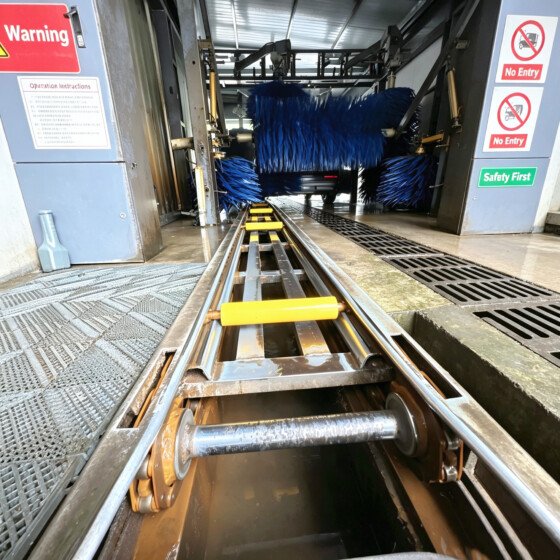
Small-track chain
Many drive systems use connected shafts, motors, couplings, or gear reducers.
If these parts are misaligned, unwanted forces may develop.
However, alignment requirements differ by mechanical design.
Some couplings accommodate limited movement.
Others require tighter positioning.
Therefore, alignment should be verified against the component manufacturer’s limits.
Operators should not attempt alignment adjustments based only on visible appearance.
Qualified technicians may need approved tools and procedures.
After maintenance or component replacement, alignment should be checked where required.
Correct installation can help reduce unnecessary bearing and coupling loads.
9. Managing Brush Motor Wear
Automatic car wash brush motors provide rotational movement for cleaning assemblies.
However, their operating conditions can vary during a wash.
Brush contact, speed changes, and mechanical resistance may influence loading.
Therefore, brush motor protection and maintenance are important.
Operators should review relevant drive faults and abnormal performance.
Unusual vibration or noise should be reported.
However, motor problems should not be diagnosed from sound alone.
Qualified personnel may need to assess bearings, electrical supply, drive settings, and mechanical load.
The motor should operate within the machine manufacturer’s approved limits.
10. How Brush Material Wear Affects Performance
Brushes experience repeated contact during washing.
Over time, cleaning media may become worn or damaged.
However, different brush materials have different service characteristics.
Brush wear may affect cleaning coverage and the behavior of the assembly.
Therefore, operators should inspect the cleaning media at the recommended intervals.
Look for conditions identified by the manufacturer, such as broken elements, irregular wear, or foreign material.
Replacement materials should match the approved specification.
Using an unsuitable brush can change mechanical loads.
A worn brush should not remain in operation simply because it can still rotate.
11. Avoiding Excessive Brush Contact Force
Brush contact must be suitable for the intended cleaning process.
Too little contact may reduce cleaning effectiveness.
Excessive contact may increase mechanical stress or create other risks.
However, the appropriate contact level depends on the brush design and vehicle compatibility.
Therefore, operators should not increase contact force to compensate for poor cleaning without technical review.
The actual problem may involve chemicals, water flow, brush wear, or program settings.
Some machines have automated positioning or load control.
However, those functions vary by model.
Buyers should request written information about the brush control system.
12. Brush Balance and Vibration

cylinder
An uneven rotating assembly can create vibration.
Possible causes include damaged cleaning media, incorrect installation, or mechanical wear.
However, vibration can have other causes.
Therefore, maintenance should not rely on one assumption.
Operators should record when the vibration occurs and which brush assembly is affected.
A qualified technician should inspect the system using the manufacturer’s procedures.
If the machine shows abnormal or unsafe movement, remove it from service.
Operating with excessive vibration can increase stress on supporting components.
Correcting the underlying problem is more useful than repeatedly replacing the same part.
13. Chain Wear in Automatic Car Wash Equipment
Some commercial wash machines use chains to transmit or coordinate movement.
Repeated operation can produce wear in chain joints and sprockets.
However, chain behavior depends on design, lubrication, loading, and contamination.
Over time, wear may increase the effective chain pitch.
This is commonly described as chain elongation.
It should not be confused with simple elastic stretching.
A worn chain can affect engagement with the sprocket.
Therefore, technicians should measure wear using the manufacturer’s method.
Replacement limits should come from the approved component documentation.
14. Maintaining Correct Chain Tension
Chain tension influences drive performance.
However, too much tension can place additional loads on supporting components.
Too little tension may create poor engagement or unwanted movement.
Therefore, the chain should be adjusted only within the approved range.
The correct procedure depends on the machine’s drive arrangement.
Some systems use manual adjustment.
Others use automatic tensioning devices.
Maintenance personnel should review the relevant tensioning components.
Do not adjust chains while machinery is running or capable of unexpected movement.
Proper energy isolation and safe mechanical support are essential.
15. Chain Lubrication and Contamination Control
Where lubrication is required, it should be selected for the chain type and operating conditions.
However, not every chain uses the same lubrication method.
Some designs may use specialized materials or factory lubrication.
The manufacturer’s instructions should determine the correct approach.
In a car wash, water and chemicals can affect the lubrication environment.
Therefore, operators should inspect for contamination and washout where relevant.
Excessive or unsuitable lubricant may also attract dirt or affect nearby equipment.
A practical lubrication plan uses the correct product, amount, and interval.
It should also include proper records.
16. Sprocket Wear and Drive Alignment
Chains work together with sprockets.
If sprockets are damaged or incorrectly aligned, chain engagement may deteriorate.
However, visible wear should be evaluated against technical limits.
A worn sprocket may need replacement together with other drive components.
The correct decision depends on the condition of the assembly.
Therefore, maintenance should consider the complete chain drive rather than one part alone.
Qualified technicians should inspect alignment, tooth condition, mounting, and the manufacturer’s replacement criteria.
Continued operation with damaged components may lead to further mechanical problems.
17. Gear Reducer Maintenance
Gear reducers help control speed and transmit torque.
They may be used in brush drives, travel mechanisms, and conveyors.
However, their maintenance requirements depend on the design.
Some gear reducers use oil.
Others may have different lubrication arrangements.
The manufacturer should specify lubricant type, quantity, and service intervals.
Operators should also monitor unusual noise, leaks, temperature changes, and repeated drive faults.
However, no single symptom confirms internal gear damage.
Qualified personnel should investigate before a component is replaced.
Suitable lubrication and operating loads are important for long-term service.
18. Preventing Gearbox Overheating
A gear reducer operates within a defined temperature range.
High operating temperature may result from several factors.
These can include loading, lubrication condition, ambient temperature, or mechanical issues.
However, a warm gearbox is not automatically faulty.
The correct assessment depends on the manufacturer’s limits.
Operators should review available temperature readings or fault information.
Do not open the housing or touch potentially hot components without appropriate precautions.
A technician should verify the cause of abnormal heating.
Changing lubricant type or increasing cooling should not be used as a substitute for proper diagnosis.
19. Couplings and Mechanical Connections
Couplings connect rotating equipment.
They may transfer motion between motors, shafts, and gear reducers.
Their design may allow limited misalignment or movement.
However, each coupling has specific operating limits.
Wear, installation errors, or unsuitable loads can affect performance.
Therefore, maintenance should include approved inspection of the coupling and its surrounding components.
Unusual vibration or repeated connection problems should be investigated.
Replacement couplings must match the intended torque and operating conditions.
A similar-looking component is not necessarily a compatible replacement.
20. Preventing Wear in Rollover Car Wash Travel Systems
An in-bay rollover machine moves along a defined path around a stationary vehicle.
The travel system may include rails, wheels, motors, drives, and position sensors.
Repeated movement places demands on these parts.
Therefore, operators should monitor travel behavior.
Unusual noise, jerking, or repeated position faults may indicate a problem.
However, the cause could involve mechanical components or controls.
The machine should be inspected under approved procedures.
Track alignment, wheel condition, and drive settings should be verified by qualified personnel.
21. Guide Rails and Running Surfaces
Guide rails help control machine movement.
Their condition can affect the operation of a rollover system.
However, the required maintenance depends on the design.
Some systems have specific cleaning or lubrication requirements.
Others should not receive added lubricant on certain running surfaces.
Therefore, operators must follow the actual service manual.
Dirt and debris may need removal using approved methods.
Damage or misalignment should be reported.
Do not modify rails or guide surfaces without engineering approval.
Correct maintenance helps maintain predictable machine travel.
22. Wheels, Rollers, and Guide Bearings
Wheels and rollers support movement in some washing systems.
Their wear depends on loads, surface condition, alignment, and material.
However, visible wear may not show the complete condition.
A damaged bearing or incorrect alignment can also affect wheel behavior.
Therefore, maintenance should examine the complete assembly.
Operators may notice abnormal movement or vibration.
Qualified technicians should determine whether parts need adjustment or replacement.
The manufacturer should provide relevant wear limits and compatible spare parts.
This is particularly important for machines with frequent repeated travel.
23. Preventing Conveyor Wear in Tunnel Car Washes
Tunnel car wash systems may use conveyors to move vehicles through cleaning stages.
The conveyor has its own drive and supporting components.
High wash volume can increase the number of operating cycles.
However, wear depends on the exact conveyor design and maintenance practices.
Operators should monitor abnormal movement, noise, and fault indications.
The loading process should follow approved vehicle restrictions.
Maintenance personnel should inspect the conveyor according to the manufacturer.
Never enter moving conveyor areas or clear obstructions while hazardous energy remains uncontrolled.
A safe and reliable conveyor is essential for tunnel throughput.
24. Conveyor Alignment and Vehicle Loading
Vehicle loading can influence conveyor operation.
Improper positioning may create unwanted mechanical loads or interruptions.
However, different tunnel systems use different vehicle-handling methods.
Therefore, staff need training for the specific installation.
Customers should receive clear entry instructions.
The operator should follow the approved loading speed and spacing.
Conveyor alignment adjustments require qualified personnel.
Operating at a higher rate than the machine’s approved settings can increase risk.
A high-volume facility should focus on reliable throughput rather than simply pushing the conveyor faster.
25. How Water and Cleaning Chemicals Affect Mechanical Wear
Car wash equipment operates in a wet, chemically active environment.
However, different materials respond differently to exposure.
For example, unsuitable chemicals may affect certain seals or protective coatings.
Water may also carry dirt or other contaminants into poorly protected mechanical parts.
Therefore, chemical selection and equipment maintenance are connected.
Operators should use approved products and concentrations.
They should also verify the compatibility of exposed materials.
However, not every mechanical failure is caused by chemical exposure.
The actual failure mechanism should be identified before changes are made.
26. Corrosion Protection for High-Volume Wash Equipment
Corrosion can affect exposed metal components.
However, corrosion resistance depends on the materials and environment.
Some machines use galvanized steel, coated steel, or selected stainless steel parts.
Each has different limits.
Therefore, buyers should request material and protective finish specifications.
Operators should inspect areas exposed to persistent moisture and chemical spray.
Damage to protective coatings should be addressed using an approved repair procedure.
In coastal regions, environmental exposure may require additional consideration.
A corrosion-resistant structure can support durability, but no material should be described as immune to every condition.
27. Protecting Seals and Moving Joints
Seals help keep contaminants out and fluids inside selected assemblies.
However, seals can deteriorate through wear, chemical exposure, or unsuitable installation.
A failed seal may allow water or dirt to reach a bearing or other component.
Therefore, seal condition matters.
Maintenance should include the inspection points specified by the manufacturer.
Replacement seals must match the intended material and dimensional requirements.
The use of an incorrect substitute may create recurring failures.
A good maintenance program treats seals as part of the wider mechanical system.
28. Why Correct Installation Reduces Premature Wear
Mechanical wear sometimes begins with installation problems.
For example, misalignment can affect drive components.
Incorrect mounting may influence vibration.
Poor structural support may create unwanted movement.
However, these conditions require a proper technical assessment.
Therefore, commissioning should include the manufacturer’s required mechanical checks.
The machine should be installed on a suitable foundation.
Utility connections must also meet the design requirements.
Qualified personnel should verify alignment and operating conditions.
A careful installation process can help avoid problems that would otherwise appear during normal service.
29. Avoiding Overloading and Excessive Machine Speed
Operating equipment beyond its approved limits can increase mechanical stress.
However, maximum speed and operating capacity are not the same thing.
For example, a machine may complete a fast wash program under defined conditions.
That does not mean operators should increase motor speed or shorten protective sequences.
Therefore, use only approved settings.
If customer queues are growing, evaluate the complete operation.
Payment, loading, entry, and exit delays may be limiting throughput.
Increasing mechanical speed without technical approval can create new problems.
30. Car Wash Equipment Wear Prevention Through Preventive Maintenance
Preventive maintenance involves planned tasks intended to reduce the likelihood of failure.
Examples may include inspections, lubrication, cleaning, adjustment, and replacement of selected components.
However, maintenance tasks and intervals must match the equipment.
A generic monthly schedule may be insufficient for a heavily used component.
Likewise, some components should not be serviced more frequently without reason.
Therefore, start with the manufacturer’s guidance.
Then review actual operating conditions and failure history.
The goal is a practical program that reduces avoidable faults without creating unnecessary maintenance work.
31. Calendar-Based vs. Usage-Based Maintenance
Calendar-based maintenance uses fixed periods.
For example, a manufacturer may require inspection at defined weekly or monthly intervals.
Usage-based maintenance considers operating hours, cycles, or wash counts.
Both methods can be useful.
However, neither is automatically best for every component.
A bearing may require maintenance based on its operating conditions.
A brush assembly may have relevant wear indicators.
A high-volume facility should record machine use.
This information can help maintenance teams assess whether the existing schedule remains suitable.
Changes should be approved where they affect manufacturer requirements.
32. Condition-Based Maintenance
Condition-based maintenance uses information about equipment health.
This may include vibration, temperature, noise trends, operating current, or inspection findings.
However, not every machine includes built-in condition monitoring.
Some data may need additional instruments.
The purpose is to identify changes that may justify inspection.
For example, a rising vibration trend can suggest that further assessment is needed.
However, vibration alone does not identify the exact cause.
Condition data should be interpreted by qualified personnel.
A good program uses trends, context, and appropriate technical limits.
33. Predictive Maintenance and Its Limits
Predictive maintenance uses available information to estimate future equipment condition or failure risk.
However, predictive maintenance is more than storing fault codes.
Reliable predictions need relevant data and appropriate analysis.
For example, repeated motor faults may be useful information.
Yet they do not prove that a motor will fail on a particular date.
Therefore, buyers should ask what a manufacturer’s predictive maintenance feature actually does.
Does it collect operating data?
Does it identify abnormal trends?
Does it provide maintenance recommendations?
Have those recommendations been validated?
Clear answers are more useful than broad claims about artificial intelligence.
34. Using Vibration Monitoring for High-Volume Equipment
Vibration measurements may help identify changes in rotating machinery.
However, their meaning depends on the component, operating speed, mounting, and measurement location.
A useful monitoring program should establish a baseline.
Measurements should then be compared under similar operating conditions.
For example, a change in vibration may justify inspection of a blower, drive, or bearing.
However, do not diagnose a specific failure from one reading alone.
Qualified personnel should determine the appropriate measurement methods and limits.
Monitoring should also avoid exposing staff to moving machinery.
35. Temperature Monitoring and Overheating
Temperature is another useful operating indicator.
Bearings, motors, and gear reducers may operate within defined temperature limits.
However, expected temperature varies by equipment.
Therefore, operators should not use one general temperature threshold for every machine.
A trend may be more informative than an isolated reading.
For example, a component operating much hotter than its established baseline may need investigation.
However, ambient conditions and operating load should also be considered.
Measurements should be taken using approved methods.
Any suspected overheating should be assessed before continued operation.
36. Recording Faults and Maintenance History
Maintenance records help operators identify recurring problems.
A useful record includes the date, machine model, affected component, observed symptoms, and repair action.
It should also identify replaced parts and responsible personnel.
Where available, include operating hours or wash count.
For example, repeated bearing replacements in one location may suggest an underlying problem.
However, the cause could involve loading, lubrication, contamination, or installation.
Records make that investigation easier.
A consistent system also supports spare-parts planning and budgeting.
37. Building a High-Volume Maintenance Schedule
Maintenance planning should reflect operating intensity.
The table below shows a practical structure.
| Frequency | Example Activities |
|---|---|
| Daily | Review alarms, unusual sounds, visible damage, and safe operating conditions |
| Weekly | Complete manufacturer-approved component inspections |
| Monthly | Review drive condition, wear findings, and maintenance records |
| Based on wash count | Perform designated usage-based checks |
| Based on operating hours | Complete specified lubrication or replacement tasks |
| After abnormal faults | Investigate and confirm equipment is safe before restarting |
These are categories, not universal service intervals.
The actual schedule must come from the relevant machine and component manuals.
38. Staff Training and Mechanical Wear Prevention
Operators do not need to perform every repair.
However, they should understand normal machine behavior.
Staff should recognize unusual movement, noise, and visible faults.
They should also know which vehicle types are permitted.
Training should explain the correct response when equipment becomes abnormal.
For example, employees should stop customer entry when a machine presents an unsafe condition.
They should not attempt to clear a jam while the machine may restart.
Maintenance duties should be assigned to authorized personnel.
A clear division of responsibilities supports safe operation and consistent reporting.
39. Machine Guarding and Hazardous Energy Control
Mechanical maintenance can involve serious hazards.
Chains, conveyors, rotating brushes, and moving gantries can create trapping or crushing risks.
Electrical, hydraulic, and pneumatic systems may also contain hazardous energy.
Therefore, maintenance must follow applicable safeguards.
In the United States, OSHA’s Control of Hazardous Energy Standard addresses covered servicing and maintenance activities.
It requires appropriate procedures to prevent injury from unexpected energization or energy release.
Operators should not treat the emergency-stop button as a complete energy-isolation method.
Only trained and authorized personnel should perform covered servicing work.
40. Spare-Parts Planning for High-Volume Car Washes
A high-volume site may lose substantial business when essential equipment is unavailable.
Therefore, spare-parts planning can help reduce repair delays.
However, the correct inventory depends on the machine.
Common parts may include selected bearings, seals, sensors, valves, brush materials, and drive components.
Some components may require long supplier lead times.
Therefore, buyers should request a critical spare-parts list.
For international installations, shipping time deserves attention.
The supplier should identify approved part numbers and replacement procedures.
Avoid ordering substitute components based only on appearance.
41. Identifying Critical Components
Not every component failure has the same effect.
A minor part may reduce cleaning quality.
A critical drive failure may stop the entire operation.
Therefore, operators should identify components with a high impact on machine availability.
Consider failure frequency, repair duration, spare-parts lead time, and the effect on customer service.
However, criticality should also account for safety consequences.
A component associated with an essential protective function should not be managed solely according to replacement cost.
A structured criticality review helps prioritize inspection and support arrangements.
42. How Mechanical Wear Affects Cleaning Quality
Mechanical wear is not only a maintenance issue.
It can also affect customer results.
For example, worn cleaning media may reduce brush performance.
A poorly functioning travel mechanism may disrupt a wash sequence.
A failing blower bearing or drive may affect drying availability.
However, cleaning problems can also come from water, chemicals, or control settings.
Therefore, diagnosis should consider the full washing process.
Operators should compare wash results with equipment condition and fault records.
Consistent cleaning quality depends on both mechanical and process performance.
43. How to Measure Equipment Availability
Equipment availability describes how much of the scheduled operating time a machine remains available.
A simple measure is:
Availability = (Scheduled Time − Unplanned Downtime) ÷ Scheduled Time × 100
For example, suppose a machine is scheduled to operate for 300 hours during a month.
It experiences nine hours of unplanned downtime.
Availability would be:
(300 − 9) ÷ 300 × 100 = 97%
This is an illustrative calculation.
It does not describe a particular manufacturer’s reliability.
Operators should use consistent definitions when comparing periods or machines.
44. Why Downtime Can Be More Expensive Than a Replacement Part
A replacement bearing or seal may have a modest purchase cost.
However, the associated shutdown can affect customer service.
Consider a hypothetical car wash.
Suppose the site normally completes 12 paid washes per hour during a busy period.
The average selling price is $15.
If the wash closes for four busy hours, potential gross sales exposure is:
12 × $15 × 4 = $720
However, this is not necessarily lost profit.
Some customers may return later, and certain variable costs are avoided.
The example simply shows why downtime should be included in maintenance planning.
45. Comparing Reactive and Preventive Maintenance Costs
Reactive maintenance takes place after a failure.
Preventive maintenance takes place according to a planned process.
However, the cheapest strategy is not always to replace every part early.
A suitable program should balance inspection, replacement, and failure risks.
For example, unnecessary component replacement creates additional costs.
On the other hand, continuing to use damaged equipment may cause larger failures.
Therefore, operators should review component condition, failure history, and manufacturer guidance.
The most economical approach is based on the actual machine and its operating conditions.
46. Example: Evaluating a Preventive Maintenance Investment
Consider a hypothetical high-volume washing facility.
Suppose unexpected mechanical repairs and related downtime cost $18,000 in one year.
The owner considers an additional maintenance program costing $5,000 annually.
Assume the program reduces those unexpected costs to $9,000.
The modeled annual benefit before the program cost is:
$18,000 − $9,000 = $9,000
After subtracting the program cost:
$9,000 − $5,000 = $4,000
This is an illustrative scenario, not guaranteed savings.
Real results depend on whether the program actually reduces failures and downtime.
47. Mechanical Wear in Automatic Rollover Car Washes
Rollover machines have distinct mechanical wear points.
These may include gantry travel systems, brush drives, moving hoses, and guide components.
Repeated travel can affect the associated mechanisms.
However, each model uses a different configuration.
Therefore, maintenance should be based on the actual equipment.
Operators should monitor travel faults, unusual vibration, and cleaning irregularities.
Qualified technicians should review wear indicators and alignment.
A rollover machine used at a busy gas station may need careful usage-based maintenance planning.
48. Mechanical Wear in Tunnel Car Washes
Tunnel systems may include conveyors, multiple brush assemblies, motors, and drying equipment.
Their high-volume operating model can create continuous demands on moving components.
Therefore, maintenance planning is especially important.
A conveyor problem may interrupt the entire wash line.
A worn brush assembly may affect cleaning quality.
However, the actual failure risk depends on equipment design and operation.
Tunnel operators should maintain detailed component records.
They should also plan service windows around expected customer demand.
No component should be serviced in an unsafe operating condition.
49. Mechanical Wear in Touchless Car Wash Machines
Touchless systems do not use contact cleaning brushes.
Therefore, they avoid wear associated with brush-to-vehicle cleaning contact.
However, they still contain mechanical equipment.
Depending on the model, this may include pumps, motors, valves, moving structures, and blowers.
These components require maintenance.
Therefore, touchless washing should not be described as maintenance-free.
Buyers should review pump operating conditions, movement systems, sealing arrangements, and spare-parts needs.
The overall maintenance comparison should include every major machine function.
50. Mechanical Wear in Soft-Touch Car Wash Machines
Soft-touch systems use designed cleaning media to help remove dirt.
Therefore, brush condition is especially important.
The associated drives and positioning mechanisms also experience operating loads.
However, wear rates depend on many factors.
These include brush material, wash volume, cleaning conditions, vehicle types, and maintenance.
Operators should follow approved replacement limits.
They should also confirm chemical compatibility where relevant.
A suitable soft-touch system needs both reliable contact cleaning and well-maintained mechanical components.
51. Maintenance Planning for Gas Station Car Washes
Gas stations often provide washing as an additional customer service.
Therefore, equipment downtime may affect both direct wash revenue and customer satisfaction.
However, staff may not have specialist maintenance training.
This makes clear operating instructions important.
The supplier should provide fault documentation and practical service support.
Owners should also identify which tasks require external technicians.
A maintenance plan should fit the site’s customer traffic and staffing model.
Scheduled work can help avoid disruption during the busiest periods.
52. Maintenance Planning for Convenience Store Washes
Convenience store car washes often operate on compact sites.
Therefore, equipment access may be more limited.
Buyers should review service clearance before installation.
They should also confirm where major components can be inspected or replaced.
A machine may fit the available wash bay while still being difficult to maintain.
Therefore, installation drawings should include service requirements.
Owners should plan for routine inspections and emergency technical support.
Reliable maintenance helps keep the washing service aligned with the broader retail operation.
53. Fleet Washing and High-Frequency Maintenance
Fleet facilities may wash similar vehicles repeatedly.
This can create a predictable operating schedule.
However, some fleets have unusual vehicle dimensions or contamination.
Therefore, the equipment should be selected for the intended application.
Maintenance planning can use wash counts, operating hours, and actual component condition.
Buyers should also check whether the machine supports the required vehicle types.
A passenger-car system should not automatically be used for heavy commercial vehicles.
Correct selection and maintenance planning help reduce unnecessary mechanical stress.
54. US and Canadian Maintenance Considerations
Commercial operators in the United States and Canada should review the applicable safety, electrical, and workplace requirements.
Specific obligations vary by location and activity.
In the United States, OSHA’s hazardous-energy control requirements are particularly relevant to covered maintenance work.
Canadian operations should review applicable federal, provincial, or territorial requirements.
Climate can also affect equipment operation.
For example, freezing conditions may require special protection for water-related components.
For imported equipment, local spare-parts access and technical support should be assessed before purchase.
55. UK and EU Equipment Reliability Considerations
UK and EU buyers should review applicable machinery requirements, installation conditions, and maintenance documentation.
The supplier should provide suitable technical information for the destination market.
In the European Union, machinery conformity requirements depend on the product and relevant placing-on-the-market date.
Regulation (EU) 2023/1230 introduces an updated machinery framework with application provisions beginning in 2027.
UK requirements should be reviewed separately.
Buyers should also consider wastewater, noise, electrical compatibility, and workplace safety requirements.
A reliable equipment purchase includes both machinery quality and suitable local support.
56. How to Compare Manufacturers for Durability
Durability claims should be supported by useful technical information.
For example, a manufacturer may describe a machine as suitable for high-volume operation.
However, the buyer should ask what that means.
What operating duty is intended?
Which drive components are used?
What maintenance intervals are required?
Which parts are subject to routine replacement?
What performance data is available?
How are spare parts supplied?
A clear technical answer is more useful than an unsupported claim of exceptional service life.
Buyers should compare the complete machine, not only its frame thickness or motor power.
57. Questions to Ask About Mechanical Components
Before selecting automatic car wash equipment, ask:
- What daily operating volume is the machine intended to support?
- What motors and gear reducers are used?
- Which bearings require lubrication?
- What chain or belt drives are installed?
- Which parts are exposed to water and chemicals?
- What are the main wear components?
- How are component replacement limits defined?
- What is the recommended maintenance schedule?
- Which faults can the control system report?
- Is operating data available for maintenance planning?
- What spare parts should be kept on site?
- What warranty and technical support are provided?
These questions help clarify actual operating responsibilities.
58. High-Volume Car Wash Maintenance Checklist
Mechanical Components
- Review bearing condition.
- Confirm approved lubrication requirements.
- Inspect chains and sprockets.
- Assess gear reducers.
- Review coupling and drive condition.
- Inspect brush materials.
- Check guide components and running surfaces.
Operating Conditions
- Record wash counts.
- Review operating hours.
- Monitor abnormal noise and vibration.
- Record recurring faults.
- Confirm approved speed and load settings.
Environmental Protection
- Review exposure to water and chemicals.
- Inspect relevant seals.
- Check protective coatings.
- Follow approved cleaning methods.
Business Management
- Maintain service records.
- Keep critical spare-parts information.
- Schedule appropriate service windows.
- Train operators.
- Review downtime and maintenance costs.
All inspection and repair activities must follow the manufacturer’s instructions and applicable safety procedures.
59. Frequently Asked Questions About Car Wash Equipment Wear Prevention
What causes mechanical wear in automatic car wash machines?
Common causes include repeated loading, inadequate lubrication, contamination, misalignment, corrosion, and unsuitable operating conditions.
How can I reduce wear in a high-volume car wash?
Use equipment designed for the workload, follow approved lubrication and maintenance schedules, inspect components, and monitor operating condition.
Which car wash components wear out most often?
Wear items depend on the machine. Brushes, bearings, chains, seals, guide components, and selected drive parts may require attention.
How often should car wash bearings be lubricated?
Follow the bearing and machine manufacturer’s requirements. The interval depends on the bearing design, load, speed, and environment.
Can too much grease damage a bearing?
Excess grease can create problems in some bearing arrangements. Use only the specified lubricant and quantity.
Why does my car wash chain wear quickly?
Possible reasons include contamination, poor lubrication, misalignment, incorrect tension, or unsuitable loading.
Should chains and sprockets be replaced together?
The correct decision depends on component condition and manufacturer guidance. The complete drive should be assessed.
What causes car wash gear reducers to fail?
Possible factors include lubrication problems, inappropriate loads, contamination, overheating, or mechanical damage.
Why does my car wash brush vibrate?
Possible causes include damaged cleaning media, imbalance, bearing problems, or mechanical faults. Qualified diagnosis is required.
Do touchless car wash machines have less mechanical wear?
They avoid contact brush wear, but pumps, motors, moving structures, and other components still require maintenance.
Can regular maintenance reduce downtime?
A suitable maintenance program can reduce some avoidable failures, but results depend on equipment and operating conditions.
What is preventive maintenance?
It involves planned inspections and service intended to help reduce equipment failure risk.
What is condition-based maintenance?
It uses component condition information to decide when further inspection or service may be needed.
Is predictive maintenance useful for automatic car washes?
It may be useful when relevant data and validated analysis are available. Not all machines include these capabilities.
How do I know when a bearing should be replaced?
Use the component manufacturer’s wear criteria and qualified technical assessment.
Can misalignment damage drive components?
Yes. Incorrect alignment may create unwanted loads on bearings, couplings, and other parts.
What should I do if the machine makes unusual noises?
Stop operation if safety is uncertain, record the symptoms, and arrange an appropriate inspection.
Can I lubricate moving parts while the machine is running?
Follow the manufacturer’s procedures and applicable safety requirements. Servicing that exposes workers to hazardous energy requires appropriate controls.
What spare parts should a busy car wash keep?
Use the manufacturer’s recommended critical spare-parts list for the exact machine model.
How do I compare high-volume car wash machines?
Compare intended duty, mechanical configuration, maintenance requirements, realistic throughput, spare parts, documentation, and supplier support.
60. Final Recommendations for High-Volume Operators
Reducing mechanical wear requires a complete equipment management strategy.
First, select equipment that matches the operating volume.
Second, install the machine correctly.
Third, follow the approved lubrication and maintenance schedule.
Fourth, monitor the condition of important moving components.
Fifth, record faults and review recurring problems.
Sixth, maintain suitable spare-parts and service arrangements.
Finally, evaluate the financial effect of downtime and maintenance.
The goal is consistent operation rather than simply extending the time between repairs.
A reliable maintenance strategy protects both machine performance and business continuity.
Conclusion: Reduce Mechanical Wear Through Better Equipment Management
High-volume car wash operations depend on reliable mechanical systems.
Bearings, chains, gear reducers, brushes, motors, and moving structures all experience operating demands.
However, premature wear is not inevitable.
Correct lubrication, suitable alignment, contamination control, appropriate loading, and planned inspections can help reduce avoidable damage.
Equipment condition monitoring may provide additional useful information.
However, no single monitoring feature can replace proper maintenance.
For commercial operators, the strongest approach combines technical discipline with practical business planning.
For equipment buyers, machine durability should be evaluated through specifications, intended duty, service requirements, and supplier support.
The best strategy for car wash equipment wear prevention is to operate the right machine within its approved limits, maintain it correctly, and address early signs of trouble before they become costly failures.
Request High-Volume Automatic Car Wash Equipment Specifications
Are you planning a new commercial car wash installation or replacing equipment that experiences frequent mechanical wear?
A qualified manufacturer can help review suitable machine configurations.
Prepare the following project information:
- Country and installation location
- Business type
- Available site dimensions
- Expected daily wash volume
- Peak-hour demand
- Required vehicle compatibility
- Preferred washing technology
- Water and electrical conditions
- Maintenance expectations
- Existing equipment problems
- Project budget
Ask for detailed machine specifications, mechanical component information, maintenance schedules, installation drawings, spare-parts lists, and warranty terms.
Request Technical Specifications | Compare High-Volume Car Wash Systems | Get a Customized Equipment Quote
References and Further Reading
US Occupational Safety and Health Administration — Control of Hazardous Energy (Lockout/Tagout)
https://www.osha.gov/control-hazardous-energy/
US OSHA — 29 CFR 1910.147
https://www.osha.gov/laws-regs/regulations/standardnumber/1910/1910.147
European Union — Regulation (EU) 2023/1230 on Machinery
https://eur-lex.europa.eu/eli/reg/2023/1230/oj
Google Search Central — Google Search Essentials
https://developers.google.com/search/docs/essentials
Google Search Central — Guidance for AI Experiences on Search
https://developers.google.com/search/blog/2025/05/succeeding-in-ai-search/
Disclaimer: This article provides general commercial equipment maintenance and purchasing information. It does not diagnose a specific machine or establish universal lubrication, wear, replacement, or operating limits. Actual requirements depend on the manufacturer, model, components, environment, and applicable regulations. Technical servicing must be performed by qualified personnel using approved energy-control and safety procedures. Financial figures are illustrative and do not represent verified industry averages or guaranteed savings.