 intenționez să | Producător de mașini de spălat auto complet automate
How Do Manufacturers Prepare Automatic Car Wash Machines for Overseas Markets?
A Complete 2026 Guide to International Equipment Standards, Factory Testing, Export Packaging, Shipping, Installation, and After-Sales Support
Introducere: Preparing a Car Wash Machine for Global Business
An automatic car wash machine may work well inside a factory. Cu toate acestea, preparing that same machine for an overseas customer requires much more than packing it into a shipping container.
Different countries have different electrical systems, machinery rules, water supply conditions, and installation practices. In addition, overseas buyers need clear documents, reliable transport, and practical technical support.
Prin urmare, automatic car wash machine export is both an engineering task and a project management process.
A manufacturer must understand where the equipment will operate, how it will be installed, and what the buyer expects it to achieve.
For example, a machine designed for one power supply may need changes before it can operate in another market. Likewise, a wash system that fits one building may not fit a smaller gas station site.
These details can affect cost, safety, delivery time, and long-term performance.
As a result, international buyers should not judge suppliers only by machine appearance or factory price.
Instead, they should examine how manufacturers prepare equipment for the destination market.
This guide explains the main steps involved in exporting automatic car wash machines to the United States, Canada, Europe, and other international markets.
It also provides practical checklists to help commercial buyers, gas station operators, fleet managers, and equipment distributors make better purchasing decisions.
Quick Answer: How Are Automatic Car Wash Machines Prepared for Export?
Manufacturers prepare automatic car wash machines for overseas markets through a series of technical, commercial, and logistics checks.
The process usually includes:
- Reviewing the destination country’s requirements
- Confirming the customer’s site and business needs
- Selecting a suitable machine model
- Checking electrical and utility compatibility
- Reviewing applicable safety and conformity requirements
- Preparing technical drawings and export documents
- Completing production and quality inspections
- Performing agreed factory acceptance tests
- Protecting equipment for international transport
- Arranging shipping, customs, and delivery responsibilities
- Supporting local installation and commissioning
- Providing maintenance information and after-sales arrangements
Cu toate acestea, the exact process depends on the machine type, destination, contract terms, and local regulations.
The most reliable export preparation begins before manufacturing, not after the machine is finished.
1. Understand the Destination Market Before Production
A manufacturer should first identify the country where the car wash machine will operate.
This step may sound simple. Cu toate acestea, it affects many technical decisions.
For example, the United States, Canada, Germany, France, and the United Kingdom may have different electrical, product conformity, and installation requirements.
Even within one country, local authorities may apply additional rules.
Prin urmare, a supplier should ask where the machine will be installed.
The manufacturer should also confirm whether the equipment is intended for a commercial car wash, gas station, dealership, or fleet facility.
These details help define the project.
Without them, a factory may produce equipment that is difficult or expensive to install.
A professional export project should begin with a written destination-market review.
2. Study Local Customer Needs

Reciprocating Car Wash Machine
International customers do not all operate the same type of business.
For example, a gas station may offer free washes to fuel customers.
A dedicated car wash business may charge for several wash packages.
Meanwhile, a fleet operator may need to clean company vehicles at regular intervals.
Prin urmare, the manufacturer should understand the intended business model.
Important questions include expected daily wash volume, available space, vehicle types, operating hours, and service expectations.
The supplier should also ask whether the customer needs a rollover, touchless, soft-touch, or tunnel system.
This early discussion supports better machine selection.
It may also prevent the customer from paying for unnecessary features.
3. Select the Right Automatic Car Wash Machine
Machine selection is one of the most important export decisions.
A rollover car wash machine may suit a compact commercial site.
A touchless system may appeal to operators who prefer non-contact washing.
A soft-touch machine uses approved brush or textile contact to support cleaning.
Meanwhile, a tunnel system may suit a site designed for higher vehicle throughput.
Cu toate acestea, no single machine is best for every business.
The manufacturer should compare the site’s conditions with the proposed equipment.
In addition, buyers should consider the level of automation, maintenance needs, and expected operating costs.
A suitable machine is one that matches the business requirements and can be installed and operated within its approved limits.
4. Confirm the Available Installation Space
Before finalizing the equipment, manufacturers should review the proposed installation area.
This includes more than the machine’s physical dimensions.
The site may also need space for vehicle entry, exit, service access, and utility connections.
For example, a machine that fits inside a building may still leave too little room for maintenance.
Prin urmare, buyers should request a layout drawing.
The manufacturer should show the equipment footprint and relevant clearances.
For retrofit projects, existing columns, doors, drains, and traffic patterns may limit the available space.
A clear layout review reduces the risk of expensive site changes after delivery.
5. Check Vehicle Size and Clearance Requirements
Commercial sites may serve different vehicle types.
For example, passenger cars, SUVs, vans, and certain fleet vehicles have different dimensions.
Prin urmare, manufacturers should confirm the maximum approved vehicle envelope.
This may include vehicle width, height, length, and other relevant limitations.
Cu toate acestea, clearance requirements should not be estimated from the appearance of the machine.
Buyers should request model-specific specifications.
The supplier should also explain whether optional vehicle accessories affect compatibility.
A machine intended for normal passenger vehicles may not be suitable for oversized commercial vehicles.
Clear operating limits protect both the customer and the equipment.
6. Adapt Electrical Specifications for Overseas Markets
Electrical compatibility is a critical part of automatic car wash machine export.
Power systems differ between markets and facilities.
Prin urmare, a manufacturer should confirm the site’s voltage, frequency, phase arrangement, and available capacity.
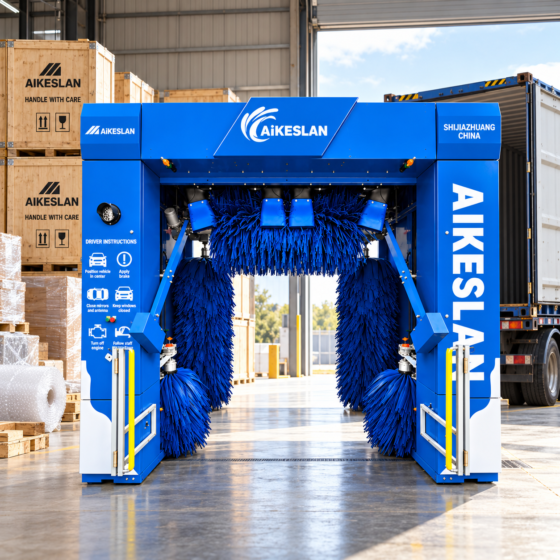
Reciprocating machine
For example, equipment designed around a 50 Hz supply may require engineering review for a 60 Hz application.
Cu toate acestea, electrical adaptation is not always as simple as changing a motor.
Control panels, drives, protective devices, pumps, and other components may also be affected.
The supplier should prepare an approved electrical specification.
In addition, qualified local electricians should verify installation requirements.
Manufacturers should never assume that the power arrangement used at their factory will suit every overseas customer.
7. Review Electrical Control Panel Design
A control panel connects many electrical and automation functions.
Prin urmare, its design deserves careful attention during overseas preparation.
Manufacturers should review component selection, wiring documentation, circuit protection, and environmental suitability.
Cu toate acestea, the appropriate control panel requirements depend on the destination and equipment.
For US projects, relevant local electrical requirements may include assessment under applicable codes and workplace rules.
For European projects, different conformity obligations may apply.
The manufacturer should provide accurate technical information for local review.
Buyers should also ask how replacement components will be identified.
A well-documented control panel can make installation and future maintenance easier.
8. Prepare PLC and Software Settings
Many automatic car wash systems use programmable logic controllers.
The PLC coordinates machine functions and responds to sensor signals.
Cu toate acestea, control software may need project-specific configuration.
For example, the buyer may require different wash programs, operating permissions, or supported interface languages.
Prin urmare, software preparation should be part of the export plan.
The manufacturer should confirm which functions are standard and which require customization.
In addition, software versions and configuration changes should be recorded.
Safety-related control functions need appropriate assessment and validation.
A clear software process helps maintain consistency between the tested factory machine and the equipment delivered overseas.
9. Localize the Operator Interface

Rendering of a gas station
International customers need an operator interface they can understand.
An English-language screen may be essential for many North American and UK projects.
Other markets may require additional languages.
Prin urmare, manufacturers should discuss HMI language options before delivery.
Cu toate acestea, translation must cover more than button labels.
Alarm messages, warnings, operating instructions, and maintenance guidance also need to be clear.
Poor translation can create confusion during operation.
A useful interface should help trained staff understand the machine’s status and available actions.
Din acest motiv, localization should be reviewed as part of the factory acceptance process.
10. Evaluate Machinery Safety Requirements
Safety engineering is an important part of international equipment preparation.
Automatic car wash systems may include moving assemblies, electrical equipment, pumps, and powered mechanisms.
Prin urmare, the manufacturer should identify foreseeable hazards and choose suitable protective measures.
Depending on the design, these measures may involve guarding, interlocks, emergency stop functions, or protective sensing.
Cu toate acestea, requirements depend on the complete machine and its intended application.
Buyers should request relevant safety information and supporting documentation.
A manufacturer’s general safety claims are not enough.
The equipment should be assessed against the rules that apply to its destination market.
11. Prepare Machines for the European Union
Manufacturers supplying the European Union must determine the applicable EU product legislation.
For machinery placed on the market in 2026, the Machinery Directive 2006/42/EC remains an important framework where applicable.
Regulation (EU) 2023/1230 generally applies from January 20, 2027.
Prin urmare, the project timeline matters.
Manufacturers should identify relevant obligations for the specific product, complete the appropriate conformity assessment, and prepare supporting technical documentation.
Where required, they must draw up the EU Declaration of Conformity and apply the CE marking.
Cu toate acestea, CE marking is not simply a general quality award.
It represents conformity with applicable EU requirements.
Buyers should verify that the supplied documents relate to the actual machine and configuration.
12. Understand CE Documentation Requirements
Technical documentation helps demonstrate how a product meets applicable requirements.
Depending on the equipment and legislation, it may include design information, risk assessments, drawings, and test evidence.
Prin urmare, manufacturers should organize these materials as part of the development process.
They should not wait until a shipment is ready.
The buyer should also receive the documents required for the equipment’s safe installation and use.
Cu toate acestea, the complete technical file may contain confidential engineering information that is not necessarily supplied in full to every customer.
The contract should identify which records will be delivered.
Clear documentation helps importers, installers, and authorities assess the relevant obligations.
13. Prepare Equipment for the UK Market
The United Kingdom requires careful attention because product rules are not identical across all UK markets.
Great Britain includes England, Scotland, and Wales.
Northern Ireland has a different product conformity framework.
For many machinery products placed on the Great Britain market, applicable rules allow the use of CE or UKCA marking under defined conditions.
Cu toate acestea, the correct process depends on the product and current legislation.
Prin urmare, manufacturers should check official UK government guidance for the equipment category.
They should also prepare clear English instructions and the necessary conformity records.
A UK project should not be treated automatically as either an EU project or a US project.
14. Prepare Machines for the United States

Reciprocating machine
The United States has different product approval and workplace requirements from the European Union.
Prin urmare, a manufacturer should not assume that CE marking alone will satisfy a US installation.
Electrical equipment may need approval under applicable OSHA requirements.
An OSHA-recognized Nationally Recognized Testing Laboratory, or NRTL, may be involved where required.
Cu toate acestea, not every automatic car wash machine is subject to exactly the same testing or certification process.
Local electrical codes and the authority having jurisdiction may also affect acceptance.
Prin urmare, buyers should consult qualified local professionals early.
The manufacturer should provide technical documents and cooperate with the required evaluation process.
15. Prepare Equipment for Canada
Canadian projects also require market-specific planning.
Electrical approval, installation, and workplace requirements may differ by province and application.
Prin urmare, manufacturers should confirm the destination province and project conditions.
The supplier should provide suitable electrical specifications and supporting documentation.
Buyers should consult local authorities or qualified professionals to determine the applicable approval route.
In addition, Canadian facilities may face cold-weather operating conditions.
Where relevant, manufacturers should discuss freezing protection, drainage, and environmental limits.
Cu toate acestea, cold-weather features should be specified and verified rather than assumed.
16. Check Water Supply Requirements
Automatic car wash equipment needs a suitable water supply.
Cu toate acestea, required flow and pressure depend on the machine and wash process.
Prin urmare, manufacturers should provide model-specific utility requirements.
Buyers should confirm the site’s available water conditions.
For example, an undersized supply line may prevent the machine from delivering its intended performance.
Water quality can also influence filtration, pumps, and chemical dosing.
The manufacturer should explain the equipment’s operating limits.
If the site cannot meet those limits, the project may require additional water infrastructure.
This should be resolved before production and shipment.
17. Review Water Treatment and Recycling Options
Water use is an important business issue in many markets.
Cu toate acestea, water treatment needs vary by location.
Some sites may benefit from reclaim systems, filtration, or other treatment equipment.
Prin urmare, manufacturers should identify whether their machines can integrate with the proposed water system.
They should also specify relevant water quality requirements.
Cu toate acestea, local wastewater discharge and environmental obligations must be assessed separately.
A water recycling system that works in one country may need changes for another site.
The manufacturer should coordinate with qualified local water-treatment specialists when necessary.
18. Adapt Chemical Application Systems
Chemical products and operating practices may differ across overseas markets.
Prin urmare, a manufacturer should review the intended dosing system.
This includes pump compatibility, tubing materials, seals, and operating conditions.
Cu toate acestea, the machine supplier should not assume that every cleaning product is suitable.
Chemical selection and handling must follow the supplier’s instructions and applicable local requirements.
The manufacturer should explain how the machine applies chemicals and how dosing is adjusted.
Buyers should also confirm whether chemical supply is included in the equipment contract.
Often, local sourcing may be more practical.
Clear responsibilities help avoid problems after installation.
19. Consider Local Climate Conditions
Environmental conditions can affect machine operation.
For example, outdoor equipment in cold regions may require protection against freezing.
Meanwhile, humid or coastal environments may influence corrosion protection.
Prin urmare, manufacturers should ask about the installation environment.
Indoor and outdoor machines may require different design measures.
Cu toate acestea, suitable protection depends on the actual temperature range, exposure, and machine configuration.
The manufacturer should state the approved environmental limits.
For cold-weather projects, the complete water system and site infrastructure must be considered.
A single heating component does not automatically provide full freeze protection.
20. Evaluate Corrosion Protection for Export Projects
Car wash machines operate in wet environments.
Prin urmare, corrosion protection matters for long-term operation.
Manufacturers may use galvanized steel, stainless steel, protective coatings, or suitable combinations of materials.
Cu toate acestea, corrosion resistance depends on the full design and chemical exposure.
A material name alone cannot guarantee service life.
Buyers should ask about the structure, protective finish, and maintenance requirements.
For coastal or demanding locations, a more detailed review may be appropriate.
The manufacturer should explain which materials are used in the quoted model.
It should also identify important limitations or recommended maintenance practices.
21. Confirm Customization Before Manufacturing
International customers may request specific features.
For example, a distributor may want a branded operator interface.
A gas station may require a compact installation layout.
A commercial wash operator may need a particular wash program.
Cu toate acestea, customization can affect engineering, testing, and delivery time.
Prin urmare, requests should be reviewed before production begins.
Manufacturers should confirm feasibility and document approved changes.
In addition, the quotation should identify the included options.
The buyer should understand whether a feature is standard, optional, or a custom development.
A clear approval process reduces errors and unexpected costs.
22. Prepare Technical Drawings for International Buyers
Drawings are essential for overseas equipment installation.
A manufacturer may need to provide layout drawings, foundation requirements, electrical information, and utility connection details.
Cu toate acestea, drawing scope depends on the project.
Prin urmare, the supplier and buyer should agree on required documents.
The drawings should clearly identify the relevant model and revision.
If machine dimensions or connections change, the documents should be updated.
Using incorrect drawings can create expensive construction errors.
Din acest motiv, buyers should request approved installation information before completing site works.
23. Organize Production Planning and Quality Control
Once the configuration is approved, the manufacturer can finalize the production plan.
Cu toate acestea, overseas projects need clear traceability.
For example, the production team must know which electrical configuration and optional features were ordered.
Prin urmare, the factory should link the manufacturing records to the confirmed specification.
Quality checks may include mechanical assembly, wiring, component identification, and selected operating functions.
Cu toate acestea, the exact inspection scope varies.
A manufacturer should establish clear acceptance criteria.
The buyer should also understand how identified defects are corrected.
Good production control helps ensure that the delivered machine matches the agreed order.
24. Complete Factory Acceptance Testing
Factory acceptance testing, or FAT, is an important export preparation step.
It helps verify agreed equipment functions before shipment.
For example, the factory may check machine movement, control functions, sensor operation, and selected wash sequences.
Cu toate acestea, the factory environment cannot reproduce every installation condition.
Prin urmare, the FAT scope should be agreed in writing.
Buyers may request test records, photographs, or video evidence.
For important projects, a buyer or independent representative may attend agreed inspections.
The manufacturer should document results and correct identified problems.
Successful factory testing supports shipment readiness, but it does not replace local commissioning.
25. Inspect the Machine Before Packing
After production testing, the equipment should undergo a shipment inspection.
This helps confirm that the correct components and accessories are included.
For example, the inspection may verify machine sections, control cabinets, pumps, sensors, and agreed spare parts.
The supplier should also check labels and identification marks.
Cu toate acestea, the inspection must match the packing list and contract.
Buyers may request photographs of the packed components.
This creates a useful reference if delivery questions arise.
A well-organized final inspection can reduce the risk of missing equipment and delayed installation.
26. Prepare Machines for Sea Freight
Sea freight is often considered for large industrial equipment.
Cu toate acestea, automatic car wash machines may include heavy structures and sensitive electrical components.
Prin urmare, packing methods must account for transport conditions.
The manufacturer should consider lifting points, load restraint, moisture protection, and component separation.
Some assemblies may need partial disassembly to fit into the selected container.
Cu toate acestea, disassembly should be planned so the machine can be reassembled correctly.
The packing list should identify the contents clearly.
Buyers should confirm whether containers, crates, or other loading arrangements are suitable for the equipment.
27. Protect Electrical and Mechanical Components
International transport can expose cargo to vibration and moisture.
Prin urmare, suitable protection is important.
Electrical cabinets should be prepared according to the transport plan.
Sensitive components may require additional packing.
Moving assemblies should be restrained where necessary.
Cu toate acestea, packaging should not create new risks during unloading.
The supplier should provide handling instructions.
Where components are removed for transport, the reassembly information should be clear.
A detailed packing record makes it easier to check the shipment when it reaches the destination.
28. Check Export Wood Packaging Requirements
Some export shipments use wooden crates or pallets.
Cu toate acestea, wood packaging may be subject to phytosanitary requirements.
For many international trade routes, ISPM 15 requirements may apply to regulated solid wood packaging material.
Prin urmare, manufacturers should confirm the destination’s current rules.
They should use suitable packaging materials and required markings where applicable.
Cu toate acestea, not every type of processed wood packaging is treated the same way.
The freight forwarder or relevant authority can help clarify the requirements.
Correct packaging preparation reduces the risk of customs delays or treatment at the destination.
29. Prepare the Export Documentation
Overseas equipment shipments require accurate commercial and transport documents.
Depending on the transaction, these may include a commercial invoice, packing list, transport document, and relevant customs information.
Other documents may be required by the destination country, buyer, or bank.
Prin urmare, the manufacturer and freight forwarder should confirm the document checklist early.
The invoice should describe the goods consistently.
The packing list should match the shipment.
Incorrect or inconsistent information can cause delays.
Cu toate acestea, the manufacturer should not promise that one standard document package will work for every country.
30. Understand Incoterms and Delivery Responsibilities
International buyers should understand which party is responsible for each part of the delivery.
Incoterms rules help define certain delivery obligations, costs, and risks.
For example, contracts may use EXW, FCA, FOB, or DAP depending on the arrangement.
Cu toate acestea, the appropriate term depends on the actual transport method and commercial agreement.
Buyers should not assume that every quoted price includes ocean freight, customs clearance, duties, or site delivery.
Prin urmare, the contract should state the selected Incoterms rule, named place, and agreed version.
The parties should also separately address installation, insurance, and service responsibilities.
Clear terms reduce commercial disputes.
31. Plan Customs Clearance and Import Responsibilities
Import requirements vary by destination.
Prin urmare, buyers should clarify who acts as importer of record.
They should also confirm product classification, applicable duties, and customs documentation.
Cu toate acestea, tariffs and trade measures can change.
A supplier should not promise a fixed import tax rate without current verification.
The buyer may need advice from a customs broker.
For complex shipments, early customs planning is especially useful.
The manufacturer should provide accurate technical and commercial information.
This helps the broker assess the correct import process.
32. Estimate the Total Landed and Installed Cost
The equipment purchase price is only one part of an overseas project.
Other expenses may include transport, insurance, duties, handling, and local delivery.
Installation costs can also be significant.
For example, a site may require foundation work, drainage, electrical upgrades, or water supply improvements.
Prin urmare, buyers should calculate the total project cost.
A useful estimate should separate the machine price from logistics and site costs.
It should also identify assumptions.
Cu toate acestea, costs will vary by destination, machine, and project scope.
A lower factory quotation does not always result in a lower total investment.
33. Prepare Spare Parts for Overseas Delivery
Spare parts can become especially important when equipment operates far from the manufacturer.
Prin urmare, suppliers should discuss the recommended service parts before shipment.
Cu toate acestea, the correct spare-parts package depends on the machine and expected use.
For example, certain sensors, seals, nozzles, or wear components may be relevant.
Buyers should ask which parts are included.
They should also request clear part numbers and replacement guidance.
A spare-parts list helps local technicians identify suitable components.
It can also reduce delays when maintenance is required.
Cu toate acestea, parts availability and delivery times should be confirmed contractually where important.
34. Plan Overseas Installation Support
Shipping the machine does not complete the project.
The equipment must be installed at the destination.
Prin urmare, manufacturers should define the installation support scope.
Some suppliers may provide remote guidance.
Others may offer an engineer visit or work through an authorized local partner.
Cu toate acestea, actual services vary.
The buyer should confirm who performs mechanical assembly, electrical connection, and commissioning.
Local contractors may need relevant licenses or qualifications.
The supplier should provide suitable technical drawings and instructions.
Clear responsibilities help prevent delays after the equipment arrives.
35. Prepare the Site Before the Machine Arrives
Site readiness is a major factor in project success.
For example, the foundation and utility connections may need to be completed before the installation team begins work.
Prin urmare, buyers should request site requirements early.
These may include floor conditions, access routes, drainage, and equipment clearances.
Cu toate acestea, the exact requirements are model-specific.
The manufacturer should provide approved technical information.
Local designers and contractors should verify site compliance.
A pre-installation checklist helps identify unfinished work.
It also supports better coordination between the supplier, customer, and installers.
36. Complete Installation and Commissioning
Once installed, the machine needs suitable commissioning.
This process checks the equipment in its actual operating environment.
For example, technicians may verify power connections, mechanical movement, water systems, control functions, and protective measures.
Cu toate acestea, the test plan should be agreed before handover.
Safety-related checks may require qualified personnel.
The manufacturer should explain which commissioning tasks it supports.
The buyer should receive records of agreed test results.
If problems are found, they should be resolved through the agreed process.
A machine should not enter normal commercial operation before necessary checks have been completed.
37. Provide Operator Training
Even a highly automated machine requires proper operation.
Prin urmare, staff should receive suitable training.
For example, operators may need to understand vehicle positioning, wash program selection, warnings, and emergency procedures.
Cu toate acestea, training should match their responsibilities.
Maintenance work may require additional qualifications and safety procedures.
The manufacturer should provide clear operating instructions.
Where available, videos and illustrated guides may improve understanding.
Cu toate acestea, training materials should be kept consistent with the delivered machine configuration.
Good training helps operators use the equipment correctly and recognize problems earlier.
38. Organize Overseas After-Sales Support
International buyers should examine support arrangements before purchasing.
For example, who handles technical questions after installation?
What information is needed to diagnose a fault?
Are replacement parts available?
Does the supplier offer remote assistance?
Cu toate acestea, support capabilities differ by manufacturer and market.
Prin urmare, buyers should request written service terms.
The warranty should also identify its coverage, exclusions, and claim process.
A supplier’s general statement about global service is not enough.
Clear agreements help customers manage equipment throughout its operating life.
39. Evaluate Remote Diagnostics and Software Support
Connected control systems may support remote troubleshooting.
Cu toate acestea, this depends on the equipment architecture and contract.
Manufacturers should explain which diagnostic functions are available.
They should also clarify internet requirements and access permissions.
If software updates are possible, buyers should ask how versions are controlled.
Cybersecurity matters because unauthorized access can create operational risks.
Prin urmare, remote support should use appropriate safeguards.
Buyers should also consider what happens when the machine operates without an internet connection.
Remote assistance should support safe local maintenance, not replace it.
40. Prepare for Long-Term Maintenance
An export-ready machine should be supported by practical maintenance information.
For example, the buyer may need inspection schedules, lubrication instructions, and spare-parts references.
Cu toate acestea, service needs depend on the equipment design and operating conditions.
Prin urmare, the manufacturer should provide model-specific maintenance guidance.
The operator should also plan routine inspections.
For high-use facilities, local maintenance capability can be especially valuable.
A machine that is easy to service may reduce long-term operating disruptions.
Cu toate acestea, maintenance should always follow safe isolation procedures and the manufacturer’s approved instructions.
41. Adapt Export Preparation to Gas Stations
Gas stations often use automatic car wash equipment to improve customer experience.
Cu toate acestea, space and vehicle traffic can create special requirements.
Prin urmare, manufacturers should review entry and exit paths.
They should also consider the site’s available utilities.
For example, a compact rollover system may fit better than a larger tunnel installation.
Cu toate acestea, selection must be based on actual site conditions.
The buyer may also need to connect washing services with existing customer management systems.
Any integration requirements should be reviewed before production.
A well-planned machine should support the station’s operating process.
42. Adapt Export Preparation to Commercial Car Wash Businesses
Dedicated car wash businesses may place more emphasis on wash programs, service capacity, and operating costs.
Prin urmare, suppliers should review business expectations.
For example, buyers may require several wash packages.
They may also need a machine suited to frequent use.
Cu toate acestea, commercial capacity claims should be supported by realistic operating assumptions.
The manufacturer should explain the machine’s approved duty and maintenance needs.
In addition, customers should plan water use, chemical supply, and site staffing.
A suitable configuration connects equipment performance with the business model.
43. Adapt Export Preparation to Fleet Facilities
Fleet operations have different needs from typical retail car washes.
For example, some fleets include taller or longer vehicles.
Prin urmare, vehicle compatibility must be confirmed before equipment selection.
The manufacturer should review relevant dimensions and site conditions.
Cu toate acestea, a passenger-car washing machine may not be suitable for larger commercial vehicles.
The buyer should also consider how often vehicles need washing.
Service access and maintenance planning may become important for scheduled fleet operations.
A clear technical review prevents the purchase of equipment that does not match the intended vehicles.
44. Adapt Export Preparation to Equipment Distributors
Overseas distributors may buy equipment for resale or local installation projects.
Prin urmare, their needs often extend beyond one machine.
For example, a distributor may require product documentation, staff training, and spare-parts support.
Some may request branding or regional configuration options.
Cu toate acestea, the manufacturer should define what can be customized.
The parties should also discuss service responsibilities.
A distributor may need local technical capability to serve customers effectively.
A clear cooperation agreement helps establish product specifications, marketing responsibilities, warranty terms, and after-sales procedures.
45. Compare Manufacturers Beyond Export Price
International buyers should compare suppliers using more than a quoted machine price.
For example, one manufacturer may offer a lower equipment cost but limited technical documentation.
Another may provide better testing records and installation support.
Prin urmare, buyers should review the complete offer.
Important factors include engineering expertise, approved configuration, testing scope, delivery terms, and spare-parts arrangements.
Cu toate acestea, no single supplier will be ideal for every project.
The best choice depends on business requirements and verified capabilities.
A structured comparison helps buyers make a more informed decision.
46. Common Export Preparation Mistakes
Several mistakes can delay overseas projects.
One is confirming electrical compatibility too late.
Another is ordering equipment before checking site dimensions.
Poor packing documentation can also create problems.
In addition, buyers may misunderstand what the quoted shipping term includes.
Some projects face delays because local installation responsibilities were never defined.
Cu toate acestea, many of these problems can be reduced through early planning.
Manufacturers and buyers should confirm technical specifications, documents, delivery terms, and commissioning responsibilities before production.
Clear communication is one of the most useful risk controls.
47. Automatic Car Wash Machine Export Checklist
Before placing an international order, buyers can review the following checklist.
| Preparation Item | What to Confirm |
|---|---|
| Destination market | Country, region, and intended installation |
| Machine selection | Suitable model and vehicle compatibility |
| Installation layout | Approved footprint and required clearances |
| Electrical system | Voltage, frequency, phases, and local approval |
| Water system | Flow, pressure, quality, and drainage |
| Safety requirements | Applicable assessment and protective functions |
| Product documentation | Specifications, drawings, and instructions |
| Factory inspection | Agreed quality and acceptance checks |
| Packing | Suitable packaging and shipping protection |
| Export documents | Accurate invoice, packing list, and transport records |
| Delivery terms | Named Incoterms rule and responsibility split |
| Customs | Importer, broker, and destination requirements |
| Installation | Contractor responsibilities and site readiness |
| Commissioning | Agreed test procedure and acceptance records |
| After-sales support | Warranty, spare parts, and technical assistance |
This checklist is a starting point.
A detailed project may require additional items.
48. Frequently Asked Questions
What is automatic car wash machine export preparation?
It is the process of adapting, testing, documenting, packing, and arranging equipment for delivery and operation in another country.
Can a Chinese automatic car wash machine be installed in the United States?
Potentially, yes. Cu toate acestea, the equipment must meet applicable destination requirements, and installation must satisfy relevant local rules.
Does every exported car wash machine need CE certification?
No. CE marking applies according to relevant product legislation and destination-market requirements. It is not a universal export requirement for every country.
Do automatic car wash machines need UL certification?
Requirements depend on the equipment and installation. Some electrical equipment may require NRTL approval or other accepted evaluation under applicable US rules.
What is the best way to ship an automatic car wash machine overseas?
Sea freight is often suitable for large equipment, but the best method depends on dimensions, weight, urgency, destination, and cost.
What documents should manufacturers prepare?
Typical documents may include specifications, commercial invoices, packing lists, transport documents, installation instructions, and relevant conformity records.
How do buyers confirm electrical compatibility?
They should provide the site’s electrical specifications and request written confirmation of the machine’s approved power requirements.
Can manufacturers customize machines for different countries?
Some can. Cu toate acestea, customization depends on engineering feasibility, cost, testing, and applicable requirements.
What is factory acceptance testing?
FAT is an agreed testing process used to check selected machine functions before shipment.
Can overseas customers inspect machines before shipping?
Many manufacturers may support agreed factory inspections or testing reviews. Buyers should confirm the arrangement in advance.
Who installs an exported automatic car wash machine?
Installation may be performed by qualified local contractors, the manufacturer’s technicians, or an authorized service partner, depending on the agreement.
How long does international shipping take?
Transit time varies by departure port, destination, route, carrier, customs conditions, and inland delivery arrangements.
What should buyers know about import duties?
Duties and taxes depend on the destination, product classification, origin, and current trade measures. A customs professional should verify the details.
Are spare parts included with exported machines?
That depends on the contract. Buyers should request a list of included parts and optional maintenance packages.
How can buyers reduce overseas purchasing risks?
They should verify the manufacturer, confirm technical requirements, agree on testing and delivery terms, and establish installation and support responsibilities.
Conclusion: Successful Overseas Delivery Starts With Engineering Preparation
Preparing an automatic car wash machine for an overseas market is more than an export transaction.
It is a complete technical and commercial process.
Manufacturers must understand the destination market, review installation conditions, and select suitable equipment.
They must also address electrical compatibility, machinery safety, documentation, and factory quality.
After production, the machine needs appropriate testing, packing, shipping arrangements, and installation planning.
Cu toate acestea, the manufacturer’s responsibility does not always end when the container leaves the factory.
Clear technical support, maintenance information, and spare-parts arrangements can provide important value after delivery.
Prin urmare, international buyers should evaluate the entire preparation process before choosing a supplier.
A well-prepared automatic car wash machine is not simply ready to ship. It is supported by the information, engineering decisions, and practical arrangements needed for successful installation and operation in its destination market.
Request an International Automatic Car Wash Equipment Quotation
Are you planning an automatic car wash project in the United States, Canada, Europe, the United Kingdom, or another international market?
Before requesting a final quotation, prepare the following information:
- Country and installation location
- Business type and intended application
- Preferred machine model
- Available installation dimensions
- Vehicle size requirements
- Expected daily wash volume
- Electrical supply specifications
- Water supply and drainage conditions
- Required wash programs
- Local conformity or approval requirements
- Customization needs
- Shipping destination
- Desired installation support
- Estimated project schedule
- Approximate investment budget
Ask the manufacturer to prepare a project-specific technical proposal.
The proposal should identify the machine configuration, utility requirements, available options, delivery responsibilities, and technical support scope.
Request a Technical Proposal | Get an Export Quotation | Explore Automatic Car Wash Equipment Solutions
Technical and Regulatory References
- European Commission — CE Marking and Manufacturer Responsibilities
https://single-market-economy.ec.europa.eu/single-market/goods/ce-marking_en - European Commission — Preparing Technical Documentation
https://europa.eu/youreurope/business/product-rules-compliance/general-product-compliance/preparing-technical-documentation/index_en.htm - European Union — Regulation (EU) 2023/1230 on Machinery
https://eur-lex.europa.eu/eli/reg/2023/1230/oj - OSHA — Nationally Recognized Testing Laboratory Program
https://www.osha.gov/nationally-recognized-testing-laboratory-program/frequently-asked-questions - UK Government — Placing UKCA or CE Marked Products on the Market in Great Britain
https://www.gov.uk/guidance/ukca-marking-conformity-assessment-and-documentation - Google Search Central — Helpful, Reliable, People-First Content
https://developers.google.com/search/docs/fundamentals/creating-helpful-content
Disclaimer: This article provides general information about international machinery procurement and export preparation. It does not establish legal compliance, certification, or suitability for a particular installation. Applicable requirements depend on the machine, destination, project date, and local authority. Manufacturers and buyers should verify current obligations and use qualified professionals where appropriate.