
How to Prevent Premature Chain Wear in Automatic Car Wash Machines?
How to Prevent Premature Chain Wear in Automatic Car Wash Machines?
2026 Technical Guide to Chain Lubrication, Sprocket Alignment, Chain Tension, Corrosion Protection, Preventive Maintenance, and Commercial Car Wash Equipment Reliability
Introduction: Why Premature Chain Wear Matters in Automatic Car Wash Machines
Automatic car wash machines depend on reliable mechanical systems to keep vehicles moving through each wash cycle. Depending on the equipment design, chains may transfer power, support controlled movement, or form part of a conveyor system.
However, chain drives operate under demanding conditions.
Water, cleaning chemicals, vibration, dirt, and repeated movement can all affect their performance. During busy periods, an automatic car wash may complete many cycles with little time between them.
Over time, normal chain wear is expected. However, chains that deteriorate earlier than their intended service life can create unnecessary maintenance costs.
For example, a worn chain may produce unusual noise, poor movement, or unstable engagement with its sprockets. In serious cases, a chain drive fault can stop a washing operation.
This affects more than equipment repair costs.
For commercial car wash operators, downtime can reduce throughput, interrupt customer service, and create problems during peak business hours.
That is why automatic car wash chain wear prevention should be part of every suitable maintenance program.
The goal is not to make chains last forever. Instead, operators should reduce avoidable wear and replace components before their condition creates larger problems.
This guide explains why car wash chains wear prematurely and how to prevent common problems through correct lubrication, proper tension, sprocket alignment, environmental protection, and regular inspection.
It also provides practical advice for commercial car wash buyers in North America and Europe.
Quick Answer: How Can You Prevent Premature Chain Wear?
To prevent premature chain wear in automatic car wash machines, use the correct chain for the application, maintain proper lubrication, verify sprocket alignment, and keep chain tension within the manufacturer’s specifications.
You should also control contamination, inspect components regularly, and replace worn parts before they cause additional damage.
The most important practices include:
- Use a chain designed for the required load and operating environment.
- Follow the manufacturer’s lubrication method and schedule.
- Prevent excessive chain tension or uncontrolled slack.
- Verify sprocket alignment and tooth condition.
- Reduce exposure to water, dirt, and unsuitable chemicals where practical.
- Measure chain wear elongation using an approved method.
- Review bearings, shafts, and tensioning components.
- Keep maintenance records based on actual machine use.
- Replace damaged components with approved parts.
Above all, never inspect, lubricate, tension, or adjust an exposed chain while hazardous movement or stored energy remains uncontrolled.
1. What Causes Premature Chain Wear?
Premature chain wear occurs when a chain reaches an unacceptable condition earlier than expected for its intended application.
However, the cause is not always poor chain quality.
A suitable chain can wear quickly if the drive system is installed or maintained incorrectly.
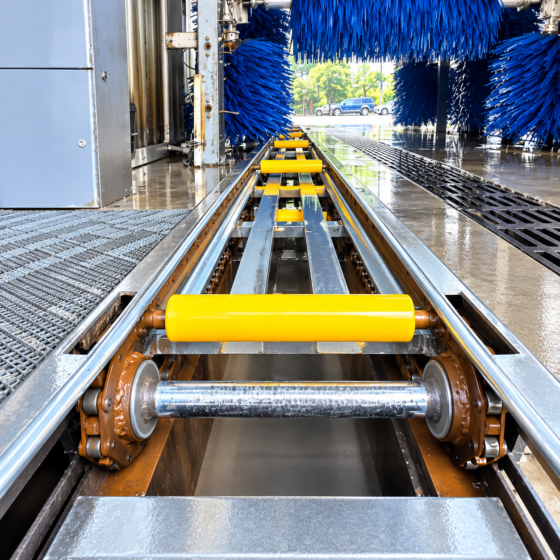
Machine Chain
For example, inadequate lubrication may increase wear between moving chain surfaces.
Incorrect alignment may create unwanted side loading.
Excessive tension can place additional forces on the chain and supporting bearings.
Contamination may also accelerate wear.
Therefore, a complete diagnosis should consider the entire drive system.
Replacing the chain alone may not solve the underlying problem.
2. Understanding How Roller Chains Wear
A roller chain contains several connected components.
These generally include pins, bushings, rollers, and side plates.
As the chain moves, its joints articulate around the sprockets.
Over time, wear may occur at these moving contact surfaces.
For example, wear between pins and bushings can increase the effective pitch of the chain.
This is commonly described as chain elongation.
However, it is not normally the same as the entire chain permanently stretching like an elastic band.
Instead, wear inside the joints increases the distance between corresponding points along the chain.
As a result, engagement with the sprocket may deteriorate.
3. Why Automatic Car Wash Chain Wear Prevention Matters
A chain drive is part of a larger mechanical system.
Therefore, poor chain condition may affect other components.
For example, an elongated chain may engage less smoothly with a sprocket.
Incorrect tension may increase loads on bearings and shafts.
A damaged sprocket may then contribute to further chain wear.
This can create a cycle of repeated repairs.
However, preventive maintenance can reduce some avoidable problems.
When operators identify wear early, they can plan service before a major failure occurs.
This supports predictable maintenance spending and machine availability.
4. Which Automatic Car Wash Systems Use Chains?
Not every automatic car wash machine uses chains in the same way.
Some rollover systems may use chains in selected movement or drive assemblies.
Certain tunnel car wash systems use conveyor chains.
Other machines may use belts, gear drives, or different mechanisms.
Therefore, the first step is to identify the actual chain application.
A conveyor chain may have different requirements from a chain used for power transmission.
The load, speed, movement pattern, and lubrication arrangement can vary.
Buyers should request a mechanical system diagram or component list for the specific machine model.
5. Why High-Volume Washing Increases Chain Maintenance Demands
High-volume operations place repeated demands on mechanical equipment.
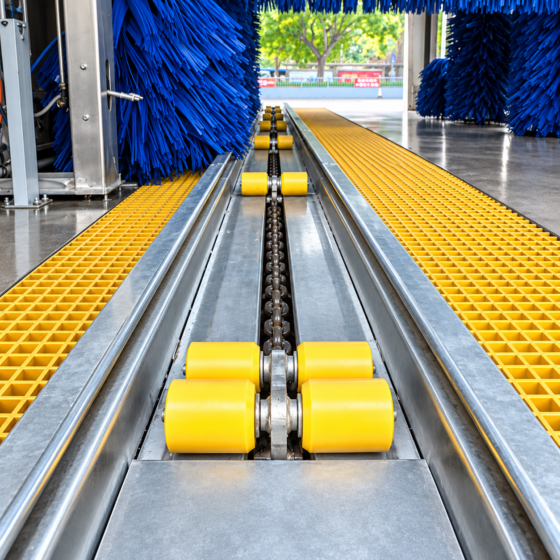
Machine Chain
A chain may complete many operating cycles throughout the day.
However, the number of washes is only one factor.
Operating hours, speed, loading, and environmental conditions also matter.
For example, frequent starting and stopping may produce different loads from steady operation.
Similarly, a chain working in a wet environment may face different maintenance requirements from one inside a protected enclosure.
Therefore, high-volume facilities should monitor chain condition according to actual usage.
A fixed calendar schedule may not reflect the full workload.
6. Incorrect Chain Lubrication
Lubrication is one of the most important factors affecting roller chain wear.
It helps reduce friction between moving surfaces inside the chain joints.
However, applying lubricant to the outside of the chain is not always enough.
The lubricant needs to reach the relevant contact surfaces.
For conventional roller chains, this often includes the areas between the pins and bushings.
If lubrication is insufficient, internal wear can increase.
However, the correct approach depends on the chain design.
Some chains have special lubrication systems or maintenance requirements.
Therefore, always follow the manufacturer’s instructions.
7. Choosing the Right Chain Lubricant
Different chains require different lubrication methods.
The correct product depends on speed, load, operating temperature, and environmental exposure.
For example, a chain operating in a wet wash bay may need a lubricant that performs under the expected water exposure.
However, this does not mean any waterproof grease is suitable.
Some heavy lubricants may not reach the internal surfaces of certain roller chains effectively.
The chain manufacturer should provide approved lubricant grades or performance requirements.
Operators should also consider cleaning chemical compatibility.
Using an unsuitable lubricant can reduce performance rather than improve it.
8. Why Too Much Grease Can Be a Problem
More lubricant does not always mean better protection.
For some roller chain applications, a thick layer of grease may remain on the outside without reaching the important joint surfaces.
It may also collect dirt or other contaminants.
As a result, internal wear can continue even when the chain appears well coated.
However, certain chain designs use different lubrication arrangements.
Therefore, operators should not remove or replace a lubricant without checking the approved method.
The goal is correct lubrication at the relevant surfaces.
It is not simply to make the chain look oily or heavily greased.
9. Chain Lubrication in Wet Car Wash Environments

Tunnel-type car wash machine
Automatic car wash equipment operates near water and cleaning chemicals.
Therefore, chain lubrication can face unusual challenges.
Water may remove or dilute some lubricants.
Cleaning products may also affect selected lubricant formulations.
However, the actual effect depends on exposure and chemical composition.
Operators should identify whether the chain is exposed to direct spray, splashes, or occasional moisture.
The lubricant should match those conditions.
If frequent washdown is unavoidable, the manufacturer may recommend a special chain, coating, or lubrication arrangement.
Do not assume a standard industrial chain is suitable for every wash bay.
10. Incorrect Chain Tension
Chain tension is another important maintenance factor.
If a chain is too tight, additional loads may act on the drive system.
These loads can affect bearings, shafts, and chain joints.
However, excessive slack can also create problems.
The chain may move unpredictably or engage poorly with the sprockets.
Therefore, a chain should be adjusted to its approved operating condition.
The correct amount of slack depends on the drive arrangement.
Do not use a universal measurement without consulting the machine’s specifications.
Qualified personnel should perform adjustments after the system has been safely isolated.
11. Why Chain Tension Changes Over Time
Chain tension may change as components wear.
For example, increased chain pitch can affect the overall operating condition.
Tensioning devices may also move or deteriorate.
However, an apparent tension problem may result from other causes.
These include incorrect mounting, shaft movement, or a worn sprocket.
Therefore, technicians should inspect the complete drive.
Simply tightening the chain may temporarily reduce visible slack without correcting the real issue.
A chain that has reached its replacement limit should be replaced.
Repeated adjustment should not become a substitute for proper maintenance.
12. Chain Tensioners and Idler Sprockets
Some chain drives use tensioners or idler sprockets.
These devices help maintain the intended chain path and operating condition.
However, their design and placement matter.
A worn tensioner may create unusual movement.
A damaged idler bearing may introduce additional resistance.
Incorrect adjustment may also affect chain loading.
Therefore, maintenance should include the relevant tensioning components.
Technicians should check the manufacturer’s approved position, operating range, and wear criteria.
Replacement components should match the original design.
13. Sprocket Misalignment

Small guide rail structure
Sprocket alignment affects how a chain engages with its drive components.
If sprockets are incorrectly aligned, the chain may experience unwanted side loading.
Over time, this can increase wear.
The sprocket teeth may also show uneven contact.
Therefore, technicians should verify alignment during installation and maintenance.
However, the correct method depends on the mechanical arrangement.
Suitable tools may include alignment instruments or other manufacturer-approved methods.
A visual check alone may not be accurate enough.
Proper alignment can help distribute load more evenly and support chain life.
14. How Shaft Problems Affect Chain Alignment
Sprocket alignment depends partly on the shafts and bearings supporting the drive.
If a shaft moves or a bearing becomes worn, the sprocket position may change.
Therefore, chain problems can sometimes begin outside the chain itself.
A technician should review shaft mounting, bearing condition, and relevant drive components.
However, the inspection must follow safe maintenance procedures.
Repeated chain replacement without checking the supporting system may result in continued premature wear.
A complete mechanical assessment is more effective than focusing only on visible chain damage.
15. Worn Sprocket Teeth
Sprockets transfer motion to the chain.
Over time, their teeth may wear.
However, wear patterns vary by application.
Some damaged sprockets may show uneven tooth profiles or poor chain engagement.
A new chain installed on a badly worn sprocket may not operate as intended.
Therefore, technicians should inspect both components.
Replacement decisions should follow manufacturer guidance.
In some cases, a chain and sprocket may need to be replaced together.
The correct approach depends on the actual condition and design.
16. Why Chain and Sprocket Compatibility Matters
Chains and sprockets must have compatible dimensions.
These include pitch and relevant geometry.
However, matching a basic size number does not always confirm suitability.
Chain series, width, roller dimensions, strength, and application requirements also matter.
Therefore, buyers should request accurate part numbers.
A replacement chain must meet the intended load and operating conditions.
Do not choose components based only on appearance.
An unsuitable replacement may create poor engagement or reduce reliability.
Correct component selection is particularly important for imported automatic car wash equipment.
17. Chain Corrosion in Car Wash Machines
Corrosion can affect exposed chain components.
However, corrosion risk depends on material, environment, and maintenance.
Water, humidity, and cleaning chemicals may contribute under certain conditions.
A corroded chain may experience increased friction or poor articulation.
However, surface discoloration alone does not establish the full condition.
Therefore, technicians should review the chain carefully.
The correct response may involve approved cleaning, lubrication, or replacement.
If corrosion repeatedly returns, the chain specification or protection method may need review.
18. Are Stainless Steel Chains Better?

Main guide rail
Stainless steel chains may be useful in selected environments.
However, stainless steel is not automatically the best choice for every car wash drive.
Different grades have different corrosion resistance and mechanical properties.
Some stainless chain designs may also have different load capabilities from other chain materials.
Therefore, buyers should compare the complete technical specifications.
Important factors include corrosion exposure, operating load, wear resistance, and lubrication requirements.
The supplier should confirm compatibility with the intended application.
A chain should not be selected solely because it is described as stainless steel.
19. Coated Chains and Corrosion Protection
Some industrial chains use coatings or other protective treatments.
These may help address particular environmental conditions.
However, their performance depends on the product and service conditions.
A coating may offer protection against selected exposures while having limitations elsewhere.
Therefore, operators should request technical information from the manufacturer.
Cleaning chemicals and repeated water exposure should be considered.
If a coating becomes damaged, the affected component may need assessment.
No coating should be assumed to provide permanent protection under every condition.
20. Chemical Exposure and Chain Wear
Car wash detergents are designed to clean vehicles.
However, their formulations may affect some materials or lubricants.
A chain exposed to unsuitable chemicals may experience changes in surface condition or lubrication performance.
Therefore, operators should use approved cleaning products and concentrations.
The chain supplier should be consulted when chemical exposure is significant.
A product’s safety data sheet may provide relevant handling information.
However, it may not fully establish compatibility with every mechanical component.
Additional technical guidance may be necessary.
21. Dirt and Abrasive Contamination
Dirt can contribute to mechanical wear.
For example, abrasive particles may enter moving contact areas.
If those particles remain, they can affect chain articulation.
However, the level of risk depends on the chain design and environment.
Therefore, operators should control unnecessary contamination.
Protective covers may help in suitable applications.
Cleaning procedures should follow the manufacturer’s instructions.
Do not use aggressive cleaning methods that remove required lubricant or damage protective parts.
A clean appearance is not enough if contamination remains inside the chain joints.
22. Chain Cleaning Methods
Chain cleaning should follow the approved maintenance procedure.
For example, a manufacturer may specify a suitable cleaning product and method.
However, cleaning requirements vary by chain type.
Some chains may contain specialized internal lubrication.
Using an unsuitable solvent may remove essential lubricant or damage components.
Therefore, operators should avoid improvised chemical treatments.
Never pressure wash an exposed chain without confirming that the procedure is approved.
After cleaning, the chain may require lubrication.
The correct sequence should come from the manufacturer’s documentation.
23. Excessive Mechanical Loading
Chain drives are designed for particular loads.
However, actual operating loads can vary.
A jammed mechanism, unexpected resistance, or unsuitable equipment setting may increase stress.
In some applications, repeated shock loading can affect chain performance.
Therefore, technicians should investigate abnormal drive behavior.
A chain should not be upgraded or replaced with a larger size without evaluating the complete mechanical system.
The motor, sprockets, bearings, shafts, and safety functions may also need review.
Correct sizing requires an engineering assessment.
24. Frequent Starts and Stops
Automatic car wash machines often operate through repeated programmed cycles.
Some mechanisms accelerate, stop, and reverse.
However, these movements can create changing loads.
The effect depends on the drive design and control settings.
Therefore, buyers should ask whether the selected chain drive is suitable for the intended operating pattern.
Do not increase speed or acceleration without manufacturer approval.
A machine used continuously at a busy location may need closer monitoring than one used occasionally.
Actual duty should guide maintenance planning.
25. How Motor and Gear Reducer Problems Affect Chains
A chain drive may be connected to a motor and gear reducer.
If these components operate incorrectly, the chain may experience abnormal loading.
For example, mechanical vibration or drive faults may affect the transmission system.
However, chain noise does not automatically indicate a gearbox problem.
A technician should review the complete drive.
Relevant checks may include shaft alignment, mounting, lubrication, and operating data.
Replacement of one component should not be treated as proof that the entire problem has been solved.
26. Bearings and Their Effect on Chain Wear
Bearings support shafts and rotating components.
If a bearing becomes worn or incorrectly installed, the drive alignment may change.
This can affect chain engagement.
However, bearing condition should be evaluated by qualified personnel.
The chain and sprockets should not be adjusted to compensate for a damaged bearing.
Instead, the underlying support problem should be corrected.
After repairs, the drive should be checked and tested according to the manufacturer’s instructions.
Proper bearing maintenance can therefore support the reliability of the chain system.
27. How to Recognize Premature Chain Wear
Several symptoms may justify further inspection.
These include unusual chain noise, irregular movement, repeated tension adjustments, and visible corrosion.
Other possible signs include poor sprocket engagement or damaged chain components.
However, these symptoms do not identify the exact cause.
For example, noise may result from misalignment, inadequate lubrication, or a damaged bearing.
Therefore, maintenance personnel should record the symptoms and inspect the complete assembly.
If movement becomes unsafe or abnormal, stop the affected equipment.
Do not continue operating simply because the drive still moves.
28. Understanding Chain Wear Elongation
Wear elongation is an important indicator for many roller chains.
As internal joint surfaces wear, the effective chain pitch increases.
Therefore, a chain may no longer fit its sprockets as intended.
However, elongation should be measured correctly.
A casual measurement over one short section may be inaccurate.
The manufacturer may specify measuring a defined number of pitches under controlled conditions.
A chain wear gauge can make inspection easier.
The replacement threshold should always be taken from the actual chain and machine documentation.
29. How to Calculate Chain Wear Elongation
A common calculation is:
Chain Wear Elongation (%) = [(Measured Length − Original Length) ÷ Original Length] × 100
For example, suppose the original length across a defined number of chain pitches is 500 mm.
The measured length is 507.5 mm.
The calculation is:
[(507.5 − 500) ÷ 500] × 100 = 1.5%
Therefore, the calculated elongation is 1.5%.
However, this does not automatically mean the chain must be replaced.
The applicable replacement limit depends on the chain type, sprocket arrangement, machine design, and manufacturer requirements.
Use the approved measurement method.
30. When Should a Car Wash Chain Be Replaced?
There is no single replacement limit suitable for every chain application.
For example, some industrial roller chain manufacturers provide typical elongation limits around 1.5% to 2% for selected applications.
However, other chains may require earlier replacement.
Conveyor chains, specialized chains, and safety-related applications can have different criteria.
Therefore, the actual specification takes priority.
The chain should also be replaced when the manufacturer identifies unacceptable damage, even if elongation appears within the usual range.
A qualified technician should assess the condition of the chain and associated drive components.
31. Why Uneven Chain Wear Matters
Chain wear may not occur evenly along the entire length.
For example, one section may be more damaged than another.
Therefore, a single measurement may not represent the whole chain.
The chain manufacturer’s inspection method may require several measuring positions.
The technician should also check for stiff or damaged joints.
Uneven wear can provide clues about operating conditions.
However, it does not prove one specific cause.
The complete drive should be assessed before deciding whether replacement alone is sufficient.
32. Avoid Repeated Chain Adjustments Without Diagnosis
Repeated chain tension adjustments may temporarily improve operation.
However, frequent adjustment can indicate a developing problem.
For example, excessive chain wear elongation may be increasing slack.
A tensioner or mounting component may also be faulty.
Therefore, operators should record each adjustment.
If the same problem returns quickly, arrange a technical review.
Do not continue tightening a chain that has exceeded its approved wear limit.
Correcting the underlying problem helps reduce repeated maintenance and unexpected failure.
33. Daily Inspection for Automatic Car Wash Chains
Daily checks should focus on safe operating observations.
Staff may review available fault messages and note unusual mechanical noise.
They can also report visible damage from approved observation points.
However, employees should not approach an exposed moving chain.
They should not remove guards or attempt lubrication while the machine can move unexpectedly.
The manufacturer should define permitted operator checks.
Detailed chain inspection should be assigned to authorized maintenance personnel.
Clear reporting helps identify problems early.
34. Weekly and Monthly Chain Maintenance
Periodic maintenance may include checking lubrication condition, tension, sprocket wear, and alignment.
However, the correct interval depends on the chain and machine design.
High-volume sites may require different planning from low-volume installations.
Therefore, operators should use manufacturer guidance as the starting point.
Maintenance records should include findings and corrective actions.
If a problem repeats, review the cause rather than simply shortening the inspection interval.
A structured maintenance program should improve reliability without creating unnecessary work.
35. Creating a Chain Maintenance Schedule
A maintenance plan should identify the components, inspection method, and responsible personnel.
| Maintenance Period | Example Activity |
|---|---|
| Daily | Review unusual sounds, faults, and safe operating conditions |
| Weekly | Review permitted condition checks and maintenance records |
| Monthly | Complete scheduled technical inspection where specified |
| Based on operating hours | Perform approved lubrication and component checks |
| Based on machine cycles | Measure relevant wear indicators when required |
| After abnormal movement | Inspect the affected drive before returning it to service |
This is an example structure.
It does not establish universal maintenance intervals.
The equipment manufacturer’s actual schedule must be followed.
36. Chain Maintenance in Rollover Car Wash Machines
Rollover machines move around stationary vehicles.
Depending on the design, selected movement mechanisms may use chains.
These drives can experience repeated starts, stops, and directional changes.
Therefore, their maintenance requirements should reflect the operating pattern.
A technician should review chain condition, sprocket alignment, tension, and supporting components.
However, not every rollover machine has the same chain drive arrangement.
Buyers should request the specific mechanical configuration.
The relevant maintenance procedures should be included in the equipment documentation.
37. Chain Maintenance in Tunnel Car Wash Systems
Tunnel car washes may use chain-based conveyors.
These systems can operate at high frequency during busy periods.
Therefore, conveyor reliability is important for throughput.
However, conveyor chains may differ from standard power transmission chains.
They may have different loading, lubrication, and replacement requirements.
Operators should review the exact conveyor design.
The maintenance plan should consider wear measurements, track condition, sprockets, and associated components.
Conveyor service requires particular attention to moving machinery hazards.
Only authorized personnel should perform technical maintenance.
38. Chain Maintenance for Gas Station Car Washes
Gas station car washes often operate with changing customer demand.
For example, traffic may increase during weekends or promotional periods.
Therefore, maintenance should be planned around the expected workload.
A chain failure can interrupt the wash service and affect customer satisfaction.
However, gas station employees may not be trained mechanical technicians.
The equipment supplier should provide clear operating instructions.
Owners should also establish a reliable service arrangement.
Routine operator checks and qualified technical maintenance should remain separate responsibilities.
39. Choosing Chains for High-Volume Equipment
Chain selection should consider the intended application.
Important factors may include load, speed, operating conditions, duty cycle, and environment.
However, selecting the strongest available chain is not always the best approach.
A larger chain may require different sprockets and installation space.
It may also affect the mechanical design.
Therefore, buyers should request the chain specification from the equipment manufacturer.
Where unusual conditions exist, the chain supplier may need to review the application.
Correct selection helps reduce unnecessary failures.
40. Comparing Standard and Specialized Chains
Different industrial chains are designed for different conditions.
| Chain Type | Potential Application | Important Consideration |
|---|---|---|
| Standard roller chain | General power transmission | Requires suitable lubrication and environmental protection |
| Corrosion-resistant chain | Selected wet or corrosive environments | Verify material properties and load rating |
| Coated chain | Applications needing particular surface protection | Check coating and chemical compatibility |
| Self-lubricating chain | Selected applications with limited lubrication access | Confirm operating limits and environmental suitability |
| Conveyor chain | Vehicle movement or conveyor systems | Match conveyor design and load requirements |
No chain type is universally best.
The manufacturer should confirm suitability for the exact car wash machine.
41. Why Replacement Parts Must Match Specifications
A replacement chain must fit the drive system correctly.
However, its technical requirements involve more than basic length.
Pitch, width, strength, construction, and connection method all matter.
Therefore, operators should keep accurate part numbers.
Replacement sprockets and connecting links should also meet approved specifications.
Using unverified substitute parts may create additional wear or safety risks.
For international buyers, a complete parts list helps simplify future orders.
The equipment supplier should provide clear spare-parts identification.
42. Spare-Parts Planning for Commercial Operators
A chain-related fault can stop important machine functions.
Therefore, spare-parts planning is valuable.
However, stock requirements depend on failure risk and replacement lead time.
Operators should identify which components are critical to machine availability.
These may include selected chains, sprockets, bearings, and tensioning components.
The manufacturer should recommend suitable spare parts.
For imported machines, buyers should review international shipping times and local support.
Good inventory planning may reduce delays when a planned replacement or unexpected repair is necessary.
43. How Chain Failure Affects Operating Costs
The price of a replacement chain is only one part of repair cost.
Labor, downtime, transport, and related component damage may also matter.
For example, a worn chain may require replacement during an otherwise busy operating period.
This can interrupt customer service.
Therefore, operators should evaluate maintenance costs alongside lost operating time.
However, the actual financial impact varies.
A small low-volume wash may face different consequences from a busy tunnel facility.
Good records help operators understand these costs.
44. Example: Cost of Unexpected Chain Failure
Consider a hypothetical commercial car wash.
Suppose the facility completes 14 paid washes per hour during a busy period.
The average selling price is $16.
A chain drive failure stops washing for five hours.
Potential gross sales exposure would be:
14 × $16 × 5 = $1,120
However, this is not necessarily lost profit.
Some customers may return later, and certain costs are avoided.
The example simply shows why reliable equipment matters.
Actual financial effects depend on customer demand, repair timing, and operating conditions.
45. Preventive Maintenance and Total Cost of Ownership
Total cost of ownership includes more than the equipment purchase price.
It may also include installation, maintenance, replacement parts, energy, and downtime.
Therefore, buyers should review chain maintenance requirements before selecting a machine.
A lower initial price does not automatically mean lower long-term cost.
However, expensive components are not always better.
The best choice depends on service requirements and operating performance.
A useful supplier comparison should include both technical specifications and expected maintenance responsibilities.
Buyers should request supporting documentation rather than relying on general durability claims.
46. Example: Comparing Maintenance Strategies
Suppose a hypothetical wash business experiences two unplanned chain repairs per year.
Each repair costs $600 in parts and labor.
The annual direct cost is:
2 × $600 = $1,200
Now consider an additional planned maintenance program costing $350 per year.
If that program reduces unplanned repair costs to $600, the combined annual expense becomes:
$350 + $600 = $950
The modeled annual difference is:
$1,200 − $950 = $250
This is an illustrative example, not a guaranteed result.
Real maintenance benefits should be supported by actual equipment data.
47. Common Chain Wear Troubleshooting Guide
| Symptom | Possible Cause | Recommended Response |
|---|---|---|
| Chain makes unusual noise | Poor lubrication, alignment, or wear | Arrange a complete drive inspection |
| Chain needs frequent tension adjustment | Wear elongation or tensioner issue | Measure chain wear and inspect tensioner |
| Chain shows rust or discoloration | Water or chemical exposure | Review corrosion and lubrication conditions |
| Chain does not engage smoothly | Sprocket wear or pitch elongation | Inspect chain and sprockets |
| Uneven chain wear | Alignment or load problem | Review shafts, bearings, and sprockets |
| Chain movement becomes irregular | Mechanical restriction or damaged joints | Stop if unsafe and investigate |
| New chain wears quickly | Unresolved drive problem | Recheck installation and operating conditions |
The table is a troubleshooting aid.
It does not replace qualified mechanical diagnosis.
48. Safe Chain Inspection and Maintenance
Chain drives can create serious hazards.
Moving chains and sprockets may trap clothing, tools, or body parts.
Stored mechanical or electrical energy may also cause unexpected movement.
Therefore, maintenance must follow applicable safety procedures.
In the United States, OSHA’s Control of Hazardous Energy Standard applies to covered servicing and maintenance activities.
Authorized personnel must use the required energy-control procedures.
Do not treat pressing an emergency-stop button as complete isolation.
The machine must be made safe according to the relevant procedure before hazardous maintenance begins.
49. Training Operators to Identify Chain Problems
Operators do not need to perform advanced mechanical repairs.
However, they should recognize abnormal equipment behavior.
For example, they can report unusual noise, repeated alarms, or irregular movement.
They should also understand when to stop customer entry.
Maintenance personnel should receive training for the specific machine.
This may include chain inspection, lubrication procedures, and replacement requirements.
However, staff should perform only tasks they are qualified and authorized to complete.
Clear responsibilities help protect workers and equipment.
50. US and Canadian Purchasing Considerations
Commercial buyers in the United States and Canada should review the relevant machinery, electrical, and workplace safety requirements.
The applicable standards depend on location and machine design.
For imported equipment, buyers should verify documentation and local service arrangements.
Chain and sprocket replacement parts should be clearly specified.
The supplier should also explain maintenance requirements for wet environments.
Where necessary, a local engineer or qualified installer should review the application.
Reliable equipment support is an important part of long-term ownership.
51. UK and EU Purchasing Considerations
UK and EU buyers should review the machinery requirements that apply in the destination market.
For the European Union, the Machinery Regulation (EU) 2023/1230 is scheduled to apply generally from January 20, 2027.
Relevant requirements before and after that date should be assessed according to the actual placing-on-the-market circumstances.
The United Kingdom has separate applicable rules.
Buyers should request suitable technical documentation and maintenance instructions.
They should also verify spare-parts access and service support.
Mechanical quality and regulatory suitability are both important purchasing considerations.
52. Questions to Ask an Automatic Car Wash Manufacturer
Before ordering equipment, ask:
- Which machine functions use chains?
- What chain types and sizes are installed?
- Are the chains designed for the intended operating volume?
- What lubrication method is required?
- How are chains protected from water and cleaning chemicals?
- How is chain tension maintained?
- What sprocket materials and specifications are used?
- What are the chain replacement criteria?
- Can the manufacturer provide a maintenance schedule?
- Are compatible spare chains available internationally?
- Which tools are required for chain inspection?
- What technical support is available?
- Does the warranty have maintenance conditions?
- Are chain and sprocket part numbers included in the manual?
These questions make supplier comparisons more meaningful.
53. Automatic Car Wash Chain Wear Prevention Checklist
Chain Selection
- Confirm the correct chain type and size.
- Review intended operating load.
- Consider exposure to moisture and chemicals.
- Verify compatible connecting links.
- Keep accurate replacement part numbers.
Lubrication
- Follow the approved lubricant specification.
- Check the lubrication method.
- Review water exposure and lubricant condition.
- Maintain the required service interval.
- Avoid unapproved cleaning products.
Alignment and Tension
- Inspect sprocket alignment.
- Review the condition of tensioning devices.
- Confirm shaft and bearing condition.
- Maintain specified chain tension.
- Investigate repeated adjustment needs.
Wear Monitoring
- Measure elongation using an approved method.
- Inspect more than one chain section where required.
- Review sprocket tooth condition.
- Record abnormal noise or movement.
- Replace components at the specified limits.
Business Management
- Maintain service records.
- Keep critical spare-parts information.
- Schedule qualified maintenance.
- Review recurring failures.
- Track downtime and repair costs.
All hands-on work should follow manufacturer procedures and applicable safety controls.
54. Frequently Asked Questions About Automatic Car Wash Chain Wear
Why does my automatic car wash chain wear out quickly?
Possible causes include insufficient lubrication, incorrect tension, sprocket misalignment, corrosion, contamination, or excessive operating load.
How can I prevent premature chain wear?
Use the correct chain, follow approved lubrication requirements, maintain alignment and tension, and inspect the drive regularly.
How often should car wash chains be lubricated?
The interval depends on the chain, lubricant, operating load, and environment. Follow the manufacturer’s instructions.
Can water cause chain wear?
Water exposure can affect some lubrication systems and contribute to corrosion under certain conditions.
Do cleaning chemicals damage roller chains?
Some formulations may affect chain materials, coatings, or lubricants. Compatibility should be verified.
Is stainless steel chain better for wet car washes?
It may suit selected environments, but load rating, wear performance, and application requirements must also be considered.
What happens if a chain is too tight?
Excess tension may increase loads on the chain and supporting components.
What happens if a chain is too loose?
Excessive slack may affect chain movement and sprocket engagement.
Can misaligned sprockets damage a chain?
Yes. Misalignment may introduce unwanted loading and contribute to premature wear.
Should I replace sprockets when replacing a chain?
Inspect both components. Replacement requirements depend on their condition and the manufacturer’s guidance.
What is chain wear elongation?
It is an increase in effective chain pitch caused mainly by wear within the chain joints.
Is 2% elongation always the replacement limit?
No. Some manufacturers use limits around this value for selected chains, but actual replacement criteria vary by chain and application.
Can I tighten a worn chain instead of replacing it?
Adjustment may not correct excessive wear elongation. Follow the manufacturer’s replacement limits.
What causes chain noise?
Possible causes include poor lubrication, worn sprockets, misalignment, incorrect tension, or damaged joints.
Can a damaged bearing affect chain wear?
Yes. Bearing problems may change alignment or loading in the drive.
Are self-lubricating chains maintenance-free?
Not necessarily. They still have operating limits, inspection requirements, and replacement criteria.
Do tunnel car wash conveyors need special chains?
They may use specialized conveyor chains. The exact requirements depend on the conveyor design.
Can a larger chain improve durability?
Only if it is suitable for the complete mechanical system. A larger size is not automatically the best solution.
Should I lubricate a chain while it is moving?
Do not perform exposed maintenance on moving machinery unless a specifically engineered and legally compliant servicing method provides the required protection.
What should I ask a supplier before buying a chain-driven car wash machine?
Ask about chain specifications, lubrication, operating duty, corrosion protection, replacement limits, spare parts, and technical support.
Conclusion: Protect Your Car Wash Chain Drive With Better Maintenance
Premature chain wear can affect automatic car wash reliability, cleaning performance, and operating costs.
However, chain damage is often connected to conditions beyond the chain itself.
Incorrect lubrication, poor alignment, excessive tension, worn sprockets, contamination, and unsuitable loading may all contribute.
Therefore, effective maintenance requires a complete drive-system approach.
Start by selecting the right chain.
Then follow the manufacturer’s lubrication and tension requirements.
Inspect sprockets, bearings, shafts, and tensioning components.
Measure chain wear using the approved method.
Also, review how water and cleaning chemicals affect the equipment.
For high-volume facilities, maintenance records and spare-parts planning can help reduce unexpected downtime.
For new equipment buyers, chain specifications and service requirements should be part of the purchasing decision.
The most effective automatic car wash chain wear prevention strategy combines suitable components, correct installation, controlled operating conditions, and consistent preventive maintenance.
Request Durable Automatic Car Wash Equipment and Chain Specifications
Are you planning a new commercial automatic car wash installation or replacing equipment with recurring chain problems?
A qualified manufacturer can help review the intended workload and mechanical requirements.
Prepare the following project information:
- Installation country
- Business type
- Machine type
- Expected daily wash volume
- Peak-hour demand
- Site dimensions
- Operating environment
- Existing chain problems
- Preferred maintenance arrangements
- Water and electrical supply
- Project budget
Request detailed equipment specifications, chain and sprocket information, maintenance schedules, spare-parts lists, installation requirements, and a commercial quotation.
Request Technical Specifications | Compare Automatic Car Wash Systems | Get a Customized Equipment Quote
Technical References and Further Reading
Renold — Lubrication Advice from Renold Chain
https://www.renold.com/company/latest-news/lubrication-advice-from-renold-chain/
Renold — How to Tell When Worn Sprockets Have to Go
https://www.renold.com/company/latest-news/replacing-worn-sprockets/
Tsubaki — Chain Wear Indicator Kit
https://www.ustsubaki.com/resources/knowledge-center/chain-wear-indicator-kit/
Tsubaki — Chain Technical Questions
https://tsubaki.sg/products/chain/general-info/faq/
OSHA — Control of Hazardous Energy, 29 CFR 1910.147
https://www.osha.gov/laws-regs/regulations/standardnumber/1910/1910.147
Google Search Central — Creating Helpful, Reliable, People-First Content
https://developers.google.com/search/docs/fundamentals/creating-helpful-content
Disclaimer: This article provides general maintenance and purchasing information. The correct chain type, lubrication, tension, elongation limits, service intervals, and replacement procedures depend on the specific equipment and chain manufacturer. Numerical examples are illustrative. Maintenance and repairs must be performed by qualified personnel under applicable safety procedures.