
Why Is My Automatic Car Wash Machine Not Drying Cars Properly?
2026 Complete Troubleshooting Guide for Commercial Car Wash Dryers, Air Blowers, Nozzles, Airflow, Water Spots, Maintenance, and Equipment Upgrades
Introduction: Why Your Automatic Car Wash Leaves Cars Wet
A commercial automatic car wash should deliver a clean vehicle and a good customer experience. However, many operators face the same frustrating problem: the car looks clean, but water remains on the roof, windows, mirrors, or rear panels after the drying cycle.
This issue can affect customer satisfaction. It may also lead to complaints, repeat washes, and lower confidence in the equipment.
If your automatic car wash machine is not drying properly, the problem may come from several parts of the washing process.
For example, a blower may not produce enough airflow. A dryer outlet may point in the wrong direction. The machine may move too quickly during drying. In addition, water quality, rinse chemicals, and vehicle shape can influence the final result.
Therefore, replacing the blower is not always the right first step.
A better approach is to identify where water remains, check the machine’s operating condition, and review the complete wash and drying sequence.
This guide explains the most common causes of poor car wash drying performance. It also outlines safe troubleshooting methods, equipment maintenance needs, and ways to evaluate a commercial dryer upgrade.
The information is intended for gas station owners, convenience store operators, car wash businesses, fleet washing facilities, equipment distributors, and commercial buyers in North America and Europe.
Quick Answer: Why Is My Automatic Car Wash Machine Not Drying Properly?
An automatic car wash may leave cars wet because of low blower airflow, incorrect dryer positioning, blocked air outlets, insufficient drying time, electrical or mechanical faults, poor rinse performance, or vehicle shapes that are difficult to dry.
The first step is to identify whether the problem affects the whole vehicle or only certain areas.
If the entire vehicle stays wet, check whether the drying system is operating as designed.
If water remains only around mirrors, rear panels, or roof edges, review air coverage and vehicle geometry.
If the main problem is water spots rather than visible droplets, investigate rinse-water quality and chemical performance.
Always follow the machine manufacturer’s instructions. Electrical testing, blower repairs, and internal adjustments should be performed by qualified personnel using appropriate safety procedures.
1. How Does an Automatic Car Wash Drying System Work?
Many commercial automatic car washes use powered air blowers to remove water from vehicle surfaces.
The blowers move air through ducts and outlets. The resulting airflow pushes water across the vehicle and away from the body.
Depending on the machine, the drying system may include:
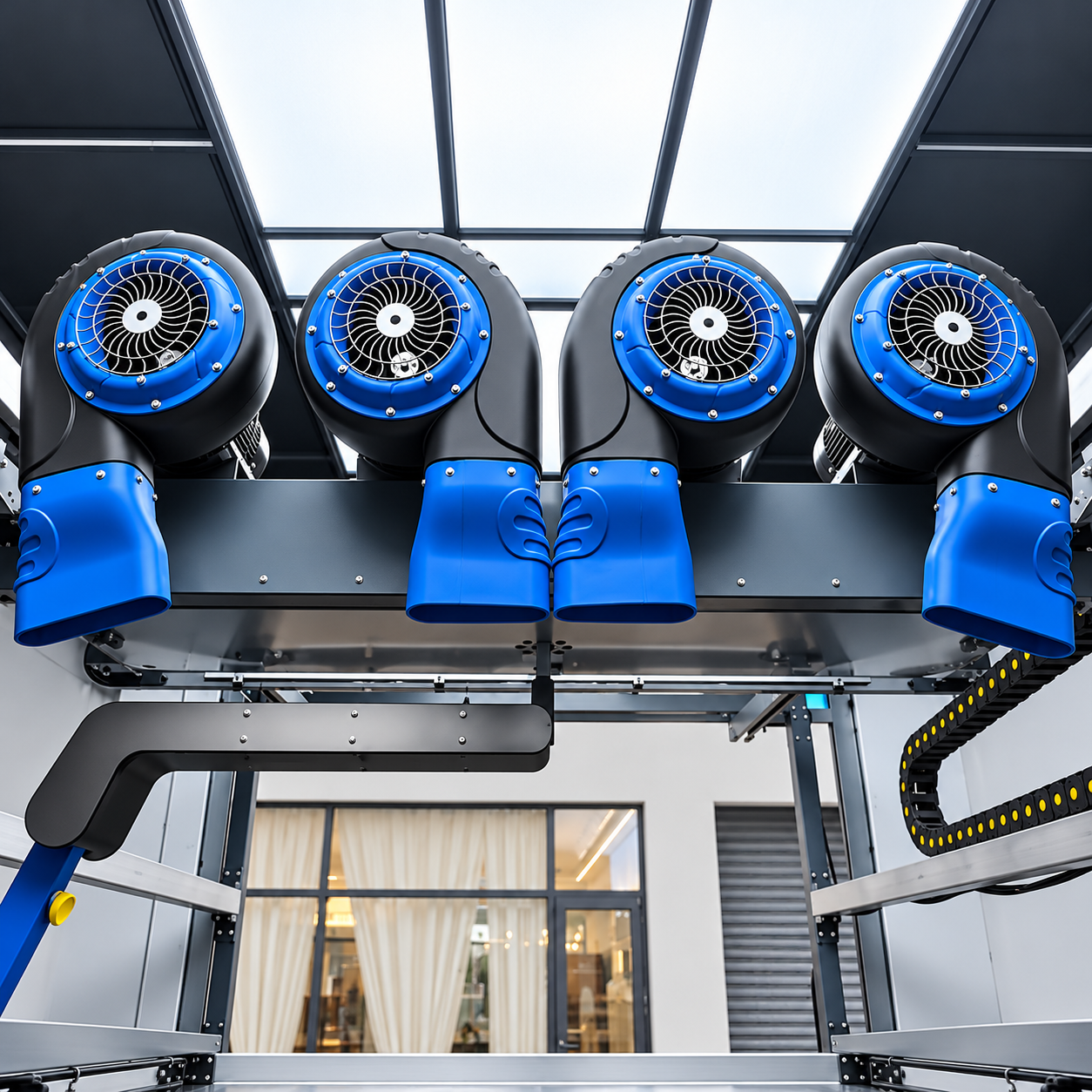
Drying blower
- Top air blowers
- Side air blowers
- Fixed or moving air outlets
- Air knives
- Electric motors
- Fans and impellers
- Air ducts
- Vehicle detection sensors
- Position controls
- A PLC or other control system
Some machines use fixed dryers. Others have moving dryer assemblies that follow the vehicle profile.
The equipment must direct enough useful airflow toward the surfaces being dried.
However, the result also depends on the water left after the final rinse.
A good dryer works as part of the complete washing system.
2. The Most Common Causes of Poor Car Wash Drying
Several issues can reduce drying performance.
The table below provides a useful starting point.
| Symptom | Possible Cause | First Check |
|---|---|---|
| Entire vehicle remains wet | Blower not operating correctly | Dryer status and fault messages |
| Roof remains wet | Weak or poorly directed top airflow | Top dryer configuration |
| Doors remain wet | Side airflow coverage issue | Side dryer operation |
| Mirrors hold water | Vehicle geometry and trapped droplets | Drying results across different vehicles |
| Drying is suddenly worse | New fault, damage, or changed settings | Maintenance and alarm history |
| Drying has always been weak | System design or cycle limitations | Original specifications |
| Water spots after drying | Rinse-water or chemical issue | Water treatment and final rinse |
| Dryer stops during operation | Electrical, drive, sensor, or control fault | Recorded fault codes |
These are possible explanations, not confirmed diagnoses.
Further investigation should follow the specific machine’s technical documentation.
3. Low Airflow From the Dryer Blower
Low airflow is an important possible cause of poor drying.
A blower must move enough air through the system to produce useful coverage at the vehicle.
However, several problems can reduce airflow.
For example, the blower may not reach its intended operating speed.
An air inlet may be obstructed.
The fan assembly or ducting may be damaged.
A control setting may also limit operation.
Therefore, a machine may appear to run normally while drying performance declines.
Operators should begin with visible operating information and fault messages.
Detailed airflow testing should be handled by qualified service personnel.
If the machine is under warranty, contact the supplier before making changes.
4. Why Blower Motor Condition Matters
The blower motor drives the fan.
Its condition can affect drying performance and equipment reliability.
Possible electrical and mechanical issues include abnormal motor operation, drive faults, overheating, or bearing problems.
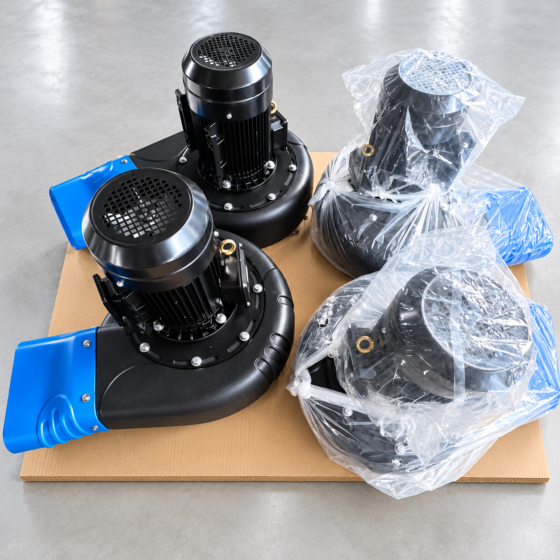
Drying blower
However, poor drying does not automatically mean the motor has failed.
The machine may have a healthy motor but poor air distribution.
Therefore, diagnosis should separate motor performance from duct and outlet performance.
A technician may need to review the electrical supply, motor data, controls, and operating condition.
The correct checks depend on the motor and drive design.
Operators should not open electrical cabinets or inspect energized components without proper training and authorization.
5. Blocked Dryer Air Inlets
Blowers need a clear air path.
If an inlet becomes restricted, airflow may decline.
Possible obstructions include accumulated debris, damaged covers, or material caught near the inlet.
However, many dryer designs use different air inlet arrangements.
Therefore, operators should consult the equipment manual.
A safe visual check may reveal an obvious obstruction from outside the guarded machinery area.
Do not reach into a blower housing or remove protective covers while the equipment is energized.
Any internal inspection must follow the applicable service and energy-isolation procedures.
Keeping the air path in good condition helps support stable drying performance.
6. Air Duct Damage and Leakage
Some automatic car wash dryers use ducting to direct airflow from the blower to the outlet.
The duct system may include bends, joints, and supporting structures.
Damage or leakage can reduce the airflow delivered to the intended location.
Likewise, internal restrictions may affect pressure losses.
A blower may therefore be operating correctly while the outlet performs poorly.
For this reason, a complete diagnosis should consider the air path.
Qualified technicians can inspect the relevant components according to the manufacturer’s instructions.
However, changes to duct dimensions or outlet geometry should not be made without engineering review.
The air delivery system is designed as a complete arrangement.
7. Incorrect Dryer Nozzle Position
Air outlet position is a major factor in vehicle drying.
Even strong airflow may perform poorly if it misses the wet surface.
For example, a top outlet that is too far from the roof may deliver less effective air at the target area.
An incorrectly directed side outlet may leave water on door panels.
Therefore, dryer positioning deserves careful attention.
However, there is no universal distance or angle that suits every automatic car wash.
The correct geometry depends on blower design, outlet shape, vehicle profile, and machine movement.
Buyers and operators should follow the manufacturer’s approved setup dimensions.
8. Understanding Dryer Air Knives
An air knife is a shaped outlet that directs airflow across a surface.
Its geometry influences how air leaves the system.
Depending on the design, an air knife may create a concentrated sheet or pattern of moving air.
This flow helps push water away from vehicle surfaces.
However, a narrower outlet is not automatically better.
The result depends on available airflow, pressure, distance, and surface coverage.
Therefore, the entire blower and outlet combination should be evaluated.
An air knife should not be modified based only on appearance or assumptions about velocity.
A suitable design balances water removal, energy use, noise, and vehicle clearance.
9. Top Dryer Problems: Why the Roof Stays Wet
The vehicle roof is often an important drying target.
If the roof remains wet, the top dryer may not be delivering suitable airflow.
Possible factors include insufficient air coverage, incorrect movement, or a drying program that does not provide enough effective exposure.
Vehicle roof height and shape also matter.
A low sedan and a tall SUV present different surfaces to the dryer.
In addition, roof rails and other permitted accessories may affect water movement.
Therefore, operators should compare results across different vehicle types.
A model-specific review can help determine whether the issue is caused by a fault or a system limitation.
10. Side Dryer Problems: Wet Doors and Windows

Drying blower
Side dryers help remove water from vertical vehicle surfaces.
These may include doors, windows, and side body panels.
However, airflow must reach the intended areas.
If one side of the vehicle remains wetter than the other, there may be a difference in dryer performance or positioning.
The problem may also relate to vehicle entry alignment.
Therefore, operators should record the location of remaining water.
Compare similar vehicles using the same drying program.
If a consistent pattern appears, ask the supplier or service technician to review the relevant side dryer assembly.
Avoid changing outlet positions without an approved adjustment procedure.
11. Why Mirrors and Rear Panels Are Hard to Dry
Mirrors and rear vehicle surfaces often include recesses and complex shapes.
Water may collect in narrow spaces.
Airflow may also be blocked by nearby body features.
As a result, a vehicle can be mostly dry while droplets remain near mirrors, trim, handles, or license plate areas.
This does not always indicate a faulty blower.
Instead, it may reflect the limits of air coverage for a particular vehicle design.
Operators should evaluate whether the machine meets its intended drying standard.
If customer expectations are higher, additional drying stages or approved program changes may be worth considering.
12. Vehicle Shape and Drying Performance
Different vehicle types require different airflow coverage.
A sedan typically has a different roofline and rear profile from an SUV.
A van may have a tall body and broad vertical surfaces.
Therefore, a dryer designed for one vehicle range may not perform equally well on all vehicle shapes.
This is why maximum vehicle dimensions are not the only compatibility requirement.
Buyers should also review the machine’s supported vehicle profiles and dryer configuration.
For example, some systems use moving top dryers to maintain a more suitable position relative to the roof.
However, that feature depends on the exact model.
13. How Contour-Following Dryers Work
Some commercial automatic washes use sensors and mechanical movement to position a dryer relative to the vehicle profile.
A suitable control system can help the outlet remain near the intended drying surface.
However, the dryer must also maintain safe clearance.
The design should account for vehicle dimensions, detection limits, and approved operating conditions.
Research into rollover drying systems has examined airflow performance and the role of outlet positioning.
This supports the broader principle that dryer geometry and vehicle contour matter.
Still, buyers should request model-specific design information.
Do not assume every moving top dryer uses the same sensors, positioning accuracy, or control method.
14. Drying Time May Be Too Short
A machine may provide reasonable airflow but still leave water behind.
One possible reason is insufficient drying time.
In a rollover car wash, the machine may move past the vehicle during a drying stage.
If the pass is too short or fast for the intended program, some surfaces may receive limited airflow exposure.
However, a longer drying cycle is not always the best solution.
It can reduce throughput and increase electricity consumption.
Therefore, operators should first confirm that the equipment is operating according to the approved wash program.
Any program changes should follow manufacturer guidance.
15. How Wash Cycle Settings Affect Drying
Commercial washing systems often provide different service programs.
These may include basic, standard, and premium packages.
However, the actual features vary by manufacturer.
Some programs may allocate different time or equipment functions to the drying stage.
Therefore, a customer using a short program may receive a different finish from one using a longer program.
Operators should verify whether the drying settings match the intended service package.
It is also useful to check whether recent software changes or parameter adjustments affected performance.
Any changes to motion, airflow, or protective limits should be handled only by authorized personnel.
16. Why the Final Rinse Affects Drying

Blower Drying System
Dryer performance is connected to the final rinse.
The rinse stage leaves water on the vehicle surface.
The dryer then removes much of that water.
However, the final result depends partly on how the water behaves.
Water may collect in recessed areas, form droplets, or spread across the surface.
Therefore, operators should evaluate the rinse and drying stages together.
For example, a problem that appears to involve the blower may actually be related to rinse coverage or water quality.
A complete wash-process review can prevent unnecessary equipment replacement.
17. Drying Agents and Rinse Aids
Some commercial wash programs use products designed to support water shedding.
These may be described as drying agents or rinse aids.
Their purpose and chemistry vary.
A suitable product can influence how water behaves on the vehicle surface.
However, poor chemical selection or incorrect dosing may reduce the expected benefit.
Operators should use only chemicals approved for the machine and intended wash process.
They should also follow the product’s safety and handling instructions.
Chemical changes should not be used to hide a mechanical fault.
A reliable approach checks both the dryer condition and the rinse chemistry.
18. Too Much or Too Little Drying Agent
Chemical dosage can affect operating cost and wash results.
However, more product does not always mean better performance.
An unsuitable dose may create unwanted residue or fail to provide the intended water-shedding effect.
Therefore, operators should follow the supplier’s dosing recommendations.
Dosing equipment may also require maintenance.
For example, pumps, tubing, and injection components can affect delivery.
The correct inspection process depends on the system design.
If chemical performance changes suddenly, operators should review the product, dilution settings, and dosing maintenance records.
Any chemical work must follow the appropriate safety procedures.
19. Water Spots vs. Poor Drying
Water spots and remaining water droplets are related, but they are not the same problem.
A vehicle may emerge nearly dry yet still show visible mineral marks.
In that case, the main issue may involve water quality rather than blower strength.
Hard water and dissolved minerals can leave residue when water evaporates.
Therefore, buyers should distinguish between:
Water remaining on the surface: a water removal issue.
Visible deposits after evaporation: potentially a water quality issue.
Both problems may occur together.
However, each needs a different troubleshooting approach.
Identifying the correct symptom can save time and maintenance expense.
20. How Reverse Osmosis Water Can Improve the Final Finish
Some commercial car washes use treated water for the final rinse.
Reverse osmosis, or RO, can reduce certain dissolved substances in water.
When properly designed and operated, this can help reduce mineral spotting.
However, RO treatment is not a substitute for a functioning dryer.
The vehicle may still leave with visible droplets.
Also, RO systems require their own maintenance and suitable water supply conditions.
Therefore, operators should evaluate the water treatment system and air drying system separately.
A complete finishing process may include appropriate water treatment, chemical control, and mechanical drying.
21. Why Humidity and Weather Matter
Environmental conditions can influence the final appearance of a washed vehicle.
High humidity may slow natural evaporation.
Cold weather may also change operating conditions.
However, commercial air dryers mainly remove water through airflow rather than relying only on evaporation.
Therefore, humidity alone should not be blamed for a major loss of blower performance.
If the machine suddenly leaves much more water than usual, investigate mechanical and control conditions first.
For outdoor sites, wind may affect how discharged water moves.
Buyers should consider local climate when evaluating the overall wash installation.
22. Cold-Weather Drying Problems
Cold-weather operation creates additional requirements.
In northern US states, Canada, and parts of Europe, outdoor wash sites may experience freezing conditions.
Water left on equipment or surfaces can create hazards.
Therefore, the wash should only operate within its approved temperature limits.
Cold-climate packages, freeze protection, and operating procedures vary by machine.
A stronger blower should not be assumed to solve every winter issue.
Site drainage, heating systems, and utility protection may also matter.
Buyers should ask the equipment supplier about cold-weather restrictions and available configurations.
23. How Fan Design Affects Drying
Not all air blowers produce the same operating characteristics.
Commercial dryer systems may use different fan and blower arrangements.
Their performance depends on the relationship between airflow and system resistance.
Therefore, buyers should look beyond motor power alone.
A machine with a larger motor does not automatically deliver better drying.
The fan must operate within a suitable range.
Duct losses and outlet design also matter.
For a technical comparison, buyers may request airflow data, pressure information, motor specifications, and the manufacturer’s operating conditions.
These should relate to the complete installed drying system.
24. Airflow vs. Air Velocity: What Is the Difference?
Airflow describes the amount of air moving through a system over time.
Air velocity describes how fast air moves at a particular location.
Both can affect dryer performance.
However, they are not interchangeable.
A high local air speed at a small outlet does not guarantee broad vehicle coverage.
Likewise, a large total airflow may perform poorly if it is not directed toward the wet surfaces.
Therefore, buyers should review air distribution and outlet geometry.
The useful measure is not simply the highest advertised air speed.
It is how effectively the system removes water under defined test conditions.
25. Static Pressure and Dryer Performance
Fan and blower systems operate against resistance.
Ducts, bends, outlet restrictions, and other components affect this resistance.
Static pressure is one of the values engineers may use when evaluating airflow systems.
However, an isolated static pressure number does not prove drying effectiveness.
The value needs to be considered alongside the fan operating curve and installed air system.
Therefore, buyers should request clear technical definitions.
A supplier should identify where a pressure figure is measured and under what operating conditions.
For major upgrades, airflow system changes may require an engineering assessment.
26. Why Higher Motor Power Does Not Always Mean Better Drying
Motor power can be useful when comparing dryers.
However, a larger kilowatt rating is not a complete performance measure.
A poorly directed dryer may waste energy.
Meanwhile, an efficient air delivery design may achieve suitable coverage with a different motor configuration.
Therefore, commercial buyers should compare drying results and electricity consumption together.
Ask suppliers to explain the configuration of the complete system.
If possible, request results from a representative vehicle test.
A balanced design should provide acceptable drying without unnecessary electrical consumption.
27. Car Wash Dryer Electrical Problems
Dryer performance may change because of electrical or drive faults.
For example, a blower may fail to start.
A drive may record a fault.
A motor may operate differently from its intended condition.
However, the specific reason cannot be confirmed from symptoms alone.
Operators should review the machine interface and maintenance records.
Qualified electrical personnel may need to inspect the equipment.
They should follow the manufacturer’s procedures and applicable electrical safety requirements.
Do not bypass overload devices, protective controls, or interlocks to restore operation.
A dryer should only return to normal service after the fault has been properly assessed.
28. Dryer Vibration and Unusual Noise
An abnormal sound may indicate a mechanical problem.
Possible causes include damaged components, unusual operating loads, or changes in the fan assembly.
However, noise does not identify a single failure.
Operators should stop using equipment that shows signs of an unsafe condition and arrange an appropriate inspection.
A damaged fan can present serious mechanical hazards.
Therefore, internal examination must be performed by trained personnel under suitable energy-control procedures.
The technician should review the relevant bearings, supports, impeller condition, and drive components according to the manufacturer’s instructions.
29. Dryer Sensors and Position Control
Some systems use sensors to monitor dryer position or vehicle presence.
These signals help coordinate machine movement.
However, not every dryer has contour tracking or automatic height adjustment.
Where these features are present, sensor problems may affect outlet positioning.
For example, the control system may report a positioning fault.
The exact response depends on the equipment design.
Operators should review displayed fault codes and service documentation.
Sensor calibration or replacement should be performed using approved procedures.
Protective limits must not be bypassed simply to move the dryer closer to the vehicle.
30. A Safe Step-by-Step Troubleshooting Process
When an automatic car wash begins drying poorly, follow a structured process.
Step 1: Identify the Symptom
Record where water remains.
Step 2: Check the Pattern
Determine whether the issue affects all vehicles or only selected vehicle types.
Step 3: Review the Wash Program
Confirm which drying stage was selected.
Step 4: Review Fault Messages
Check the operator interface and fault history.
Step 5: Compare Recent Performance
Identify whether the problem began after maintenance, parameter changes, or equipment work.
Step 6: Check Safe Visible Conditions
Look for obvious external damage or obstruction without entering hazardous areas.
Step 7: Arrange Qualified Service
Ask a technician to evaluate the relevant equipment.
This process helps narrow the problem without encouraging unsafe repairs.
31. How to Test Automatic Car Wash Drying Performance
A fair drying test needs consistent conditions.
Use representative vehicles that are permitted in the machine.
Select the same wash program.
Record the initial weather conditions and final rinse configuration.
Then inspect the vehicle after the drying stage.
Important areas may include:
- Roof
- Hood
- Windshield
- Side windows
- Doors
- Mirrors
- Rear window
- Rear hatch
- Lower panels
Photographs can help document results.
However, use the same inspection approach across tests.
Avoid comparing different machines under completely different conditions.
32. Building a Drying Performance Scorecard
A simple scorecard can help operators identify weak areas.
For example, each vehicle area may receive a rating:
| Rating | Description |
|---|---|
| 5 | Mostly dry, with only minor remaining droplets |
| 4 | Small amount of remaining water |
| 3 | Moderate visible water |
| 2 | Large wet areas |
| 1 | Poor drying across the evaluated area |
These ratings are illustrative.
They are not an official industry standard.
However, a consistent internal method can help track changes.
Compare the same vehicle types and wash settings whenever possible.
If scores become worse over time, the maintenance team can investigate the cause.
33. How Often Should Dryer Components Be Inspected?
Inspection frequency depends on the machine design, usage, environment, and manufacturer requirements.
A busy wash may need a different maintenance plan from a low-volume site.
Therefore, follow the approved maintenance schedule.
Regular checks may cover visible equipment condition, fault messages, dryer movement, blower performance, and unusual noise.
More detailed service may involve motor systems, bearings, ducts, and outlet assemblies.
However, these tasks can involve hazardous electrical and mechanical energy.
Only appropriately trained personnel should perform work that requires access to internal components.
34. Preventive Maintenance Checklist for Car Wash Dryers
| Component | Maintenance Focus |
|---|---|
| Blower assembly | Operating condition and abnormal noise |
| Motor | Fault history and approved service checks |
| Air inlet | Obstructions and physical damage |
| Ducts | Damage, leakage, and secure connections |
| Air outlets | Condition and approved alignment |
| Dryer movement system | Correct operation and clearance |
| Sensors | Fault indications and approved testing |
| Control system | Alarms, settings, and documentation |
| Drying chemicals | Product compatibility and dosing |
| Final rinse system | Water quality and rinse performance |
Maintenance must follow the manufacturer’s instructions.
The checklist is a planning aid, not a replacement for technical service documentation.
35. When Should You Replace a Blower?
A blower should not be replaced simply because customers report wet cars.
First, determine whether the installed equipment is functioning as designed.
For example, poor outlet alignment may create weak drying even with a healthy blower.
Likewise, a rinse-quality problem may produce water spots that appear to be a drying fault.
A blower replacement may be appropriate when qualified diagnosis confirms a component failure or when a documented performance upgrade is required.
The replacement must be compatible with the machine.
Buyers should review airflow requirements, motor specifications, mounting, controls, and safety documentation.
36. When Should You Upgrade the Entire Drying System?
Sometimes the existing dryer is working correctly but cannot meet the business’s service goals.
For example, customers may expect a drier finish than the original system can consistently provide.
In this situation, a properly engineered upgrade may be worth reviewing.
Possible project options include:
- Approved blower replacement
- Revised air delivery components
- Additional drying stages
- Compatible contour-following features
- Rinse-process improvements
- Control-system upgrades
However, these options are not suitable for every machine.
An upgrade should be approved by the manufacturer or qualified engineering provider.
The project must also account for structural, electrical, acoustic, and safety requirements.
37. Evaluating the Cost of a Dryer Upgrade
A commercial dryer upgrade involves more than the equipment purchase price.
The total installed cost may include blower units, controls, mounting structures, wiring, commissioning, freight, and labor.
A project may also require changes to the machine’s power supply or control system.
Therefore, compare complete proposals.
Ask each supplier to identify included and excluded work.
Review expected energy use and routine service costs.
Also, consider whether the upgrade can be completed within the site’s available shutdown period.
The best option should balance performance improvement with long-term operating value.
38. Calculating Electricity Cost per Drying Cycle
Drying equipment can use significant electrical power during operation.
However, actual energy consumption depends on motor load and running time.
Consider a simplified hypothetical example.
Suppose a dryer draws an average of 12 kW while operating for 90 seconds.
The modeled energy use is:
12 × (90 ÷ 3,600) = 0.30 kWh
If electricity costs $0.18 per kWh:
0.30 × $0.18 = $0.054 per drying cycle
This example is illustrative.
Actual dryer power may vary during operation.
The figure also excludes other washing equipment and demand-related charges.
Therefore, buyers should use measured energy data for real investment decisions.
39. Why a Longer Drying Cycle Has a Cost
Increasing drying time may improve water removal for some systems.
However, a longer cycle can also affect machine capacity.
Consider a hypothetical single-bay wash.
Suppose the original complete service time is six minutes.
Its ideal theoretical rate would be:
60 ÷ 6 = 10 vehicles per hour
If an additional minute increases complete service time to seven minutes:
60 ÷ 7 ≈ 8.6 vehicles per hour
Actual throughput will also depend on vehicle entry, exit, payment, and operating delays.
Therefore, operators should evaluate the trade-off between drying quality and wash capacity.
40. How Poor Drying Affects Customer Satisfaction
Customers judge the final appearance of their vehicles.
Therefore, drying quality can influence satisfaction even when the cleaning stage works well.
Visible water may create complaints or requests for additional service.
However, customer expectations vary by wash package and price.
Some customers expect a near-dry finish.
Others may accept small droplets around difficult vehicle features.
Operators should communicate realistic service standards.
They should also collect feedback and compare it with actual machine performance.
A consistent finish can support customer confidence and repeat visits.
41. Drying Performance for Gas Station Car Washes
Gas station car washes often operate within limited space.
Many use rollover systems installed beside existing fuel retail facilities.
For these businesses, drying performance must be balanced with service time.
A longer drying stage may create queues during busy periods.
Likewise, a poor finish may reduce customer satisfaction.
Therefore, gas station owners should evaluate dryer coverage, cycle settings, and customer demand.
The equipment should fit the property’s utility and noise requirements.
Buyers should also review maintenance access and spare-parts support.
An effective dryer can be an important part of the overall customer experience.
42. Drying Performance for Convenience Stores
Convenience store operators often use automatic washing as an additional service.
Therefore, the machine should work reliably without creating excessive operating demands.
Customers may expect a quick, simple process.
Drying performance should be consistent with the advertised wash package.
However, the equipment must also fit the available site dimensions.
Buyers should compare compact blower arrangements, supported vehicle sizes, and approved installation conditions.
Service access is important because a dryer fault may require specialist maintenance.
A reliable support arrangement can help reduce disruption.
43. Drying Performance for Tunnel Car Washes
Tunnel systems may have several drying positions or stages.
Vehicle movement and spacing influence the available drying time.
Therefore, the dryer design must fit the tunnel’s operating layout.
A system that produces strong airflow may still perform poorly if the outlets do not cover the vehicle effectively.
Likewise, drying quality may decline when equipment is damaged or operated outside approved settings.
Tunnel owners should review vehicle profiles, airflow distribution, electricity use, and maintenance access.
The best solution is one that supports the desired finish and site throughput.
44. Car Wash Dryer Noise and Local Site Requirements
Dryer blowers can create significant noise.
The impact depends on equipment design, installation location, building layout, and operating conditions.
For sites near homes or offices, noise may affect project planning.
Therefore, buyers should request acoustic information where relevant.
However, sound levels should be compared under consistent test conditions.
An isolated decibel figure without measurement details may be misleading.
Local requirements also vary.
Manufacturers and site designers should work together to assess the installation.
Drying performance, energy use, and noise should be considered together.
45. US and Canadian Buyer Considerations
Buyers in the United States and Canada should review site electrical conditions, local installation requirements, equipment documentation, and service support.
For imported automatic car wash machines, the installed electrical system must match the site’s approved design.
Local professionals should confirm relevant compliance requirements.
Cold-weather protection may also be important.
For servicing, hazardous-energy controls must be addressed.
In the United States, OSHA’s lockout/tagout requirements apply to covered servicing and maintenance work involving hazardous unexpected energization.
Buyers should request clear maintenance documentation and training information.
46. UK and EU Buyer Considerations
UK and EU buyers should review electrical compatibility, applicable machinery requirements, environmental conditions, and local installation responsibilities.
The supplier should provide relevant technical documentation.
Buyers should confirm conformity requirements for the specific market and installation date.
For EU projects, Regulation (EU) 2023/1230 generally becomes applicable on 20 January 2027, subject to its specific provisions.
UK requirements should be checked separately.
Noise, drainage, and site layout may also require local review.
A dryer quotation should not be treated as complete until installation and compliance responsibilities are clear.
47. Commercial Car Wash Dryer Buying Checklist
Before buying a new automatic car wash machine or dryer upgrade, request the following information.
Drying Performance
- Dryer type and arrangement
- Supported vehicle dimensions
- Airflow information
- Outlet configuration
- Drying program duration
- Test conditions
- Expected drying results and limitations
Technical Specifications
- Motor power and electrical supply
- Blower and fan specifications
- Dryer positioning method
- Control-system requirements
- Protective functions
- Machine dimensions
- Noise information, where available
Commercial Requirements
- Installed equipment price
- Maintenance schedule
- Warranty terms
- Spare-parts availability
- Technical support
- Commissioning responsibilities
- Upgrade compatibility
This information supports a more reliable comparison than advertising claims alone.
48. Questions to Ask an Automatic Car Wash Manufacturer
A qualified supplier should be able to explain the proposed dryer system.
Useful questions include:
- What type of blower does the machine use?
- How many drying outlets are included?
- How is airflow distributed around the vehicle?
- Does the top dryer move to follow vehicle contours?
- Which vehicle types have been tested?
- What electrical supply is required?
- What is the measured energy use?
- What maintenance does the dryer require?
- How are blower faults detected?
- Which spare parts are available?
- What support is provided after installation?
- Can the drying system be upgraded later?
Clear answers help buyers assess both performance and long-term reliability.
49. Frequently Asked Questions About Automatic Car Wash Drying Problems
Why does my automatic car wash leave water on the car?
Possible reasons include weak airflow, poor air coverage, insufficient drying time, vehicle geometry, rinse-water issues, or equipment faults.
Why is my car wash blower running but not drying?
The blower may be operating while the air delivery system performs poorly. Outlet positioning, duct condition, and actual airflow should be evaluated.
Can a weak blower motor cause poor drying?
Yes, motor or drive problems can affect drying. However, the cause should be confirmed through qualified diagnosis.
Why is the roof still wet after an automatic wash?
Top dryer position, airflow coverage, vehicle height, and drying time may affect the result.
Why do mirrors stay wet after a car wash?
Mirrors and nearby trim create recessed areas that can retain water and limit direct airflow.
Does more blower power improve car drying?
Not always. Air distribution, outlet geometry, and operating conditions are also important.
Can drying chemicals improve car wash results?
Suitable drying agents may improve water shedding, but results depend on the product, dosing, and wash process.
Does reverse osmosis water make a car dry faster?
RO water can help reduce mineral spotting, but it does not replace mechanical drying.
Why does my automatic car wash leave water spots?
Dissolved minerals, rinse quality, and chemical performance may contribute to visible deposits.
Should I increase the drying cycle time?
Only after reviewing the equipment condition and approved settings. Longer cycles may reduce hourly capacity.
How do I test my car wash drying system?
Use consistent vehicles, wash programs, and inspection criteria. Record remaining water by vehicle area.
How often should car wash blowers be serviced?
Follow the manufacturer’s model-specific schedule and adjust planning according to operating conditions.
Can I replace my automatic car wash blower with a larger one?
Not without a compatibility and engineering review. Larger equipment may change electrical loads, airflow behavior, and mechanical requirements.
Is a moving dryer better than a fixed dryer?
A moving dryer may improve positioning for some vehicle profiles, but results depend on the complete design and operating conditions.
When should I upgrade my commercial car wash dryer?
Consider an upgrade when the existing equipment is operating correctly but cannot meet the site’s verified performance and business requirements.
50. Conclusion: Better Car Wash Drying Starts With the Right Diagnosis
If your automatic car wash machine is not drying properly, do not assume the blower needs immediate replacement.
Drying performance depends on the complete washing process.
Airflow, outlet position, drying time, vehicle shape, rinse quality, and equipment condition all matter.
First, identify where water remains.
Next, review the operating program and fault history.
Then, arrange qualified inspection of the relevant mechanical, electrical, and control components.
If the machine is functioning correctly but still cannot meet customer expectations, evaluate an approved dryer upgrade.
For commercial operators, the best drying system balances water removal, electricity use, wash capacity, maintenance needs, and customer experience.
A reliable automatic car wash dryer is not simply the system with the largest motor. It is the system that delivers suitable airflow to the right areas, operates consistently, and supports the business’s real performance goals.
Request Commercial Automatic Car Wash Dryer Specifications
Are you planning to replace, upgrade, or purchase an automatic car wash machine?
A qualified manufacturer can help you compare compatible dryer configurations and technical requirements.
To request an equipment recommendation, provide:
- Country and installation location
- Existing machine type
- Available installation dimensions
- Intended vehicle categories
- Expected daily wash volume
- Current drying problem
- Electrical supply information
- Preferred drying performance
- Maintenance requirements
- Project budget
Ask for model-specific blower data, dryer layout drawings, electrical requirements, installation details, maintenance schedules, and a written quotation.
Request Dryer Specifications | Compare Commercial Car Wash Systems | Get an Equipment Quote
References and Further Reading
Design of a Drying System for a Rollover Carwash Machine Using CFD — Journal of Computational Design and Engineering
https://academic.oup.com/jcde/article/3/4/398/5743543
OSHA — Control of Hazardous Energy (Lockout/Tagout)
https://www.osha.gov/control-hazardous-energy
European Union — Regulation (EU) 2023/1230 on Machinery
https://eur-lex.europa.eu/eli/reg/2023/1230/oj
Google Search Central — Creating Helpful, Reliable, People-First Content
https://developers.google.com/search/docs/fundamentals/creating-helpful-content
Disclaimer: This article provides general equipment troubleshooting and purchasing information. It does not diagnose a specific machine. Dryer specifications, service procedures, safety functions, and performance limits vary by model. Electrical work, blower repairs, and internal adjustments should be carried out by qualified personnel using applicable safety and energy-control procedures. Example calculations are hypothetical and do not represent measured performance or guaranteed savings.