 나는 ~할 생각이다 | 완전 자동 세차 기계 제조업체
What Makes a Car Wash Machine Suitable for Commercial Truck Stops?
What Makes a Car Wash Machine Suitable for Commercial Truck Stops?
2026 B2B Buying Guide: Heavy-Duty Truck Wash Equipment, Vehicle Clearance, Fleet Washing Capacity, Water Recycling, Site Planning, and Return on Investment
Introduction: What Should Truck Stop Operators Look for in a Car Wash Machine?
A commercial truck stop car wash machine should be designed for the size, shape, cleaning needs, and daily use of heavy commercial vehicles.
Unlike a standard passenger car wash, a heavy-duty truck wash may need to clean tractor units, box trucks, semi-trailers, buses, 배달 차량, and other fleet equipment.
These vehicles can differ greatly in length, height, width, ground clearance, and exterior attachments.
결과적으로, choosing the right washing system involves more than purchasing a larger version of an ordinary automatic car wash.
Truck stop operators must review vehicle clearance, cleaning technology, equipment durability, water pressure, chemical use, wastewater collection, and the available site layout.
게다가, commercial vehicle washing is often linked to fleet operations. Drivers may have limited time, and operators may need to clean many vehicles during busy periods.
A suitable truck wash should support efficient service without compromising vehicle compatibility or safe operation.
This guide explains the main features buyers should compare when selecting automatic truck washing equipment.
It also covers site planning, equipment costs, 운영 비용, maintenance, and important considerations for North American and European buyers.
The goal is to help truck stop owners and commercial fleet operators choose equipment that fits their real business needs.
1. What Is a Commercial Truck Stop Car Wash Machine?
A commercial truck stop car wash machine is washing equipment intended for use at a truck stop or similar commercial vehicle service location.
하지만, not every machine installed at a truck stop is suitable for heavy-duty trucks.
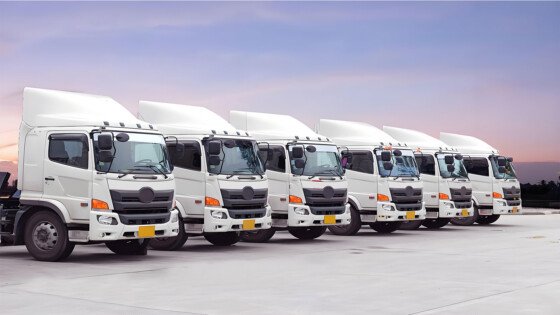
Transportation-Company-Car-Wash
Some truck stops offer only passenger vehicle washing.
Others operate dedicated commercial truck washing facilities.
Heavy-Duty Truck Washing
These systems may be designed for tractor units, trailers, and other large vehicles.
Commercial Fleet Washing
Fleet systems may serve delivery vans, buses, trucks, or specialist vehicles.
Truck Stop Applications
Equipment must fit the available space, expected demand, and local service model.
Automatic Operation
Some truck wash systems automate movement, water spraying, brush operation, or cleaning sequences.
Manual Assistance
Certain facilities combine automated washing with manual preparation or detail cleaning.
For buyers, the first step is to define which vehicles the machine must wash.
A clear vehicle specification is more valuable than a general “heavy-duty” label.
2. Why Ordinary Car Wash Machines May Not Suit Trucks
Passenger car wash machines are usually designed around smaller vehicles.
결과적으로, their structures, spray equipment, and operating clearances may not support large commercial vehicles.
Vehicle Height
Truck cabs and trailer roofs may exceed passenger car wash limits.
Vehicle Width
Large mirrors, steps, and exterior accessories can require additional clearance.
Vehicle Length
A semi-trailer combination may need a much longer wash area.
Cleaning Requirements
Commercial trucks often collect heavy road dirt, insects, grease, salt, and industrial contamination.
Equipment Loads
The cleaning system may operate for long periods at commercial sites.
Different Shapes
A box trailer has a very different exterior profile from a passenger car.
그러므로, buyers should not assume a standard rollover car wash can safely clean heavy trucks.
The manufacturer must confirm vehicle compatibility through specific drawings and technical documentation.
3. Vehicle Height and Width Requirements
Vehicle clearance is one of the most important factors in selecting truck stop washing equipment.
Buyers should establish the complete dimensions of the intended vehicle range.
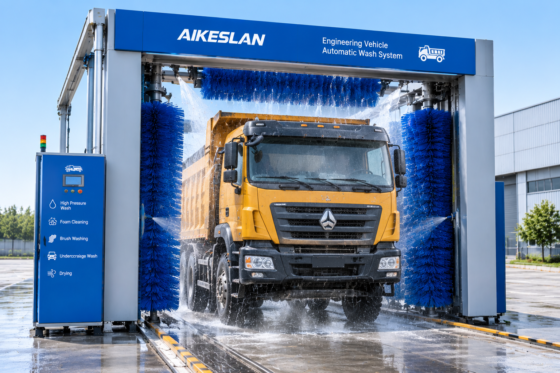
Automatic Car Wash for Construction Vehicles
Truck Height
Consider the highest vehicles expected at the site.
Trailer Height
Trailers may have different roof profiles and heights.
Vehicle Width
Body width alone may not include mirrors and external components.
Exterior Accessories
Antennas, exhaust components, roof equipment, and other attachments can affect clearance.
Machine Working Space
The equipment also needs room to move and operate.
Maintenance Clearance
Technicians require safe access around the installed system.
US and European road vehicle dimension rules provide useful context, but they do not determine the exact dimensions required for every truck wash.
The manufacturer should provide a model-specific maximum vehicle envelope and required machine clearances.
4. Understanding Truck Length and Wash Bay Design
Length matters as much as height.
A washing system suitable for a rigid truck may not accommodate a tractor-trailer combination.
Rigid Trucks
These vehicles have a fixed body attached to the vehicle structure.
Tractor-Trailer Combinations
The tractor and trailer form a longer articulated vehicle.
Buses and Coaches
These vehicles may have long bodies and distinctive roof equipment.
Oversized Vehicles
Some specialist vehicles may exceed normal road dimensions.
Entry and Exit Space
Drivers need enough room to approach and leave the washing area.
Wash Equipment Travel
Certain machines move along the vehicle, requiring additional operating distance.
구매하기 전에, buyers should share the longest expected vehicle dimensions with the manufacturer.
The complete vehicle movement path should be reviewed, not only the machine footprint.
5. Choosing the Right Truck Wash System Type
Several washing technologies may be suitable for commercial truck applications.
하지만, each system has different requirements.
| Truck Wash System | Typical Application | Main Consideration |
|---|---|---|
| Drive-through automatic truck wash | Sites with suitable vehicle flow | Equipment length and throughput |
| Truck gantry or rollover system | Stationary vehicles or controlled-position washing | Vehicle clearance and machine travel |
| Brush-based truck wash | Suitable regular fleet vehicles | Brush compatibility and cleaning maintenance |
| Touchless truck wash | Applications requiring non-contact cleaning | Chemical process, spray coverage, and pressure |
| Hybrid truck wash | Combined cleaning methods | System complexity and maintenance |
| Manual-assisted wash | Vehicles requiring extra detail cleaning | Labor and service time |
No single technology is best for every truck stop.
The selection depends on vehicle types, contamination levels, site conditions, and business goals.
6. Drive-Through Truck Washing Equipment
A drive-through truck wash allows vehicles to pass through a defined washing area.
Depending on the design, cleaning equipment may be fixed, moving, or arranged in stages.
Traffic Flow
Vehicles need a clear and suitable travel path.
Washing Stations
The system may include pre-soak, washing, 헹구기, and finishing stages.
Vehicle Position
Some designs require controlled vehicle speed or positioning.
Driver Instructions
Clear signs and operating procedures are essential.
Equipment Clearance
The entire vehicle must fit safely through the installed structure.
Throughput
Capacity depends on the cleaning process and vehicle movement.
A drive-through system can be attractive for sites expecting steady commercial vehicle traffic.
하지만, the actual operating rate should be verified through manufacturer data and site planning.
7. Gantry and Rollover Truck Wash Machines
A gantry truck wash uses a machine structure that moves relative to a stationary vehicle.
This approach can be suitable for certain commercial applications.
Controlled Positioning
The driver places the truck in an approved washing position.
Machine Movement
The equipment travels along or around the vehicle according to its design.
Cleaning Functions
Some models include brushes, spray systems, or combined cleaning methods.
Installation Length
The machine may need sufficient track or travel space.
Vehicle Compatibility
Cab shape, trailer size, and exterior attachments must be considered.
Maintenance
Motors, guides, 센서, and drive systems require regular service.
Buyers should request drawings showing the full operating envelope.
A gantry advertised as suitable for trucks still needs to be checked against the actual vehicle fleet.
8. Touchless vs. Brush-Based Truck Washing
Touchless and brush-based systems use different cleaning methods.
Their suitability depends on the vehicle type and the kind of dirt being removed.
Touchless Truck Washing
Touchless equipment relies on water pressure, spray coverage, and cleaning chemicals.
It avoids direct contact brushes.
하지만, heavy contamination may require a suitable chemical process or additional cleaning.
Brush-Based Truck Washing
Brush systems use physical contact to help remove dirt.
The cleaning materials must be maintained and used only on compatible vehicles.
Surface Compatibility
Truck wraps, decals, accessories, and special finishes may have washing restrictions.
Maintenance
Touchless systems require careful nozzle and pump maintenance.
Brush systems also require regular inspection of cleaning media.
Buyers should compare actual wash results, chemical use, operating costs, and vehicle limitations.
9. Heavy-Duty Construction and Equipment Durability
Commercial truck washing equipment may operate in demanding environments.
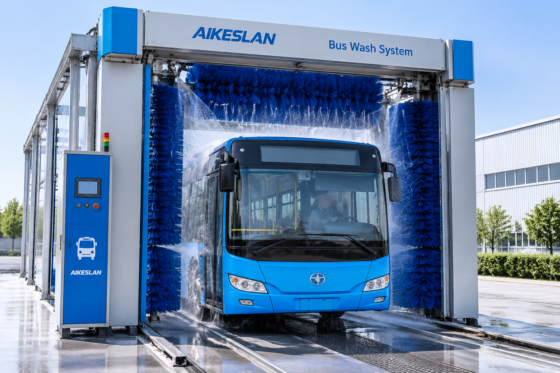
Bus Automatic Car Wash
결과적으로, structural design and component durability are important.
Main Structure
The equipment should support the intended mechanical loads.
Corrosion Protection
Moisture, cleaning chemicals, and road salt can create corrosive conditions.
Motors and Drives
Selected components should match the required duty cycle.
Bearings and Moving Parts
These components need suitable protection and maintenance access.
Fasteners
The design should use appropriate materials and fastening arrangements.
Serviceability
Common maintenance tasks should be practical to complete.
A professional supplier should provide material specifications and explain its maintenance requirements.
Buyers should not accept unsupported claims of permanent or maintenance-free operation.
10. Water Pressure and Pump Performance
A truck wash may need to remove dirt from large surface areas.
하지만, high maximum pressure does not guarantee effective cleaning.
Pump Operating Pressure
The pump must work within its approved range.
Water Flow
Large vehicles may require significant water delivery.
Spray Coverage
Nozzle placement should match vehicle surfaces.
Pressure Stability
The system should maintain suitable operating conditions during its cleaning stages.
Inlet Supply
The water source must provide the required flow.
Pump Maintenance
Filters, 밸브, 물개, and other components may require servicing.
Buyers should request pump specifications, water demand, and actual cleaning-system performance information.
The correct balance between pressure, flow, chemicals, and spray geometry matters more than a single PSI rating.
11. Cleaning Large Truck Surfaces
A commercial truck wash must account for the full exterior of the intended vehicles.
Large flat trailer sides can be different from curved tractor cab surfaces.
Cab Front
Insects and road contamination often collect on forward-facing surfaces.
Side Panels
Truck bodies and trailers may contain broad cleaning areas.
Roof Areas
Roof access and wash clearance require careful design.
Lower Body
Road spray can leave dirt around the lower vehicle.
Rear Doors
Trailer doors may have hinges, latches, and other protruding parts.
Wheel Areas
Mud, grease, and road film can collect around wheels and lower panels.
The manufacturer should explain which areas its equipment cleans automatically and which require additional attention.
12. Wheel, Chassis, and Underbody Cleaning
Some commercial operators need more than exterior body washing.
They may want to clean wheels, wheel arches, chassis surfaces, or underbody areas.
Road Contamination
Commercial vehicles may accumulate road salt, mud, and debris.
Wheel Cleaning
Dedicated spray systems may improve coverage around the wheels.
Underbody Washing
Some equipment offers additional underbody spray arrangements.
Vehicle Structure
Underside geometry differs between vehicle types.
Pressure Control
The washing process must respect sensitive components.
옵션 장비
Underbody and wheel washing may be optional rather than standard.
These requirements should be specified in the quotation.
Not every truck wash can safely or effectively clean every part of a commercial vehicle’s underside.
13. Truck Wash Sensors and Vehicle Detection
Sensors support the intended washing sequence.
하지만, vehicle detection can be more complex when washing large trucks.
Vehicle Presence
Sensors may identify when a vehicle enters the wash area.
Positioning
The system may use detection signals to guide vehicle placement.
Machine Travel
Position sensors can help monitor moving equipment.
Height Detection
Some systems support selected vehicle-size adjustments.
Fault Recognition
The controller may identify certain abnormal conditions.
Sensor Maintenance
Water, foam, dirt, and vibration can affect sensor operation.
Commercial truck wash buyers should ask about the system’s supported vehicle dimensions and fault-handling functions.
Sensor technology does not guarantee that every unusual attachment will be detected.
14. Safety Requirements for Commercial Truck Stops
Truck wash facilities must manage both machinery hazards and vehicle movement.
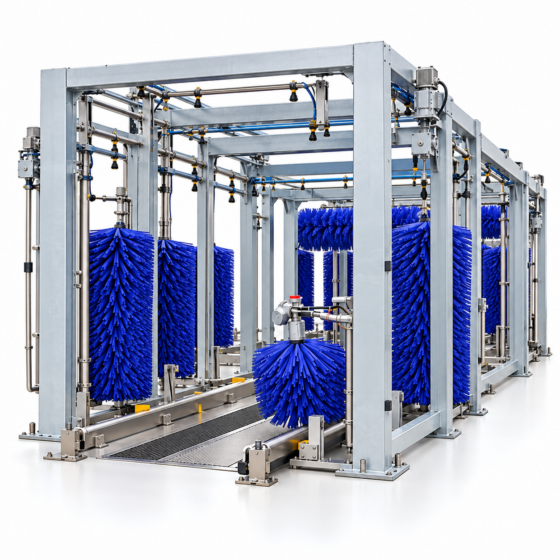
Tunnel Car Wash Machine
A suitable system should have a documented safety approach.
Driver Instructions
Signs should explain entry, stopping, and movement procedures.
Vehicle Clearance
The site should prevent unsuitable vehicles from entering the wash.
Emergency Stops
Relevant emergency-stop arrangements must match the equipment design.
Moving Machinery
Guards and other protective measures may be required.
Safe Maintenance
Servicing must follow suitable hazardous-energy isolation procedures.
Pedestrian Separation
Drivers and staff should avoid unsafe access to operating machinery.
Site Risk Assessment
Local professionals should review the complete installation.
The equipment manufacturer should provide applicable safety documentation and operating restrictions.
15. Water Supply Requirements for Truck Washing
Heavy commercial vehicle washing can create substantial water demand.
하지만, there is no single water-flow requirement for every truck wash.
Water Source
The site may use municipal water or another approved supply.
Available Flow
The water system must meet the equipment’s operating requirements.
Pressure
The incoming pressure must remain within the intended range.
Pipe Size
Existing lines may need upgrading.
Storage
Some sites may benefit from suitable water storage.
Water Quality
Sediment and hardness can affect cleaning equipment.
Site Testing
The water supply should be checked under operating conditions.
A manufacturer should provide model-specific utility requirements before the buyer commits to construction.
16. Wastewater Collection and Environmental Control
Truck washing can remove road dirt, oil, grease, cleaning chemicals, and other contaminants.
그러므로, wastewater management is an important part of facility design.
Wash Bay Drainage
The surface should direct wash water to the intended collection system.
Sediment Collection
Grit and heavy solids may require separation.
Oil and Grease
Appropriate pretreatment may be needed.
Chemical Residue
Cleaning products affect wastewater characteristics.
Approved Discharge
The facility must follow relevant local discharge requirements.
Stormwater Protection
Wash water should not be directed into storm drains without the required approval.
The US EPA identifies truck stops among the locations where vehicle washing can create water pollution risks.
그러므로, drainage and treatment should be addressed before equipment installation.
17. Water Reclamation for High-Volume Truck Washes
A water reclamation system collects and treats wash water for suitable reuse.
This may help reduce fresh-water demand.
하지만, the potential benefit depends on treatment needs and the wash process.
Reclaim Collection
Used water must be collected appropriately.
Sediment Removal
Grit and suspended material may need separation.
Oil Management
Oil and grease can affect water treatment.
Filtration
Additional processes may be needed for specific reuse stages.
Storage
Reclaimed water needs suitable tanks.
Reuse Selection
Not every wash stage should use water of the same quality.
EPA guidance explains that the level of treatment depends on the intended reuse application.
Buyers should calculate project-specific savings rather than assume universal water-reduction percentages.
18. Chemical Systems for Heavy-Duty Truck Cleaning
Large trucks can carry stubborn road film and industrial dirt.
Cleaning chemistry is therefore an important part of the wash design.
Pre-Soak
Suitable chemicals may help loosen contamination.
Detergent Delivery
Automatic dosing equipment can deliver products according to the approved program.
Surface Compatibility
Chemicals must be suitable for vehicle finishes and materials.
Dwell Time
Products need appropriate contact time.
Rinsing
The system must remove chemical residue as intended.
Operator Safety
Storage and handling must follow relevant product instructions.
Buyers should ask whether chemical dosing equipment and consumables are included in the package.
19. Drying Systems and Their Practical Value
Drying equipment is common in passenger car washes, but truck washing has different needs.
Large Surface Area
A truck or trailer has more exterior area than a passenger vehicle.
Blower Capacity
A drying system must be designed for the intended vehicle.
Airflow Distribution
Outlet placement affects drying coverage.
Energy Use
Large blower systems can increase electricity demand.
Business Model
Some truck wash customers may not require the same finish as retail passenger car wash customers.
옵션 장비
Drying may be included, optional, or unnecessary for a specific project.
그러므로, buyers should assess whether the added capital and operating costs justify the service benefit.
20. Wash Cycle Time and Vehicle Throughput
Capacity is a key concern for commercial truck stop operators.
하지만, buyers should distinguish theoretical machine capacity from real site throughput.
Vehicle Length
Longer vehicles may need more time or equipment travel.
Wash Program
Heavy cleaning may take longer than a basic rinse.
Entry and Exit
Drivers need time to position and move their vehicles.
Payment Process
Payment can affect the total customer service time.
Manual Work
Extra brushing or detail cleaning adds labor time.
Peak Demand
Throughput matters most when customers arrive close together.
Ask the supplier to explain the conditions behind its published cycle-time data.
The number of trucks served per hour should be calculated from the complete operating process.
21. Planning Entry, Exit, and Turning Space
A truck stop requires more circulation space than a typical passenger car wash.
Approach Lane
Drivers need a clear route to the wash entrance.
Turning Area
The available turning radius must suit the intended vehicle combinations.
Queue Space
Waiting trucks should not block fueling areas or internal roads.
Wash Bay Entry
The approach should support safe alignment.
Exit Route
Vehicles need room to leave without difficult reversing movements.
Pedestrian Areas
Driver and employee paths should remain separated from moving trucks where practical.
Site Survey
A qualified designer should review vehicle swept paths.
A large wash machine is not useful if trucks cannot reach it safely.
22. Site Layout for Truck Stops With Fueling Areas
Commercial truck stops often combine fueling, parking, food services, and maintenance facilities.
The wash should fit this larger operation.
Fuel Pump Access
Wash queues should not interfere with fuel lanes.
Parking Access
Trucks entering the wash should not block overnight parking areas.
Service Roads
Approach and exit routes must remain clear.
Customer Signs
Drivers need easy-to-read directions.
Operating Hours
Wash availability should suit the site’s customer demand.
Utility Location
Pumps, tanks, controls, and treatment equipment need accessible spaces.
Expansion
The layout may need to support future fleet or wash capacity growth.
Planning the entire site can reduce avoidable conflicts between washing and other truck stop services.
23. Commercial Truck Wash Equipment for Fleet Operators
Fleet washing creates a different business model from retail truck stop washing.
A fleet operator may clean the same group of vehicles on a regular schedule.
Predictable Vehicles
The operator may know the typical dimensions and configurations.
Regular Wash Frequency
Washing may be scheduled weekly or at another business-defined interval.
Maintenance Records
Equipment and wash records can support fleet planning.
Consistent Cleaning
A standard wash process may reduce variation between vehicles.
Labor Planning
Automation may reduce some manual cleaning tasks.
Site Use
The wash may operate during planned vehicle return periods.
Cost Control
The operator should measure cleaning cost per vehicle.
A fleet-specific system should match the actual vehicle population rather than a broad market category.
24. How to Select Equipment for Different Truck Types
A suitable truck wash must match the vehicles it serves.
| Vehicle Type | Key Washing Considerations |
|---|---|
| Tractor unit | Cab height, mirrors, exterior attachments |
| Semi-trailer | Length, roof clearance, side panels |
| Box truck | Body height and rear-door features |
| Delivery van | Smaller dimensions and mixed fleet operation |
| Bus or coach | Long body, windows, roof equipment |
| Tanker | Curved surfaces, ladders, fittings, specific restrictions |
| Refrigerated vehicle | Refrigeration units and roof/front equipment |
| Specialist truck | Vehicle-specific geometry and limitations |
Buyers should provide representative vehicle drawings or dimensions.
Specialist vehicles, hazardous cargo equipment, and unusual attachments may require separate procedures or may be excluded from automatic washing.
25. Pressure Stability and Commercial Cleaning Quality
Pressure stability matters because truck cleaning requires consistent water delivery.
Pump Selection
The pump must suit the intended pressure and flow.
Water Supply
Insufficient inlet flow can create problems.
Spray Nozzles
Worn or blocked nozzles affect performance.
Pressure Controls
Regulators and other devices manage hydraulic operation.
System Monitoring
Pressure sensors may help identify selected faults.
Maintenance
Filters, 밸브, and pumps require suitable service.
Wash Results
Stable conditions support repeatable cleaning.
Buyers should compare working pressure, 유량, and spray coverage instead of choosing equipment solely by its maximum advertised pressure.
26. Electrical Supply and Power Requirements
A truck wash may use pumps, 모터, brushes, controls, and optional dryers.
그러므로, electrical planning is essential.
Voltage and Frequency
Confirm compatibility with the installation location.
Motor Demand
The complete system may have several electrical loads.
Available Capacity
The existing site supply may need upgrading.
Starting Loads
Certain motors can create important starting demand.
Control Equipment
The package should include the relevant machine-side control components.
Installation
Qualified electricians should complete electrical connections.
Maintenance Safety
Appropriate isolation procedures are necessary.
A manufacturer should provide accurate electrical specifications before site construction begins.
27. Maintenance and Service Access
Commercial truck wash equipment may operate frequently.
그러므로, practical maintenance access is an important purchasing factor.
Pump Servicing
Technicians need access to pumps, filters, and valves.
Brush Inspection
Contact cleaning materials require routine checks.
Drive Components
Motors, bearings, gears, and other moving parts may need servicing.
Sensor Cleaning
Detection devices can collect water, foam, and dirt.
Electrical Cabinets
Qualified staff need suitable access for inspection.
Drainage Systems
Sediment traps and treatment equipment require cleaning.
Maintenance Records
Operators should record faults and component replacement.
A reliable truck wash is one that can be maintained safely and efficiently over time.
28. Spare Parts and After-Sales Support
Equipment availability matters to a commercial truck stop.
A failed component can interrupt paid washes or scheduled fleet cleaning.
Parts Catalog
Request a model-specific parts list.
Critical Spares
Ask which parts the supplier recommends keeping locally.
Shipping Lead Times
International delivery can extend repair time.
Technical Support
Confirm service contacts and available hours.
Warranty
Review coverage, exclusions, and claim procedures.
Local Technicians
Determine who can perform repairs.
Training
Operators should know when to stop the machine and report faults.
After-sales support should be reviewed before the purchase contract is signed.
29. Cost of a Commercial Truck Stop Car Wash Machine
The cost of truck washing equipment depends on its design and project scope.
A compact system and a large high-throughput wash may have very different prices.
Machine Structure
Size and materials affect the equipment cost.
Cleaning Technology
Brush, touchless, and hybrid systems use different components.
Capacity
A system designed for more vehicles may require additional equipment.
Optional Features
Underbody cleaning, water reclamation, payment systems, and dryers may add cost.
Shipping
Large structures require suitable transportation planning.
Installation
Civil works, 유용, and commissioning must be considered.
Maintenance
Long-term costs also matter.
Buyers should request a complete quotation rather than rely on a broad online price range.
30. Example Total Project Budget
The following example is hypothetical. It is designed to show how a commercial buyer can organize a budget.
It is not an actual manufacturer quotation or a verified industry average.
| Project Item | Illustrative Cost (USD) |
|---|---|
| Heavy-duty truck wash equipment | $110,000 |
| Optional cleaning features | $15,000 |
| Freight and handling | $14,000 |
| Civil and foundation works | $35,000 |
| Water and electrical infrastructure | $24,000 |
| Wastewater treatment | $30,000 |
| Installation and commissioning | $20,000 |
| Project contingency | $22,000 |
| Total Illustrative Investment | $270,000 |
A real project may cost substantially more or less.
The most important step is to define the complete equipment and construction scope before comparing supplier prices.
31. How to Estimate Truck Wash Operating Costs
Truck stop operators should calculate operating costs per completed wash.
Water
Measure or estimate fresh-water use for the selected program.
Electricity
Include pumps, drives, controls, and optional drying equipment.
Chemicals
Track cleaning-product consumption.
Labor
Include attendants, manual cleaning, and staff supervision.
Maintenance
Budget for inspections, repairs, and replacement parts.
Wastewater
Treatment and discharge may create ongoing expenses.
Payment Costs
Commercial payment services may charge fees.
Equipment Downtime
Repairs can affect available selling hours.
A realistic operating-cost model is more useful than a supplier claim of very low cost per wash.
32. How to Calculate Truck Wash ROI
Return on investment depends on revenue, costs, and actual demand.
Consider a hypothetical truck wash business.
Assume it completes 25 paid washes per operating day.
The average wash price is $40.
Variable operating cost is $12 per wash.
Contribution per wash is:
$40 – $12 = $28
If the site operates 300 days per year:
25 × 300 = 7,500 washes
Annual contribution before fixed costs is:
7,500 × $28 = $210,000
하지만, this amount is not net profit.
The business must still account for staffing, fixed utilities, 보험, rent, maintenance, administration, 자금 조달, and other expenses.
If annual fixed operating costs are $120,000, the illustrative operating cash contribution before financing, tax, depreciation, and further capital spending would be:
$210,000 – $120,000 = $90,000
For a hypothetical $270,000 initial investment, simple payback based on that figure would be approximately three years.
This is not a forecast or guaranteed result.
Actual economics depend on market demand, competitive pricing, truck traffic, and site operating conditions.
33. Customer Demand and Location Analysis
Before purchasing equipment, buyers should assess local demand.
Truck Traffic
Consider the volume of commercial vehicles passing the location.
Stopping Behavior
Not every truck passing a service area will purchase a wash.
Nearby Competition
Review existing truck washing services.
Fleet Customers
Local fleets may provide scheduled demand.
Seasonal Conditions
Road salt, dust, and mud can affect wash demand.
Pricing
Compare local service prices and cleaning options.
Convenience
Drivers may prefer sites that combine washing with fueling and other services.
A good location can support a strong business case, but demand should be validated rather than assumed.
34. Fleet Accounts and Commercial Payment Options
Truck washing businesses may serve both individual drivers and fleet customers.
그러므로, payment flexibility can matter.
Individual Payments
Customers may pay directly at the site.
Fleet Accounts
Commercial operators may need centralized billing.
Prepaid Washes
Certain sites offer prepaid services.
Monthly Agreements
Fleet customers may request contract pricing.
Transaction Records
Operators may need records for each completed wash.
Software Integration
Payment and management systems must be compatible.
Data Access
Customer and transaction information should be handled appropriately.
Buyers should confirm whether fleet payment features are included in the machine quotation or provided by a separate service.
35. What US and Canadian Buyers Should Check
North American truck stop operators should review local vehicle dimensions, utility conditions, 허가, and service availability.
Vehicle Dimensions
FHWA guidance notes that US federal rules do not set one nationwide commercial vehicle height limit.
States apply their own height restrictions.
Site Access
The wash must accommodate actual vehicle swept paths and external attachments.
Wastewater
Local rules may govern collection, pretreatment, and discharge.
Electrical Compatibility
Confirm the complete machine’s power requirements.
Seasonal Conditions
Cold-weather sites may need freeze protection.
Service
Spare parts and technician availability matter.
Project Approvals
Review building, environmental, and other relevant requirements with local professionals.
The final design should be based on the actual truck population and site conditions.
36. What UK and EU Buyers Should Check
European buyers should also review vehicle dimensions, machinery requirements, and wastewater obligations.
Vehicle Size
Directive 96/53/EC sets dimensional rules for specified road vehicle categories, including a 4.00-meter height in its listed framework.
Vehicle Exceptions
Some vehicles and operations are subject to different rules.
Site Clearance
The installed machine still needs additional operating and maintenance space beyond the vehicle envelope.
Machinery Documentation
Request applicable technical and conformity information.
Wastewater
Review trade-effluent requirements and treatment arrangements.
전기 설치
Confirm compatibility with the intended local supply.
EU Regulation
Relevant machinery requirements must be checked for the project and the date equipment is placed on the market or put into service.
UK buyers should verify their separately applicable requirements.
37. Comparing Truck Wash Machine Manufacturers
Buyers should compare suppliers using the same technical and commercial criteria.
| Evaluation Area | Questions to Ask |
|---|---|
| Vehicle compatibility | Which trucks and trailers can the machine wash? |
| Machine clearance | What are the maximum vehicle dimensions? |
| Cleaning system | Touchless, brush-based, or hybrid? |
| Wash capacity | How is throughput measured? |
| Water supply | What flow and pressure are required? |
| Chemical system | What products and dosing equipment are used? |
| Wastewater | What collection and treatment are needed? |
| Structure | Which materials and protective finishes are used? |
| Controls | What detection and fault functions are provided? |
| Installation | Who handles site preparation and commissioning? |
| Maintenance | What routine service is required? |
| Support | How are parts and technical assistance provided? |
A strong supplier should provide detailed documentation rather than broad claims about universal truck compatibility.
38. Warning Signs When Buying Commercial Truck Wash Equipment
Certain quotation problems should prompt further questions.
No Vehicle Size Limits
The supplier cannot identify the supported truck dimensions.
Unclear Equipment Type
A passenger car wash is presented as suitable for all heavy-duty vehicles.
Missing Water Requirements
Pump and inlet specifications are incomplete.
No Drainage Plan
Wastewater responsibilities are not addressed.
Unsupported Capacity Claims
The supplier quotes high throughput without defining the wash cycle.
Vague Warranty
Coverage and service arrangements are unclear.
Missing Site Drawings
The buyer cannot check whether the equipment fits.
No Spare-Parts Plan
Replacement availability is uncertain.
Unverified Performance
Cleaning claims are not supported by useful specifications or operating information.
These issues should be resolved before placing an order.
39. Commercial Truck Stop Car Wash Machine Buying Checklist
Use this checklist before selecting a supplier.
Vehicle Compatibility
- Confirm maximum vehicle height, width, and length.
- Identify mirrors, roof equipment, and exterior accessories.
- Review the types of trucks and trailers served.
- Check any excluded vehicles.
Equipment Performance
- Confirm cleaning technology.
- Request wash cycle information.
- Review pump and nozzle specifications.
- Confirm required water flow and pressure.
- Evaluate underbody and wheel cleaning options.
Site Requirements
- Complete a site survey.
- Check entry, exit, and turning space.
- Confirm foundation needs.
- Review electrical supply.
- Plan wastewater collection and treatment.
Commercial Terms
- Request an itemized quotation.
- Confirm included and optional equipment.
- Review shipping and installation scope.
- Obtain warranty terms.
- Check spare-parts availability.
- Define commissioning responsibilities.
Operating Business
- Estimate local demand.
- Calculate realistic wash revenue.
- Model operating costs.
- Review staffing requirements.
- Prepare conservative and optimistic financial scenarios.
This process supports more informed purchasing decisions.
40. Frequently Asked Questions About Commercial Truck Stop Car Wash Machines
What is a commercial truck stop car wash machine?
It is washing equipment installed at a truck stop or similar commercial vehicle facility. Heavy-duty systems are designed for specified trucks and fleet vehicles.
Can a regular automatic car wash clean semi-trucks?
Usually, a standard passenger car wash is not suitable for full-size semi-truck combinations. Compatibility must be confirmed for the specific equipment and vehicle.
What type of automatic truck wash is best?
The answer depends on vehicle size, site layout, wash volume, cleaning needs, and budget.
Are touchless truck washes effective?
They can clean suitable vehicles when the pressure, chemicals, spray coverage, and wash process match the contamination.
Do truck wash machines need brushes?
Not all systems use brushes. Buyers can compare touchless, brush-based, and hybrid designs.
How much clearance does a truck wash need?
Clearance depends on the maximum vehicle dimensions and the machine’s required operating and maintenance space.
Can a truck wash clean trailers?
Some systems are designed for trailers, but the supported lengths and exterior features must be confirmed.
How much water does an automatic truck wash use?
Water use varies by machine, 세탁 프로그램, vehicle size, and reclamation system. Ask for model-specific consumption data.
Is a water recycling system necessary?
It depends on local requirements, water costs, operating volume, and project design. A feasibility assessment is recommended.
How many trucks can an automatic wash clean per hour?
Capacity depends on vehicle length, wash programs, entry and exit time, and any manual work. Request verified operating data.
Can truck wash equipment remove road salt?
Suitable wash programs may remove road salt from accessible surfaces. Effectiveness depends on the design, coverage, and operating conditions.
Does a truck wash need special drainage?
Commercial truck washing generally needs planned wastewater collection and any treatment required by local rules.
What is the main maintenance requirement?
Maintenance depends on the system, but pumps, brushes where used, 센서, drives, and wastewater equipment need regular attention.
Can a truck stop offer fleet washing contracts?
Yes. Some businesses use fleet accounts, scheduled services, and commercial billing arrangements.
What should I ask a truck wash manufacturer?
Request supported vehicle dimensions, equipment specifications, water and electrical requirements, site drawings, 세탁 용량, warranty terms, and an itemized quotation.
41. Request a Commercial Truck Wash Equipment Quotation
Choosing a commercial truck stop car wash machine requires a clear understanding of the intended vehicles and the proposed installation.
A suitable manufacturer should explain which truck types its equipment can wash and what site conditions are required.
Tell the Supplier About Your Project
Provide the following information:
- Country and installation location
- Truck stop or fleet facility type
- Main vehicle categories
- Maximum truck and trailer dimensions
- Expected daily wash volume
- Desired cleaning technology
- Available site dimensions
- Entry and exit arrangement
- Electrical supply details
- Water supply conditions
- Wastewater treatment needs
- Required optional washing functions
- Target equipment budget
- Planned project schedule
Request Technical Documents
Ask for equipment drawings, supported vehicle dimensions, utility requirements, washing program details, spare-parts information, installation guidance, warranty terms, and a customized quotation.
Request Truck Wash Specifications | Compare Commercial Washing Systems | Get a Customized Equipment Quote
Conclusion: Choose a Truck Wash Designed for Real Commercial Vehicles
A commercial truck stop car wash machine should be selected for the vehicles it will actually serve.
Heavy trucks have different dimensions, cleaning needs, and operating conditions from passenger cars.
그러므로, a suitable machine needs enough vehicle clearance, practical cleaning coverage, reliable water delivery, and an appropriate control system.
The site must also provide adequate turning space, water supply, electrical capacity, and wastewater infrastructure.
For fleet operators, wash capacity and maintenance access may be important.
For retail truck stops, traffic flow, customer convenience, pricing, and payment options may carry additional weight.
하지만, the lowest equipment price does not always create the best long-term value.
Buyers should compare total project costs, 운영 비용, technical support, and realistic demand.
The strongest purchasing decision is based on clear vehicle specifications, site planning, documented equipment performance, and a practical business model.
Planning a commercial truck washing project? Contact our team to discuss available heavy-duty washing equipment, site requirements, vehicle compatibility, and customized commercial quotations.
References and Further Reading
- Federal Highway Administration (FHWA) — Federal Size Regulations for Commercial Motor Vehicles. Official US guidance on commercial vehicle width and height regulations.
https://ops.fhwa.dot.gov/FREIGHT/publications/size_regs_final_rpt/ - European Union — Directive 96/53/EC. European road vehicle dimensions and related conditions for applicable vehicle categories.
https://eur-lex.europa.eu/legal-content/EN/TXT/?uri=CELEX%3A01996L0053-20150526 - US Environmental Protection Agency — Managing Vehicle Washing to Prevent Contamination of Drinking Water. Discusses commercial vehicle washing, including truck stops, and wastewater pollution risks.
https://nepis.epa.gov/Exe/ZyPURL.cgi?Dockey=P1009V6A.TXT - US Environmental Protection Agency — WaterSense at Work: Vehicle Washes. Provides information on water-efficient washing, water reclamation, and system maintenance.
https://nepis.epa.gov/Exe/ZyPURL.cgi?Dockey=P1018SSR.TXT - Google Search Central — Creating Helpful, Reliable, People-First Content.
https://developers.google.com/search/docs/fundamentals/creating-helpful-content
Disclaimer: This article is a general commercial buying guide. Equipment dimensions, vehicle compatibility, operating performance, costs, and service arrangements vary by project and manufacturer. All financial examples are hypothetical and do not represent market averages or guaranteed returns. Buyers should verify technical data, site requirements, wastewater obligations, and applicable regulations with the manufacturer and qualified local professionals.