 나는 ~할 생각이다 | 완전 자동 세차 기계 제조업체
How Do Automatic Car Wash Machines Manage Sequential Wash Operations?
A Complete 2026 Guide to Automatic Car Wash Sequence Control, PLC Programming, Sensors, Pumps, Wash Cycles, Safety Interlocks, and Commercial Equipment Performance
Introduction: Why Sequential Wash Operations Matter
An automatic car wash machine does much more than spray water onto a vehicle. It performs a series of connected tasks in a planned order.
First, the system must confirm that the vehicle is in the correct position. Next, it may apply water and cleaning chemicals. Depending on the machine, brushes or high-pressure spray assemblies then clean the vehicle. 마지막으로, the system rinses the surface, applies optional finishing products, and completes the drying stage.
Each step has a purpose. More importantly, each step must work with the others.
If a pump starts too early, the machine may waste water. If a moving assembly operates at the wrong time, it may create a mechanical problem. If the drying stage starts before rinsing ends, the process may produce poor results.
This is why automatic car wash sequence control is a key part of modern commercial washing equipment.
A well-designed control system coordinates sensors, 모터, 슬리퍼, 밸브, and other components throughout the wash cycle. It also checks the conditions needed to move from one stage to the next.
For gas stations, commercial car wash centers, fleet facilities, and vehicle dealerships, sequence control affects the customer experience and the daily operation of the equipment.
하지만, good automation is not simply a matter of adding more programs or using a larger PLC.
The machine needs a suitable mechanical design, clear operating logic, appropriate safeguards, and reliable component integration.
This guide explains how automatic car wash machines manage sequential wash operations. It also explores the technology behind each wash stage, common control problems, and the key features that buyers should evaluate before purchasing equipment.
빠른 답변: How Does an Automatic Car Wash Manage Its Wash Sequence?
An automatic car wash machine follows a programmed sequence of operating stages.
Depending on the machine configuration, these stages may include:
- Vehicle arrival and detection
- Vehicle positioning and readiness checks
- Wash program selection
- Pre-rinse or pre-soak application
- Cleaning chemical application
- Brush washing or touchless spray cleaning
- Main rinsing
- Optional wax or protective product application
- Final rinsing
- Air drying
- Cycle completion and vehicle exit
The programmable logic controller, or PLC, may coordinate these functions using sensor signals, timers, control states, and programmed conditions.
하지만, the exact sequence varies by machine type, 세탁 프로그램, and equipment design.
A well-designed system advances to the next washing stage only when the relevant operating conditions have been satisfied.
Safety-related functions must also be addressed through the machine’s appropriate safety architecture rather than relying only on normal process software.
1. What Are Sequential Wash Operations?

Tunnel-type car wash machine
Sequential wash operations are the controlled steps a machine performs during a complete cleaning cycle.
Instead of activating every component at once, the system follows an established process.
예를 들어, chemical application may need to occur before rinsing. Drying normally takes place after the final water-based treatment.
그러므로, timing and order matter.
Each stage may have an entry condition, a defined action, and a condition for moving forward.
Some stages may run for a set time. Others may depend on machine position, sensor information, or the selected wash program.
This approach helps the machine manage a complex process consistently.
하지만, the sequence must be designed for the actual equipment and its approved operating conditions.
2. Why Does Wash Sequence Control Matter?
Good sequence control can support repeatable washing, better equipment coordination, and more predictable operation.
예를 들어, activating only the required pumps and valves may help the machine deliver water to the correct part of the wash process.
A controlled chemical stage may support consistent product application.
Likewise, defined movement sequences can help mechanical assemblies operate as intended.
하지만, poor programming can create problems even when individual components are working correctly.
A motor may start at the wrong point. A valve may remain open too long. A rinse stage may end before the required process is complete.
그러므로, buyers should evaluate the whole automatic car wash sequence control system, not just its components.
3. The Role of the PLC Control System
Many commercial automatic car wash machines use a programmable logic controller.
The PLC reads input signals and sends commands to connected devices.
Inputs may include sensor information, operator selections, and equipment status signals.
Outputs may control motors, 밸브, 슬리퍼, 및 기타 구성 요소.
하지만, the exact arrangement depends on the machine.
The controller uses programmed logic to determine when operations should begin, continue, or end.
예를 들어, it may allow a pre-rinse stage after confirming the necessary readiness conditions.
A PLC also helps coordinate different wash programs.
하지만, PLC hardware alone does not guarantee reliable machine operation.
The quality of the control logic and system integration remains essential.
4. How PLC Programming Organizes Wash Stages
Sequential control can be organized using defined machine states.
예를 들어, a simplified machine may have the following states:
Ready, Vehicle Detected, Positioning, Pre-Rinse, Wash, Final Rinse, Drying, and Complete.
The program changes states when the required conditions are met.
하지만, the real control design may use more detailed logic.
IEC 61131-3 defines industrial controller programming languages and includes Sequential Function Chart, or SFC, elements for structuring sequential operations.
A manufacturer may use ladder logic, function blocks, structured text, SFC, or a combination, depending on the controller and engineering approach.
The important issue is whether the software is clear, tested, and suitable for the machine.
5. Vehicle Detection Starts the Washing Process

Tunnel Car Wash Machine
Most automated wash processes begin by identifying a vehicle.
Depending on the equipment, sensors may detect vehicle presence at the entrance or inside the wash bay.
하지만, the type and placement of sensors vary.
A rollover machine may need confirmation that the vehicle has reached the intended stopping position.
A tunnel system may use different devices to coordinate vehicle movement along the conveyor.
그러므로, manufacturers should explain how vehicle detection works for each model.
Buyers should also ask what happens when a signal is missing or inconsistent.
A reliable process should not treat every sensor change as proof that the machine is ready to begin washing.
6. Vehicle Positioning and Readiness Checks
After detecting the vehicle, the machine or site system may guide the driver into the approved position.
Depending on the installation, this guidance may use lights, screens, signs, or other devices.
하지만, the readiness process should be clearly defined.
예를 들어, a stationary rollover system may require the vehicle to remain inside a specified area.
Before starting movement, the machine may check several process conditions.
These can include selected equipment status signals, vehicle positioning information, and utility availability.
하지만, required safety functions must be determined through the appropriate risk assessment.
The machine should not start simply because a payment was accepted or a start button was pressed.
7. Wash Program Selection
Many commercial automatic car wash machines offer more than one wash program.
예를 들어, a basic package may include washing and rinsing.
A premium package may add extra chemical treatment or finishing stages.
하지만, available programs depend on the actual equipment.
The PLC may use the selected program to determine which stages to run.
It may also control the timing of certain operations.
그러므로, clear program configuration matters.
Buyers should request a list of included wash packages and their functions.
They should also ask whether program settings can be changed and who is authorized to make those changes.
8. Automatic Car Wash Sequence Control During Pre-Rinse
Pre-rinse may remove loose dirt before the main cleaning stage.
The machine activates the appropriate pump and water delivery components.
하지만, water flow must match the design.
The control system may open selected valves or operate a spray assembly while the vehicle remains in the approved position.
In some machines, the assembly moves along a defined path.
The stage may end after a programmed interval or another suitable transition condition.
하지만, a timer alone may not be appropriate for every operation.
The manufacturer should explain how pre-rinse timing and water delivery are validated.
The goal is a controlled process that supports the following cleaning stages.
9. Pre-Soak and Chemical Application
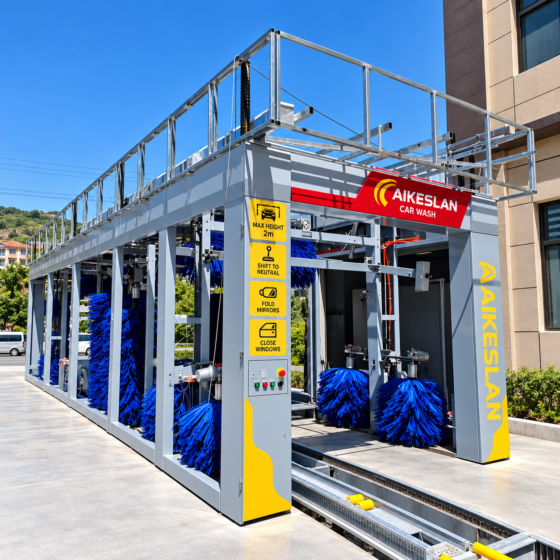
Tunnel Car Wash Machine
A pre-soak stage applies an approved cleaning product before the main wash.
Automatic dosing equipment may deliver the chemical through selected nozzles.
하지만, chemical concentration and compatibility must be managed carefully.
The PLC may coordinate pumps and valves during the application stage.
It may also control relevant timing.
예를 들어, the program could provide a defined interval before the next stage begins.
하지만, the correct contact time depends on the product and cleaning process.
그러므로, manufacturers should identify approved chemical requirements.
Buyers should not assume that every machine supports every chemical product or wash formula.
10. The Role of Water Pumps in Sequential Washing
Water pumps supply the flow and pressure needed for different wash stages.
하지만, not every stage requires the same delivery conditions.
예를 들어, a pre-rinse may use a different arrangement from a high-pressure cleaning stage.
The controller may activate selected pumps according to the program.
하지만, pump operation must remain within approved limits.
The system should also account for available water supply and appropriate protective functions.
Buyers should request pump specifications and utility requirements.
They should also ask how pump faults affect the wash sequence.
A good system integrates water delivery with the overall machine control process.
11. How Solenoid Valves Control Water and Chemicals
Solenoid valves help direct fluids through different parts of a washing system.
Depending on the design, the PLC may command selected valves to open or close.
예를 들어, one valve may serve a pre-rinse circuit while another controls chemical application.
하지만, valve selection depends on pressure, flow, chemical compatibility, and operating conditions.
The controller must coordinate valve commands with pump operation.
A correct sequence helps reduce unintended fluid delivery.
하지만, buyers should ask how the system handles valve failures or abnormal conditions.
Suitable feedback, diagnostics, and protective measures depend on the application.
12. Automatic Brush Washing Sequences

aikeslan reciprocating car wash system installed at a gas station
Soft-touch systems use mechanical cleaning elements that move in a controlled way.
Depending on the machine, these may include side brushes, top brushes, or other approved assemblies.
The wash program may coordinate brush movement, rotational action, and travel.
하지만, the exact design differs between manufacturers.
A brush stage may use sensor information or defined machine positions.
The controller must also coordinate related drive systems.
하지만, brush contact does not automatically mean better cleaning.
The machine must operate within its intended vehicle compatibility and mechanical limits.
Buyers should request details about brush design, maintenance, and control behavior.
13. Touchless Wash Sequence Control
Touchless systems depend on coordinated water delivery, chemistry, and spray movement.
Unlike brush-based machines, they do not normally use physical brushes for exterior contact.
하지만, a touchless machine still needs accurate positioning and control.
The program may operate different spray circuits in a set order.
예를 들어, chemical application may be followed by high-pressure cleaning and rinsing.
하지만, the actual stages vary by design.
The system may also control the movement of a spray arm or gantry.
Buyers should assess how the manufacturer coordinates nozzles, 슬리퍼, 밸브, 센서, and moving parts.
14. Control of Machine Travel and Gantry Movement
In a rollover car wash, the gantry may travel along a defined path.
하지만, its movement must be coordinated with the active wash stage.
예를 들어, a machine may apply water while moving in one direction and perform another process during a return movement.
The actual method depends on the model.
The PLC may use position feedback and drive commands to control travel.
하지만, movement must remain within approved limits.
Safety-related stopping and protective functions need suitable engineering.
A buyer should ask the manufacturer how travel position is detected and how movement faults are handled.
15. How Motors and Gear Reducers Work With the PLC
Motors provide mechanical movement during washing.
Gear reducers may help match motor speed and torque to the required action.
하지만, motor control must match the mechanical system.
예를 들어, a gantry movement stage needs a suitable drive arrangement.
A brush stage may use a different type of motor or control method.
The PLC may coordinate start, stop, and operating commands.
하지만, appropriate motor protection and safety functions are separate engineering considerations.
Buyers should review the machine’s drive specifications and maintenance requirements.
A reliable sequence depends on both the control software and the physical equipment.
16. Coordinate Sensors With Mechanical Movement
Sensors help the system understand selected machine and vehicle conditions.
예를 들어, a sensor may provide position information.
Another may identify whether a specific operating condition has been reached.
하지만, each sensor should have a defined function.
The manufacturer should explain how signals affect the control sequence.
Buyers should also ask how sensors are protected from water, chemicals, and the operating environment.
False or missing signals can affect the wash process.
그러므로, appropriate selection, mounting, testing, and fault handling are important.
Safety-related sensing requires its own suitable design and validation.
17. Use Timers Without Relying on Timing Alone
Timers are useful in sequential automation.
예를 들어, a chemical stage may run for a defined period.
하지만, not every operation should depend only on elapsed time.
A mechanical movement stage may need position feedback.
A pump stage may need relevant operating conditions.
그러므로, engineers should select suitable transition conditions.
A time limit can also help identify a process that has taken longer than expected.
하지만, the response to such a condition must be designed and tested.
Buyers should ask which operations use timers and which use sensor-based confirmation.
This helps reveal the maturity of the control system.
18. Main Rinse and Water Delivery Coordination
After the main cleaning stage, the machine typically performs a rinse.
하지만, rinsing arrangements differ between systems.
The PLC may activate selected pumps, 밸브, and spray assemblies.
It may also coordinate the movement of the machine.
The goal is to remove approved cleaning products and loosened dirt.
하지만, rinse performance depends on water quality, spray coverage, and operating conditions.
The supplier should explain which rinse stages are included.
Buyers should also verify the required water supply.
A carefully controlled rinse supports a more consistent washing process.
19. Optional Wax and Finishing Stages
Some automatic car wash programs include wax or other finishing products.
하지만, these functions are optional and configuration-dependent.
The PLC may add the relevant stage when the customer selects an eligible program.
The system then activates the appropriate delivery components.
하지만, chemical compatibility and dosing limits remain important.
The manufacturer should explain the intended finishing process.
It should also clarify any extra supply or maintenance requirements.
Premium features may improve product differentiation for commercial wash operators.
하지만, they should be evaluated against real customer demand and operating costs.
20. Final Rinse Sequence
The final rinse usually takes place near the end of the water-based cleaning process.
하지만, the exact method depends on the wash program.
Some configurations may use treated or purified water for certain finishing stages.
The control system must activate the appropriate water circuit.
If different water sources are used, the manufacturer should explain how they are separated and managed.
하지만, water treatment requirements are site-specific.
Buyers should request relevant utility specifications and operating limits.
A final rinse should form part of a complete process design rather than an isolated feature.
21. Automatic Drying Sequence Control
Drying commonly follows the final rinse.
The system may activate blowers and coordinate airflow with vehicle or equipment movement.
하지만, the timing and arrangement depend on the machine type.
A rollover system may use a moving dryer assembly.
Another system may have a different airflow arrangement.
The controller should coordinate the drying stage with other machine functions.
하지만, actual drying results depend on airflow, vehicle shape, and environmental conditions.
Buyers should request realistic performance information.
They should also confirm blower maintenance and electrical requirements.
22. Confirm Cycle Completion Before Vehicle Exit
The washing process should end with a clear cycle-completion state.
하지만, the specific exit process depends on the installation.
For a stationary rollover machine, the system may need to complete its final movement before the customer receives an exit signal.
For tunnel systems, the vehicle exit process differs.
그러므로, the manufacturer should explain the intended sequence.
Drivers need clear guidance.
The machine should also avoid signaling readiness for a new cycle while the previous operation has not been properly completed.
A clear completion process improves usability and supports smooth customer flow.
23. What Happens Between Two Wash Cycles?
Commercial equipment must prepare for the next customer.
그러므로, the end of one wash cycle is followed by a reset or ready process.
The machine may return moving assemblies to a defined position.
It may also clear completed program information and update its operating state.
하지만, reset behavior must match the equipment design.
A machine should not automatically resume hazardous movement after certain faults without the required conditions and authorization.
Buyers should ask how the system returns to normal operation.
The answer is particularly important for sites that serve many vehicles throughout the day.
24. Sequential Operations in Rollover Car Wash Machines
Rollover machines typically clean a stationary vehicle using moving equipment.
하지만, the details vary by model.
The control system may coordinate gantry travel, washing functions, and sensor feedback.
예를 들어, several wash stages may be completed over defined travel passes.
This can reduce the need for separate manual operations.
하지만, cycle time depends on the number of passes and selected program.
A commercial buyer should request a sample wash sequence.
The supplier should also explain vehicle positioning, entry conditions, and maintenance requirements.
A compact machine can still have a complex control system.
25. Sequential Operations in Tunnel Car Wash Systems
Tunnel machines use a different process.
Vehicles move through successive washing zones.
Each zone may perform a specific task.
예를 들어, an entrance section may lead to pre-soak, cleaning, 헹구기, and drying areas.
하지만, the exact arrangement varies.
The control system must coordinate equipment operation with conveyor movement and vehicle spacing.
Different vehicles may occupy different zones at the same time.
그러므로, tunnel automation involves both sequence control and continuous process coordination.
Buyers should ask about conveyor integration, capacity assumptions, and the required operating staff.
A tunnel’s maximum rated throughput should not be confused with actual daily customer demand.
26. Multiple Vehicles and Wash Program Tracking
At a suitable tunnel installation, more than one vehicle may be inside the system.
하지만, each vehicle may have purchased a different wash package.
그러므로, the control system may need to associate selected services with the correct vehicle as it moves through the line.
This requires a suitable tracking method.
The exact approach depends on the equipment.
하지만, incorrect tracking may result in the wrong service being activated.
Buyers should ask how the manufacturer verifies program tracking.
They should also request information about error handling.
Program coordination is an important feature for commercial sites that offer multiple service levels.
27. How Safety Interlocks Affect Wash Sequences
Normal process control and safety control serve different purposes.
A process program determines when washing stages should run.
Safety-related controls address hazards identified through the machine’s risk assessment.
These may involve protective devices, interlocks, or safe stopping functions.
하지만, the required design depends on the actual machinery.
A normal PLC command is not automatically a validated safety function.
그러므로, buyers should ask for the machine’s relevant safety documentation.
They should also confirm how safety functions are tested.
A properly designed system should not allow normal commercial programming goals to override required protective measures.
28. Emergency Stops and Safe Restart Procedures
An emergency stop may interrupt machine operation.
하지만, it is not a substitute for all other safeguards.
The manufacturer should explain what the emergency stop affects and how the equipment is brought to a safe condition.
It should also explain what happens before operation can resume.
예를 들어, some faults or stops may require authorized local inspection.
A machine should not restart hazardous movement solely because an emergency stop device has been reset.
The correct behavior depends on the safety design.
Buyers should review documented restart procedures and relevant validation records.
29. Automatic Car Wash Sequence Control During Faults
Fault handling is essential for commercial equipment.
예를 들어, a pump may report an abnormal operating condition.
A sensor may stop providing the expected signal.
A drive may indicate a fault.
하지만, different failures require different responses.
The control system may stop a stage, prevent a new cycle, or enter a defined fault state.
Safety-related failures require appropriate protective behavior.
그러므로, buyers should ask how important faults are detected and recorded.
The manufacturer should also explain recovery procedures.
Reliable automation requires clear fault handling, not simply the ability to perform a normal wash.
30. Prevent Incorrect Stage Transitions
One common automation problem is a stage transition occurring before the previous operation is complete.
예를 들어, a cleaning stage may end too soon.
Another example is a moving mechanism receiving a command before it has reached the required position.
그러므로, well-designed software uses suitable transition conditions.
These may involve position signals, process status, or defined program states.
하지만, actual implementation depends on the machine.
Buyers should ask how the control software is tested.
The manufacturer’s response should show that sequence behavior has been considered beyond ideal operating conditions.
31. Optimize Wash Programs Without Reducing Quality
Commercial operators often want shorter cycle times.
하지만, reducing time does not automatically improve business results.
예를 들어, shortening a chemical stage may affect cleaning performance.
Increasing mechanical movement speed may create additional equipment demands.
그러므로, program optimization should consider cleaning results, operating limits, and reliability.
The manufacturer should explain which settings are adjustable.
It should also identify the conditions under which a program has been tested.
A suitable automatic car wash sequence control system supports practical operation rather than simply minimizing every timer.
32. Understand Water and Energy Efficiency
Sequential operation may help coordinate when pumps, blowers, and other equipment are active.
This can support more controlled resource use.
하지만, actual savings depend on the machine and program.
A shorter cycle may not always use less water.
Likewise, operating a larger pump for less time does not automatically guarantee lower energy consumption.
그러므로, buyers should compare measured or documented consumption under defined conditions.
Relevant metrics may include liters of water per wash and energy use per selected program.
Manufacturers should provide test assumptions where performance claims are made.
33. Support Different Wash Packages With Program Logic
Commercial car washes often offer basic, standard, and premium packages.
The controller may use the selected package to determine which stages are enabled.
예를 들어, a basic program may omit an optional finishing treatment.
A premium program may include additional passes or selected chemical stages.
하지만, available functions depend on the machine.
The supplier should provide clear program descriptions.
Buyers should also consider how changes affect cycle time, consumable use, and maintenance.
A flexible control system can support different services.
하지만, modifications must remain within the approved machine configuration.
34. Integrate Automatic Payments With Wash Sequencing
Some commercial sites use automated payment terminals.
하지만, payment approval and machinery readiness are different conditions.
A successful payment should not override machine safety or readiness requirements.
The control architecture must coordinate the business transaction with the wash program.
예를 들어, a payment system may authorize a particular service package.
The machine then checks whether it can begin that service.
하지만, buyers should also ask about failed transactions and unavailable equipment.
Refunds and customer assistance remain important.
A practical integration should prevent customers from purchasing a wash that cannot be provided without an appropriate resolution process.
35. Remote Monitoring of Wash Stages
Connected equipment may provide information about the machine’s current operating stage.
예를 들어, an operator may be able to see whether the machine is ready, washing, or reporting a fault.
하지만, monitoring features vary by manufacturer.
Some systems may record completed cycles or selected alarms.
Others may provide more limited information.
그러므로, buyers should request a live demonstration.
Remote monitoring can support maintenance planning and operational review.
하지만, it does not replace physical inspections.
Remote control functions also require appropriate cybersecurity, authorization, and safety measures.
36. Equipment Diagnostics and Maintenance
A clear control system can support troubleshooting.
예를 들어, maintenance technicians may review fault records or identify the stage where a cycle stopped.
This can help narrow the investigation.
하지만, diagnostics are only useful when the information is accurate and understandable.
The manufacturer should provide relevant service instructions.
It should also identify which maintenance tasks require qualified personnel.
예를 들어, servicing moving components or electrical equipment may require safe energy isolation.
A reliable machine combines useful control information with a practical maintenance program.
37. Compare Wash Cycle Times Carefully
Cycle time is important when estimating commercial capacity.
하지만, buyers should understand how it is measured.
예를 들어, the duration of the washing program may not include vehicle entry, payment, positioning, and exit.
그러므로, a quoted cycle time may not equal the complete customer transaction time.
For a rollover machine, this distinction affects the number of vehicles the bay can serve.
For a tunnel, conveyor speed and vehicle spacing affect throughput differently.
Buyers should request realistic capacity assumptions.
They should also ask which wash program was used in the test.
38. Example: A Simplified Rollover Wash Sequence
Consider a hypothetical machine with the following programmed stages.
| Stage | Illustrative Duration |
|---|---|
| Position confirmation | Variable |
| Pre-rinse | 30 seconds |
| Chemical application | 25 seconds |
| Main wash | 100 seconds |
| Main rinse | 40 seconds |
| Optional finishing | 20 seconds |
| Final rinse | 35 seconds |
| Drying | 70 seconds |
| Completion and exit | Variable |
The fixed stages in this example total 320 seconds, or five minutes and 20 seconds.
하지만, this is not a manufacturer’s tested cycle time.
It excludes variable positioning and exit time.
Real machines may use overlapping operations, different travel paths, or alternative stage durations.
그러므로, buyers should rely on model-specific test information.
39. How Wash Sequencing Affects Commercial Throughput
Commercial throughput depends partly on the wash sequence.
하지만, it also depends on machine type and customer flow.
예를 들어, a rollover machine must generally finish one vehicle’s wash before beginning another inside the same bay.
A tunnel can process vehicles through different zones when its design permits.
그러므로, the relationship between cycle time and throughput is different.
Buyers should compare suitable equipment using realistic operating conditions.
They should also consider customer demand and service package mix.
Maximum theoretical capacity should not be treated as guaranteed daily sales.
40. Review Sequence Control for Gas Station Applications
Gas stations often need a practical washing process that fits the available site.
예를 들어, a rollover machine may serve customers using a dedicated wash bay.
A clear automatic sequence can reduce routine staff involvement.
하지만, the complete customer journey matters.
Drivers need appropriate instructions for entry and exit.
The payment process should work with machine availability.
The system should also handle relevant faults without creating unsafe conditions.
그러므로, buyers should evaluate site layout, washing technology, and control integration together.
A good sequence alone cannot correct unsuitable vehicle traffic arrangements.
41. Sequence Control for Fleet Washing Facilities
Fleet facilities may wash vehicles on a regular schedule.
하지만, the requirements vary by fleet.
Some facilities handle passenger cars.
Others serve larger commercial vehicles.
그러므로, machine compatibility must be confirmed.
Sequential control may support repeatable washing programs for suitable vehicles.
하지만, different vehicle sizes may require different equipment or configurations.
A buyer should define vehicle dimensions, expected volume, and cleaning needs before choosing the machine.
The supplier should then explain how the available wash sequences meet those requirements.
42. Sequence Control for Commercial Car Wash Centers
Dedicated car wash centers may offer multiple wash programs.
그러므로, flexible sequence control can be valuable.
A business may need to manage different service packages while maintaining predictable equipment operation.
하지만, the chosen machine must support the actual wash features being sold.
Operators should also understand the impact of premium packages on cycle time.
예를 들어, adding another treatment may increase the time required per customer.
그러므로, pricing, capacity, and process design should be considered together.
A manufacturer should help buyers compare the available configurations without promising unsupported financial results.
43. Factory Acceptance Testing for Sequential Operations
Factory acceptance testing, or FAT, helps verify agreed machine functions before shipment.
For sequential wash control, testing may examine the expected order of operations.
It may also review selected sensors, drive functions, alarms, and process transitions.
하지만, factory testing cannot reproduce every site condition.
The FAT plan should identify the test scope and acceptance criteria.
예를 들어, the buyer may want evidence that selected programs complete as intended.
The manufacturer should document any identified problems and corrective actions.
Safety-related verification should be addressed through the relevant procedures.
44. Site Acceptance Testing and Commissioning
After installation, the machine should be tested under the actual site’s conditions.
Electrical supply, water connections, 배수, and other utilities may affect operation.
그러므로, commissioning should verify the approved equipment configuration.
The team should also check relevant wash programs and machine interfaces.
하지만, testing must follow suitable procedures.
The project should define who is responsible for correcting problems.
The buyer should request the final agreed test records.
A machine that performs correctly at the factory may still need adjustment or remedial work after installation.
45. EU and North American Technical Considerations
Machinery requirements vary by destination.
For EU projects in 2026, applicable EU machinery legislation and other relevant product rules must be considered.
Regulation (EU) 2023/1230 generally applies from January 20, 2027.
For North American projects, local electrical approval, machinery safety, and installation requirements may differ.
그러므로, a manufacturer’s general claim of international compliance is not enough.
Buyers should ask for machine-specific technical documentation.
They should also involve qualified local professionals where needed.
Relevant safety functions must be assessed independently of ordinary washing process timing.
46. How to Evaluate a Manufacturer’s Sequence Control Expertise
A supplier should be able to explain how its machine coordinates washing stages.
하지만, buyers should request more than a promotional video.
Ask for a model-specific description of the available wash programs.
The manufacturer should also explain the PLC architecture, sensor functions, and important fault responses.
Where possible, review a controlled demonstration.
The supplier should clarify whether software programming is performed in-house or supported by a technical partner.
하지만, in-house programming alone does not establish quality.
Documented design, testing, and support arrangements are more useful.
47. Manufacturer Evaluation Checklist
Use the following checklist when comparing suppliers.
| Evaluation Area | Questions to Ask |
|---|---|
| PLC architecture | Who develops and maintains the control logic? |
| Wash stages | What stages are included in each program? |
| Sensors | How are vehicle and machine positions detected? |
| Pumps and valves | How are water and chemicals coordinated? |
| Mechanical movement | How does travel relate to washing stages? |
| Safety | What risk assessment and protective functions apply? |
| Fault handling | What stops a stage or prevents a new cycle? |
| Diagnostics | What fault information is available? |
| Testing | Can the supplier provide FAT records? |
| Customization | Can programs be changed within approved limits? |
| Installation | What commissioning support is available? |
| Maintenance | Are software and component records supplied? |
Buyers should compare actual evidence rather than count the number of advertised automation features.
Frequently Asked Questions
What is automatic car wash sequence control?
It is the programmed coordination of vehicle detection, cleaning stages, 슬리퍼, 밸브, 모터, 헹구기, drying, and other machine functions.
How does a PLC control an automatic car wash?
The PLC processes selected input signals and uses programmed logic to coordinate the machine’s outputs and operating states.
What is the normal sequence of an automatic car wash?
A typical process may include vehicle positioning, pre-rinse, chemical application, washing, 헹구기, optional finishing, drying, and exit.
Are all automatic car wash sequences the same?
No. The stages and control methods vary by model, wash technology, configuration, and selected program.
How do sensors affect the wash sequence?
Sensors may provide vehicle or machine position information and selected operating signals used by the controller.
What controls car wash water pumps?
Depending on the system, the PLC and associated motor control equipment may coordinate pump operation with the wash stages.
How are solenoid valves used in automatic car wash systems?
They can control the delivery of water or chemicals to selected circuits during appropriate stages.
How is a touchless wash sequence different from a brush wash?
Touchless systems coordinate spray and chemical delivery without routine brush contact. Brush systems also coordinate mechanical cleaning assemblies.
Can the wash sequence be customized?
Some manufacturers support approved configuration changes. 하지만, engineering feasibility, testing, and safety requirements must be considered.
How long does an automatic wash cycle take?
It depends on machine type, selected program, operating conditions, and whether entry and exit time are included.
What happens when a sensor fails?
The response depends on the system design and the affected function. The manufacturer should explain and test relevant fault behavior.
Can a PLC replace machinery safety functions?
Not automatically. Safety-related functions need appropriate design, components, validation, and risk assessment.
Can automatic car washes track different wash packages?
Some systems can. The required control and tracking features depend on whether the installation is a rollover or tunnel system.
What should buyers request before purchasing a machine?
Request model-specific specifications, wash program descriptions, safety information, installation requirements, FAT scope, and maintenance support details.
Why is automatic car wash sequence control important?
It helps coordinate mechanical and fluid systems so that the required washing stages occur under defined conditions.
Conclusion: Better Wash Results Start With Better Process Coordination
Automatic car wash machines depend on a controlled sequence of operations.
Sensors provide selected information.
PLCs coordinate programmed functions.
Pumps and valves manage water and chemical delivery.
Motors move machine assemblies.
Brushes or touchless spray systems perform the main cleaning stages.
The control system then coordinates rinsing, optional finishing, drying, and cycle completion.
하지만, these operations must work as one integrated process.
A good sequence should support repeatability, suitable resource use, realistic throughput, and clear fault handling.
For commercial buyers, the quality of automatic car wash sequence control is an important part of evaluating manufacturer engineering capability.
The best supplier is not simply the one offering the largest number of wash programs.
It is the manufacturer that can explain its control design, verify the agreed functions, and provide useful technical support.
Reliable automatic washing begins with well-designed equipment and a controlled process that moves through each stage under the correct operating conditions.
Request an Automatic Car Wash Technical Proposal
Are you planning a commercial automatic car wash installation for a gas station, dedicated wash center, dealership, or fleet facility?
Before requesting a quotation, prepare these project details:
- Country and installation location
- Intended business application
- Preferred machine category
- Available site dimensions
- Typical vehicle dimensions
- Expected daily wash volume
- Required wash packages
- Electrical supply information
- Water supply and drainage conditions
- Chemical and water treatment requirements
- Desired control and monitoring functions
- Payment or membership integration needs
- Installation and commissioning requirements
- Preferred delivery timeline
- Estimated project budget
Ask the manufacturer for a model-specific proposal that explains the available wash stages, PLC controls, machine requirements, testing arrangements, and maintenance support.
Request a Technical Consultation | Compare Automatic Car Wash Control Systems | Get an Equipment Quotation
Technical References
IEC 61131-3:2025 — Programmable Controllers: Programming Languages
https://webstore.iec.ch/en/publication/68533
ISO 12100:2010 — Safety of Machinery: Risk Assessment and Risk Reduction
https://www.iso.org/standard/51528.html
European Union — Regulation (EU) 2023/1230 on Machinery
https://eur-lex.europa.eu/eli/reg/2023/1230/oj
Google Search Central — Creating Helpful, Reliable, People-First Content
https://developers.google.com/search/docs/fundamentals/creating-helpful-content
Disclaimer: This article provides general technical information about automatic car wash control systems. Wash sequences, equipment functions, timings, and operating limits vary by manufacturer and model. Illustrative examples are not verified specifications for a particular machine. Applicable safety and conformity requirements must be assessed for the actual equipment and installation.