 Aikeslan | Fully Automatic Car Wash Machine Manufacturer


Automatic Car Wash Machine Chain – Reliable Conveyor and Drive Chains for Car Wash Equipment

Automatic Car Wash Machine Chain
Industrial Roller Chain, Conveyor Chain, and Replacement Chain Solutions for Automatic Car Wash Systems
An Automatic Car Wash Machine Chain is an important mechanical component in many automated vehicle washing systems. It transfers motion, drives rotating parts, or supports the controlled movement of equipment.
In a tunnel car wash, a conveyor chain may form part of the system that moves vehicles through different washing stages. In other machines, drive chains may transfer power from a motor and gearbox to a moving component.
Therefore, selecting the correct chain helps support smooth movement, stable operation, and reliable equipment performance.
Our automatic car wash chain solutions are intended for a range of commercial washing applications, including tunnel car wash conveyors, mechanical drive assemblies, and selected equipment movement systems.
Whether you need a chain for a new automatic car wash machine or a replacement for existing equipment, correct specifications are essential.
Different car wash systems require different chain sizes, materials, and mechanical designs. For example, a vehicle conveyor chain may have different loading requirements from a smaller roller chain used in a brush drive.
As a result, chain pitch, working load, sprocket compatibility, corrosion resistance, and operating conditions must be reviewed before ordering.
We welcome inquiries from car wash equipment manufacturers, industrial distributors, maintenance companies, and commercial car wash operators.
Key Product Highlights
- Chain solutions for automatic car wash machine applications
- Conveyor and power transmission chain options
- Roller chain configurations for suitable drive systems
- Selection based on pitch, dimensions, and working load
- Material options for wet and demanding environments
- Compatibility review for sprockets and drive assemblies
- Replacement chain matching for existing equipment
- Support for OEM technical specifications
- Chain length and connection requirements reviewed by application
- B2B purchasing and international shipping inquiries
Looking for a reliable automatic car wash machine chain?
Send us your existing chain model, dimensions, application, or equipment details. Our team can review the specifications needed to identify a suitable chain option.
Request a Quote | Contact Us | Send Your Chain Specifications
What Is an Automatic Car Wash Machine Chain?
An automatic car wash machine chain is a mechanical chain used to transmit power or movement within automated vehicle washing equipment.
Depending on its design, the chain may connect a motor-driven sprocket to another rotating component or form part of a conveyor mechanism.
The chain works with sprockets and other mechanical parts to transfer motion.
For example, a roller chain consists of connected links that engage with sprocket teeth.
As the drive sprocket turns, it moves the chain and transfers force through the connected drive system.
In a tunnel car wash conveyor, the chain may be part of the mechanism that moves vehicles along the washing path.
In other equipment, chains may drive rotating brushes or auxiliary mechanisms.
However, not all automatic car wash machines use chains in the same way.
Some systems use belts, direct drives, or other mechanical arrangements.
Therefore, the correct chain must match the actual machine design.
How Does a Car Wash Conveyor Chain Work?
A car wash conveyor chain is driven by a suitable motor and mechanical transmission system.
The motor provides rotational power.
A gearbox may reduce speed and increase available output torque.
The drive sprocket then transfers movement to the chain.
As the chain moves, it carries or drives the connected conveyor components.
In a tunnel car wash, this movement may be used to advance vehicles through the wash process.
However, the chain does not work alone.
The complete conveyor may include guide rails, rollers, sprockets, take-up mechanisms, tensioning devices, and safety systems.
Therefore, chain performance depends on correct design, installation, lubrication, and maintenance.
In simple terms, an automatic car wash chain helps transfer mechanical power and controlled movement within the washing equipment.
Key Features of Chains for Automatic Car Wash Equipment
1. Reliable Mechanical Power Transmission
Automatic car wash machines require controlled movement during operation.
A correctly selected chain helps transfer mechanical power between connected components.
For example, a roller chain may connect a drive sprocket to another sprocket within the equipment.
As a result, it supports the intended movement of the machine.
However, the chain must be suitable for the load, speed, and drive arrangement.
Selecting an undersized chain may lead to excessive wear or premature failure.
2. Suitable Strength for Working Loads
Chain strength is important in commercial car wash applications.
Different systems place different loads on their mechanical components.
For example, a vehicle conveyor may experience changing loads as vehicles enter and move through the system.
Therefore, the selected chain must have suitable working load capacity and fatigue performance.
It is important to distinguish minimum tensile strength from allowable working load.
A chain’s breaking strength should not be used as its normal operating load rating.
3. Stable Engagement With Sprockets
A roller chain transfers power through engagement with sprocket teeth.
Correct chain pitch and sprocket dimensions are essential.
For example, a chain with the wrong pitch may not engage correctly with the sprocket.
This can cause noise, wear, unstable movement, or mechanical damage.
Therefore, chain and sprocket compatibility must be confirmed before installation.
4. Material Options for Wet Environments
Automatic car wash equipment operates in environments where moisture, water spray, and cleaning chemicals are common.
As a result, chain corrosion resistance is an important selection factor.
Depending on the actual product range, chain materials and finishes may include carbon steel, stainless steel, plated steel, or other suitable options.
However, material selection must match the working environment.
A chain described as corrosion-resistant should not automatically be considered suitable for every cleaning chemical.
5. Practical Maintenance and Replacement
Many industrial chain systems are designed for inspection, adjustment, and replacement.
For example, technicians may inspect chain elongation, wear, corrosion, and sprocket condition.
Regular maintenance helps identify problems before they cause equipment failure.
However, maintenance needs vary by chain type and operating environment.
Therefore, the equipment manufacturer’s maintenance instructions should be followed.
6. Flexible Chain Configurations
Automatic car wash equipment may require different chain lengths, link designs, and attachment configurations.
For example, a conveyor chain may need special attachments to connect with other mechanical parts.
Meanwhile, a standard power transmission chain may use a different link arrangement.
Therefore, the buyer should confirm the complete chain design rather than selecting by pitch alone.
7. Suitable for OEM and Replacement Projects
For OEM manufacturers, chain selection should begin during mechanical design.
For replacement projects, the new chain must match the existing equipment.
In both cases, technical drawings, dimensions, and operating requirements help support correct purchasing decisions.
Main Types of Chains Used in Automatic Car Wash Machines

Automatic Car Wash Machine Chain
Automatic car wash systems can use different chain types.
Each type serves a different mechanical function.
Car Wash Conveyor Chain
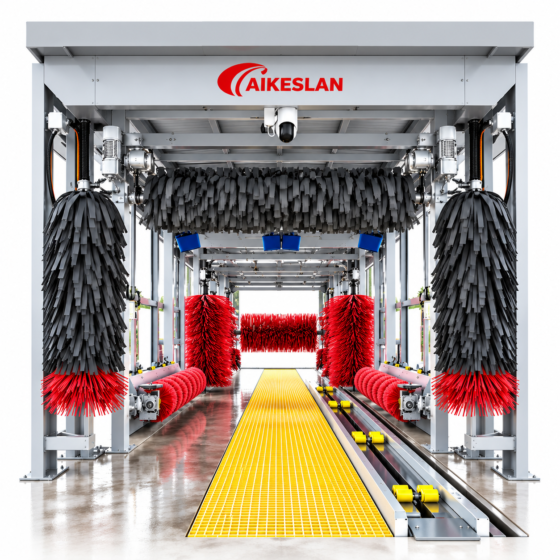
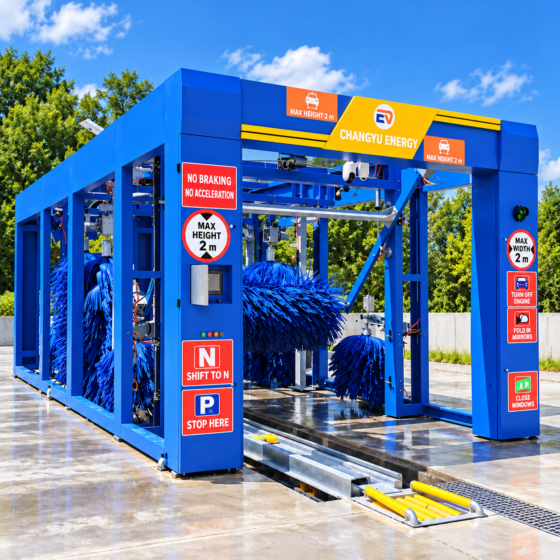
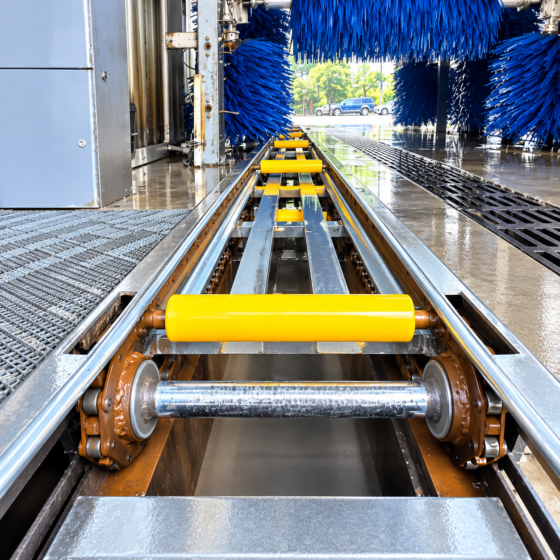
A car wash conveyor chain is used in conveyor systems that move vehicles through a tunnel washing process.
Depending on the conveyor design, the chain may drive rollers, pushers, or other movement components.
The chain must handle the required mechanical load and operating duty.
In addition, it must match the conveyor sprockets, guide system, and attachment arrangement.
Common applications include:
- Tunnel car wash conveyor systems
- Vehicle movement mechanisms
- Conveyor drive assemblies
- Commercial car wash transport equipment
- Suitable vehicle handling systems
For replacement projects, buyers should provide the original chain dimensions and conveyor model.
Car Wash Roller Chain
A roller chain is a common type of industrial power transmission chain.
It consists of interconnected links with pins, bushings, and rollers.
The rollers engage with sprocket teeth to transfer movement.
Roller chains are available in different sizes and configurations.
Some may be suitable for selected drive systems within automatic car wash equipment.
However, a standard roller chain should not automatically be used in a vehicle conveyor without checking its application rating.
Car Wash Drive Chain
A drive chain transfers mechanical power from one part of a machine to another.
For example, a motor and gearbox may turn a drive sprocket that moves the connected chain.
This arrangement may be used in brush drive systems, conveyor assemblies, or other suitable mechanisms.
The correct drive chain depends on transmitted power, speed, load, and sprocket dimensions.
Heavy-Duty Conveyor Chain
Some industrial conveyor applications require chains designed for demanding loads and repeated operation.
These chains may use stronger components, different link designs, or specialized attachments.
However, the term heavy-duty does not define a single strength rating.
Buyers should review the actual working load, fatigue characteristics, and mechanical dimensions.
Stainless Steel Car Wash Chain
Stainless steel chains may be considered where improved corrosion resistance is required.
For example, some installations expose mechanical components to frequent moisture.
However, stainless steel performance depends on its grade, mechanical design, and chemical exposure.
In addition, stainless steel chain load ratings may differ from those of similar carbon steel chains.
Therefore, material and strength requirements must be checked together.
Attachment Conveyor Chain
Some conveyor systems use chains with additional mounting features.
These attachments may connect the chain to rollers, carriers, or other conveyor parts.
The attachment design must match the complete mechanical system.
For replacement projects, attachment pitch, position, dimensions, and orientation are especially important.
Technical Specifications – Automatic Car Wash Machine Chain
Chain specifications depend on the actual product model and equipment design.
The following table outlines the main parameters required for selection.
| Specification | Description |
|---|---|
| Product Name | Automatic Car Wash Machine Chain |
| Product Category | Industrial Conveyor / Transmission Chain |
| Chain Type | Conveyor / Roller / Drive / Attachment Chain |
| Chain Pitch | According to selected chain model |
| Roller Diameter | Model-specific |
| Inner Width | According to chain dimensions |
| Pin Diameter | Model-specific |
| Plate Thickness | According to selected design |
| Chain Material | Carbon Steel / Stainless Steel / Other |
| Surface Treatment | According to selected configuration |
| Minimum Tensile Strength | Model-specific test or rated value |
| Allowable Working Load | According to chain and application |
| Fatigue Performance | According to product data |
| Chain Length | Based on equipment requirements |
| Number of Strands | Single / Multiple, where applicable |
| Attachment Type | Standard / Application-Specific |
| Connection Method | According to chain design |
| Lubrication Requirements | Based on model and environment |
| Sprocket Compatibility | Must match chain specification |
| Operating Speed | According to drive design |
| Operating Temperature | Based on product material and lubricant |
| Application | Automatic Car Wash Equipment |
| OEM Requirements | Subject to technical review |
| Replacement Support | Dimensional and specification matching |
Technical Note: Final dimensions, working load ratings, materials, surface treatments, and available chain configurations must be verified using the actual product datasheet.
Understanding Chain Pitch
Chain pitch is the distance between the centers of two adjacent pins.
It is one of the most important chain dimensions.
For example, a replacement chain must match the required pitch of the existing sprocket system.
However, matching pitch alone does not guarantee full compatibility.
Roller diameter, inner width, plate dimensions, and attachment design must also be considered.
Understanding Roller Diameter and Width
Roller diameter affects how the chain engages with sprocket teeth.
Meanwhile, inner width influences the fit between the chain and sprocket.
Therefore, these dimensions should be measured or confirmed from the original technical data.
Understanding Tensile Strength
Minimum tensile strength describes a chain’s resistance to breaking under a specified test.
However, this value does not represent the load the chain should carry during normal operation.
Allowable working load depends on the chain design, fatigue resistance, operating conditions, and application.
For this reason, chain selection should not rely only on the highest tensile strength value.
Understanding Chain Length
Chain length must match the drive or conveyor arrangement.
For many chains, length is expressed by the number of pitches or links.
However, installation requirements may also involve connection links and take-up adjustment.
Therefore, buyers should check the chain length and joining method before ordering.
Understanding Chain Materials
Carbon steel chains may be suitable for many industrial mechanical applications.
Meanwhile, stainless steel or protected chains may be considered where corrosion resistance is important.
However, strength, wear resistance, and chemical compatibility vary.
Therefore, the best material depends on the operating environment and load requirements.
How to Choose the Right Chain for an Automatic Car Wash Machine
Choosing the correct chain requires a clear understanding of the equipment.
Step 1: Identify the Chain Application
First, confirm whether the chain is used for vehicle conveyance, power transmission, brush movement, or another mechanical function.
Different applications require different chain designs.
Step 2: Confirm the Chain Type
Next, identify the original chain configuration.
For example, it may be a standard roller chain, attachment chain, or dedicated conveyor chain.
If the original model is available, use it as the starting point.
Step 3: Measure Chain Pitch
Measure the distance between adjacent pin centers.
For worn chains, use several pitches to improve measurement accuracy.
Then compare the result with the applicable chain specification.
Step 4: Check All Main Dimensions
Measure or confirm roller diameter, inner width, pin diameter, and plate dimensions.
If the chain has attachments, include their measurements.
Step 5: Review Working Load
The chain must handle the expected operating forces.
For conveyors, this may include changing loads, starting forces, friction, and shock.
Therefore, engineering calculations may be required for new equipment.
Step 6: Select Suitable Materials
Consider water exposure, cleaning chemicals, temperature, and lubrication conditions.
Choose chain materials and protective finishes according to the actual operating environment.
Step 7: Confirm Sprocket Compatibility
Check the sprocket dimensions, tooth profile, alignment, and wear condition.
A new chain installed on severely worn sprockets may wear quickly.
Step 8: Review Installation and Maintenance Requirements
Finally, confirm chain tensioning, lubrication, guiding, and inspection requirements.
This helps support reliable operation after installation.
Applications in Different Automatic Car Wash Systems
Tunnel Automatic Car Wash Systems
Tunnel car wash machines move vehicles through several cleaning stages.
A conveyor system may use a chain-driven mechanism to advance vehicles along the wash path.
The chain must match the vehicle handling system and operating conditions.
Correct installation and maintenance help support steady conveyor movement.
Touchless Tunnel Car Wash Equipment
Touchless tunnel systems wash vehicles without using rotating brushes that contact the body.
However, the equipment may still use a conveyor to move vehicles through the wash.
Where the conveyor is chain-driven, a suitable chain remains important for vehicle movement.
Rollover and In-Bay Car Wash Machines
Rollover car wash machines move a gantry around a stationary vehicle.
Some mechanical designs may use chains for selected drive or movement functions.
However, other systems use belts, racks, or direct drives.
Therefore, chain requirements depend on the specific machine.
Brush Drive Systems
Some brush assemblies use mechanical transmissions.
A chain may transfer power from a motor or gearbox to a rotating brush shaft.
However, the chain must match the required rotational speed, transmitted torque, and mechanical layout.
Commercial Vehicle Washing Equipment
Truck and bus washing equipment may have different drive loads from passenger car systems.
Where chain drives are used, they must be selected for the actual load and mechanical arrangement.
Gas Station and Fleet Washing Facilities
Automatic car wash equipment is commonly used at gas stations and commercial washing facilities.
In chain-driven systems, regular inspection helps reduce the risk of chain-related downtime.
Therefore, replacement planning is important for operators who depend on daily washing services.
Why Choose the Right Automatic Car Wash Chain?
Smooth and Consistent Mechanical Movement
A properly selected chain helps transfer movement through the drive system.
As a result, it supports the intended operating speed and mechanical function.
Suitable Performance Under Working Loads
Correct chain sizing helps the drive system handle expected forces.
This can reduce the risk of overload-related damage when combined with proper installation.
Better Equipment Compatibility
Matching chain dimensions and sprocket requirements helps avoid installation problems.
This is especially important for replacement applications.
Practical Maintenance Planning
Chains can be inspected for wear, elongation, corrosion, and damage.
Regular inspection helps identify parts that require adjustment or replacement.
Support for OEM Equipment Design
Chain specifications can be selected during machine development.
This helps engineers plan the drive layout, sprocket arrangement, and maintenance access.
Suitable Replacement Options
A compatible replacement chain can help restore the original mechanical function.
However, correct dimensions and working load ratings must be verified.
Chain Materials and Corrosion Resistance
Car wash chains may be exposed to water, detergents, dirt, and changing temperatures.

Automatic Car Wash Machine Chain
Therefore, corrosion and wear resistance should be considered together.
Carbon Steel Chains
Carbon steel is widely used in industrial chains.
It offers suitable mechanical properties for many power transmission applications.
However, unprotected carbon steel may corrode when exposed to moisture.
Therefore, surface treatment and maintenance may be required.
Stainless Steel Chains
Stainless steel may provide improved resistance to corrosion in suitable environments.
However, stainless steel grades have different mechanical and chemical properties.
For this reason, buyers should confirm the selected material grade and working load.
Surface-Treated Chains
Some industrial chains use protective coatings or plating.
These treatments may help reduce corrosion under certain conditions.
However, coating durability depends on the treatment, environment, and wear exposure.
Lubrication and Corrosion Protection
Lubrication is important for many chain drives.
It helps reduce friction and wear between pins and bushings.
However, water and cleaning chemicals may wash away unsuitable lubricants.
Therefore, lubrication methods must match the equipment environment.
Automatic Car Wash Chain Maintenance Guide
Regular maintenance helps support chain reliability.
Inspect Chain Wear
Check for visible wear, damaged rollers, bent plates, and other defects.
Also, monitor chain elongation using the manufacturer’s recommended measurement method.
Check Chain Tension
Incorrect chain tension can affect operation.
Excessive tension may increase component loads.
Meanwhile, insufficient tension may lead to poor engagement or unstable movement.
Always follow the equipment manufacturer’s adjustment instructions.
Inspect Sprockets
Check sprocket teeth for wear, damage, and misalignment.
Worn sprockets may reduce the service life of a replacement chain.
Lubricate Where Required
Use a suitable lubricant according to the chain manufacturer’s instructions.
Some chain systems require special lubrication methods.
Do not assume that every chain is designed for dry operation.
Check Corrosion
Inspect areas exposed to water and cleaning chemicals.
Corrosion may weaken components or affect movement.
Replace damaged parts according to the manufacturer’s maintenance criteria.
Follow Safety Procedures
Before inspecting or replacing a chain, isolate the drive system and prevent unexpected movement.
For vehicle conveyors, secure the system against movement caused by stored energy or vehicle loads.
Never service a moving chain or bypass protective guards.
Automatic Car Wash Chain Replacement Guide
Replacing a chain requires more than finding one with a similar appearance.
A replacement must fit the existing sprockets and meet the required load conditions.
Information Needed for Replacement
- Original chain brand and model
- Equipment manufacturer and machine model
- Chain pitch
- Roller diameter
- Inner width
- Plate and pin dimensions
- Material and surface treatment
- Chain length
- Attachment configuration
- Sprocket dimensions
- Operating load and speed
- Installation photos or technical drawings
These details help reduce replacement errors.
Common Signs of Chain Wear
A chain may require inspection if the machine shows:
- Unusual mechanical noise
- Excessive chain elongation
- Irregular conveyor movement
- Visible corrosion
- Damaged links or rollers
- Frequent tension adjustment
- Poor sprocket engagement
- Unexpected vibration
However, these symptoms may also result from worn sprockets, poor alignment, damaged bearings, or drive system problems.
Therefore, the complete mechanical system should be inspected.
Can You Replace a Car Wash Chain With Another Brand?
In some cases, a chain from another brand may be compatible.
However, standard dimensions alone may not guarantee suitability for specialized conveyor applications.
Working load, attachments, wear characteristics, and operating conditions must also match.
OEM Automatic Car Wash Chain Solutions
Automatic car wash manufacturers need mechanical components that match their equipment designs.
For OEM projects, chain selection should consider load, speed, sprocket dimensions, working environment, and expected service requirements.
OEM Chain Selection Requirements
Please provide:
- Automatic car wash machine type
- Chain application
- Chain pitch and dimensions
- Required working load
- Operating speed
- Sprocket specifications
- Material requirements
- Chain length and attachments
- Expected order quantity
- Delivery destination
Our team can review these details to help identify suitable chain specifications.
Replacement Chains for Equipment Distributors
Equipment distributors often need replacement parts for several car wash machine models.
Clear part numbers, dimensions, and drawings make product matching easier.
Therefore, buyers should provide as much original product information as possible.
Chain Solutions for Maintenance Companies
Maintenance providers may need replacement chains for urgent equipment repairs.
For faster technical evaluation, provide the original chain model and photos of the installed drive system.
European and North American Chain Standards
International buyers may use different chain standards and dimensional conventions.
Therefore, chain specifications should be confirmed for the destination market.
Roller Chains for European Equipment
Many European industrial chain applications use ISO-based dimensions.
ISO 606 covers certain short-pitch precision roller chains, bush chains, attachments, and associated sprockets.
However, not every conveyor or specialized car wash chain falls within this standard.
Therefore, the selected chain must be checked against its applicable specification.
Roller Chains for North American Equipment
North American power transmission applications commonly use ANSI/ASME chain designations.
ASME B29.1 covers precision power transmission roller chains, attachments, and sprockets.
However, specialized conveyor chains may follow other specifications.
Therefore, buyers must confirm dimensions and application suitability.
Metric and Imperial Chain Compatibility
Metric and inch-based chain designs are not always interchangeable.
Even when pitch dimensions appear similar, other dimensions may differ.
For this reason, complete dimensional matching is important.
Frequently Asked Questions About Automatic Car Wash Machine Chains
1. What is an automatic car wash machine chain?
An automatic car wash machine chain is a mechanical chain used for power transmission or equipment movement. Depending on the machine design, it may be used in conveyors, brush drives, or other mechanical assemblies.
2. What type of chain is used in a tunnel car wash conveyor?
Tunnel car wash conveyors may use specialized conveyor chains or other chain-driven mechanisms. The exact type depends on the conveyor design, sprockets, vehicle handling method, and operating load.
3. How do I choose the right car wash conveyor chain?
Check the original chain type, pitch, roller diameter, width, working load, and attachment design. Also, confirm the sprocket dimensions and installation requirements.
4. Are roller chains suitable for automatic car wash machines?
Yes, roller chains can be suitable for selected power transmission applications. However, the chain must be rated for the actual load and environment. A standard roller chain may not be suitable for every vehicle conveyor.
5. Can I replace my existing chain with another brand?
A compatible replacement may be possible if the chain matches the required dimensions and operating specifications. However, specialized conveyor chains may need additional compatibility checks.
6. What is chain pitch?
Chain pitch is the distance between the centers of two adjacent chain pins. It is a key dimension used to identify chain size and sprocket compatibility.
7. Are stainless steel chains better for car wash equipment?
Stainless steel can offer improved corrosion resistance in suitable environments. However, the best material depends on load, wear conditions, cleaning chemicals, and the required mechanical strength.
8. How long does a car wash conveyor chain last?
Chain service life depends on design, load, alignment, lubrication, moisture exposure, and maintenance. There is no single service life that applies to every car wash chain.
9. Why is my car wash conveyor chain making noise?
Possible causes include worn links, incorrect tension, poor lubrication, damaged sprockets, or misalignment. Inspect the complete drive system before replacing parts.
10. How do I know when a car wash chain needs replacement?
Common warning signs include excessive elongation, corrosion, damaged links, and poor sprocket engagement. Follow the equipment manufacturer’s wear limits and inspection procedures.
11. Can automatic car wash chains operate in wet environments?
Some chains are designed or protected for wet environments. However, water and chemical resistance depend on the material, surface treatment, and maintenance method.
12. What is the difference between a conveyor chain and a drive chain?
A conveyor chain is used as part of a system that moves materials or equipment. A drive chain mainly transmits mechanical power between connected components. Some chain designs can serve both functions.
13. Do car wash chains require lubrication?
Many roller chains require suitable lubrication to reduce friction and wear. However, maintenance requirements depend on the chain design and operating environment.
14. Can chains be supplied for OEM automatic car wash projects?
OEM chain inquiries can be reviewed based on technical specifications, load requirements, and order quantity. Available options depend on the actual product range.
15. How can I request a quote for an automatic car wash chain?
Send us the chain type, pitch, dimensions, material, length, quantity, and delivery destination. Photos or drawings of the original chain can also help with replacement inquiries.
Packing & Delivery
Secure Packaging for Automatic Car Wash Machine Chains
Industrial chains require suitable protection during handling, storage, and international transportation.
Proper packaging helps reduce the risk of impact damage, contamination, moisture exposure, and surface corrosion.
Packaging options may include:
- Protective wrapping for individual chain assemblies
- Strong cartons for smaller orders
- Suitable corrosion protection for metal components
- Wooden cases for heavy chain shipments
- Pallet packaging for wholesale orders
- Protective packaging for attachment chains
- OEM packaging arrangements, subject to confirmation
The final packaging method depends on chain weight, length, material, and order quantity.
International Shipping & Delivery
We welcome shipping inquiries from customers in Europe, North America, and other international markets.
Depending on shipment weight, size, and delivery requirements, suitable shipping methods may include:
- Sea Freight: Suitable for heavy chains and bulk orders
- Air Freight: An option for urgent replacement projects
- Express Delivery: Suitable for smaller chain parts and samples, subject to carrier limits
Lead Time & Order Processing
Delivery times depend on chain type, specifications, length, order quantity, and stock availability.
Customized chain configurations may require additional processing.
Therefore, estimated lead times and shipping arrangements will be confirmed during quotation.
OEM & Bulk Order Packaging
For automatic car wash manufacturers, distributors, and wholesale buyers, packaging requirements can be reviewed according to project needs.
Suitable packaging helps protect chains during transportation and supports efficient warehouse handling.
Why Choose Us for Automatic Car Wash Chain Inquiries?
A suitable chain is an important part of reliable automatic car wash equipment.

Automatic Car Wash Machine Chain
Correct chain selection helps support mechanical power transmission, consistent movement, and practical maintenance planning.
We welcome technical inquiries from:
- Automatic car wash machine manufacturers
- Car wash equipment distributors
- Industrial chain importers
- Car wash maintenance companies
- Equipment repair service providers
- Conveyor system integrators
- Commercial car wash operators
- Fleet washing equipment buyers
For OEM and replacement projects, accurate technical information helps identify suitable chain options.
Request a Quote for Automatic Car Wash Machine Chains
Find the Right Chain for Your Automatic Car Wash Equipment
Are you looking for a conveyor chain, roller chain, drive chain, or compatible replacement chain?
We welcome inquiries for automatic car wash equipment, OEM projects, maintenance, and wholesale purchasing.
Please provide:
- Chain application and machine type
- Original chain model, if available
- Chain pitch and main dimensions
- Chain material
- Required length
- Attachment design, if applicable
- Sprocket information
- Required order quantity
- Delivery destination
Our team can review your requirements and provide relevant information about suitable chain options.
Contact Us Today
Explore automatic car wash chain solutions for commercial washing equipment and discuss your technical requirements with our team.
Request a Quote | Contact Us | Send Your Specifications
A correctly selected automatic car wash machine chain helps support smooth mechanical movement, reliable equipment operation, and efficient maintenance.