 Aikeslan | Fully Automatic Car Wash Machine Manufacturer
Touchless vs. Soft-Touch Car Wash: Which Is Better for Your Business?
Updated: October 2026 | Category: Car Wash Industry News & Buying Guides
Choosing the right automatic car wash system is an important business decision. Two popular options are touchless car washes and soft-touch car washes.
Both systems can clean vehicles with little manual work. However, they use different cleaning methods. They also have different equipment needs, maintenance tasks, and operating costs.
A touchless car wash uses water pressure and cleaning chemicals. It does not use brushes that touch the vehicle. In contrast, a soft-touch car wash uses soft brushes or cloth materials to remove dirt from the car surface.
So, which system is better for your business?
The answer depends on your customers, location, budget, and expected washing volume.
For example, a gas station may prefer a compact touchless machine. Meanwhile, a busy car wash center may benefit from a soft-touch tunnel system.
However, neither method is always better.
This guide compares touchless vs. soft-touch car wash systems in 2026. It explains cleaning performance, paint safety, water use, machine prices, maintenance, and return on investment.
It also helps business owners choose suitable commercial car wash equipment for different locations.
1. Touchless vs. Soft-Touch Car Wash: Quick Answer
A touchless car wash uses high-pressure water and chemicals without brushes touching the vehicle. A soft-touch car wash uses soft cleaning materials that make contact with the vehicle surface.
Touchless systems reduce the risk linked to physical brush contact. They may also appeal to drivers who prefer contact-free cleaning.
Soft-touch systems use mechanical cleaning action. This can help remove road film and stubborn dirt.
However, cleaning quality depends on machine design, chemical choice, maintenance, and water quality.
For business owners, the right choice depends on more than cleaning method alone.
You should also consider equipment costs, daily vehicle volume, site space, local utility prices, and customer expectations.
Touchless vs. Soft-Touch Car Wash Comparison
| Feature | Touchless Car Wash | Soft-Touch Car Wash |
|---|---|---|
| Cleaning method | Water pressure and chemicals | Soft brushes or cloth materials |
| Vehicle contact | No routine brush contact | Direct contact with the vehicle |
| Main strength | Low-contact washing | Mechanical dirt removal |
| Main concern | Cleaning very heavy dirt | Keeping contact materials clean |
| Typical maintenance | Pumps, nozzles, chemical systems | Brushes, motors, bearings, moving parts |
| Chemical needs | Depends strongly on cleaning chemistry | Chemistry works with friction |
| Water use | Depends on system settings | Depends on system settings |
| Best application | Contact-free service demand | Strong cleaning and high-volume options |
Neither system guarantees perfect cleaning or zero paint risk.
The best equipment combines suitable design, correct operation, and regular maintenance.
2. What Is a Touchless Car Wash?
A touchless car wash is an automatic system that cleans a vehicle without using rotating brushes or cloth strips against the paint.
Instead, the machine uses pressurized water and cleaning chemicals.
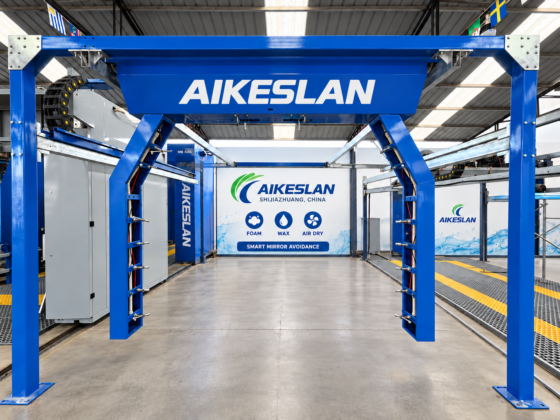
Aikesilun Touchless Car Wash Machine: Ingenious Technology
Many touchless systems also use sensors to detect the vehicle’s position and shape.
This helps guide the wash equipment around the car.
How Does a Touchless Car Wash Work?
A typical touchless wash includes several stages.
First, the machine detects the vehicle and checks its position.
Next, it applies cleaning chemicals to loosen dirt.
Then, high-pressure water removes the loosened dirt from the surface.
After that, the machine may apply another rinse, protective product, or spot-free rinse.
Finally, a dryer may remove excess water.
The exact process depends on the machine model and selected wash program.
Main Components of a Touchless Car Wash Machine
A commercial touchless car wash system may include:
- High-pressure water pumps
- Spray arms and nozzles
- Vehicle detection sensors
- Chemical dosing equipment
- Automatic control systems
- Water filtration units
- Drying fans
- Safety devices
Some machines also include underbody washing and wheel cleaning options.
However, the equipment package varies by manufacturer.
Therefore, buyers should request a full technical specification before purchasing.
Why Do Customers Choose Touchless Washing?
Some drivers prefer touchless washing because it avoids routine brush contact.
This can be attractive to owners of newer vehicles or customers who are careful about surface finishes.
However, touchless does not mean that a vehicle cannot be damaged.
Incorrect pressure, poor chemical control, damaged surfaces, or equipment faults can still create problems.
As a result, proper machine settings and maintenance remain essential.
3. What Is a Soft-Touch Car Wash?
A soft-touch car wash uses rotating brushes, cloth strips, or similar cleaning materials that touch the vehicle surface.
The contact helps remove dirt through mechanical action.
Modern systems may use foam, cloth, or other purpose-made wash materials.
However, the exact design differs between manufacturers.
How Does a Soft-Touch Car Wash Work?
First, the vehicle enters the wash area.
The machine applies water and cleaning chemicals.
Next, brushes or cloth materials move across selected vehicle surfaces.
Their movement helps loosen and remove dirt.
Then, the system rinses away the remaining chemicals and debris.
Finally, dryers may remove water from the vehicle.
Some soft-touch machines operate in a single bay. Others are part of larger tunnel car wash systems.
Main Components of a Soft-Touch Car Wash
A typical system may include:
- Rotating cleaning brushes
- Soft cloth or foam wash materials
- Electric drive motors
- Bearings and mechanical supports
- Vehicle detection sensors
- Chemical application equipment
- Rinse systems
- Drying equipment
Tunnel systems may also include conveyors and several cleaning stations.
Why Do Businesses Choose Soft-Touch Systems?
Mechanical cleaning can help remove dirt that is difficult to wash away using water and chemicals alone.
This can be useful in areas with road salt, heavy dust, or strong road film.
In addition, soft-touch systems can work well in commercial tunnel layouts.
However, cleaning materials must remain in good condition.
Damaged or contaminated brushes may increase the risk of surface marks.
Therefore, routine inspection and cleaning are important.
4. Which System Provides Better Cleaning Results?
Cleaning performance is one of the main differences between touchless and soft-touch systems.
However, the result depends on several factors.

Rendering of a gas station
These include the type of dirt, vehicle surface, cleaning chemicals, wash pressure, and cycle time.
Touchless Cleaning Performance
Touchless machines rely on chemicals and water pressure.
They can remove many common forms of surface dirt.
For example, they may work well for loose dust, light mud, and general road dirt.
However, heavy road film and bonded dirt can be harder to remove without physical contact.
In some cases, a second wash or manual cleaning may be needed.
Soft-Touch Cleaning Performance
Soft-touch systems add mechanical action.
As brushes or cloth materials move across the surface, they help break up dirt.
This can improve cleaning on heavily soiled vehicles.
For example, it may help remove road film from lower body panels.
However, the results still depend on brush condition, chemical quality, and machine settings.
Which Is Better for Heavy Dirt?
Soft-touch systems may have an advantage when strong mechanical cleaning is needed.
However, this does not mean every soft-touch machine outperforms every touchless machine.
A well-designed touchless system may clean better than a poorly maintained brush machine.
Therefore, buyers should request live demonstrations.
If possible, test vehicles with the types of dirt common in your market.
Consider Local Road Conditions
Different regions create different cleaning needs.
For example, northern parts of the United States and Canada may experience heavy road salt during winter.
Other regions may have high dust levels or frequent rain.
Therefore, your local environment should influence the machine choice.
A system that works well in one market may not be the best option in another.
5. Touchless vs. Soft-Touch Car Wash: Which Is Safer for Paint?
Vehicle paint safety is a major concern for many customers.
Touchless washing and soft-touch washing have different risk factors.
Touchless Car Wash Paint Safety
A touchless machine avoids routine physical contact from brushes and cloth materials.
This removes one possible source of contact-related marks.
However, high-pressure water and chemicals must be controlled carefully.
For example, incorrect chemical concentration may affect certain finishes or protective treatments.
High-pressure water may also cause problems on already damaged paint or loose trim.
Therefore, manufacturers should provide suitable operating limits.
Soft-Touch Car Wash Paint Safety
Soft-touch systems use direct contact.
When cleaning materials are suitable, clean, and properly maintained, they can provide effective washing.
However, dirt trapped in brushes or cloth may increase the risk of surface marks.
Poor alignment or worn materials may also create problems.
For this reason, operators should inspect and clean contact materials regularly.
What About Ceramic Coatings and Paint Protection Film?
Vehicles with ceramic coatings or paint protection film may have special care instructions.
The correct wash method depends on the coating or film product and its condition.
Therefore, operators should avoid claiming that one automatic wash method is safe for every protective finish.
Customers should follow the vehicle and coating manufacturer’s care guidance.
Final Paint Safety Comparison
Touchless washing avoids routine mechanical brush contact.
Soft-touch washing adds contact for stronger dirt removal.
Neither approach guarantees damage-free results.
For business owners, safe operation, equipment condition, and correct chemical use matter more than marketing claims.
6. Touchless vs. Soft-Touch Car Wash Equipment Costs
Equipment cost is another major factor.
However, the price depends on machine size, configuration, brand, and included accessories.
A basic touchless machine may cost less than a large soft-touch tunnel system.
Yet, a premium touchless machine may cost more than a compact soft-touch rollover model.
Therefore, it is not accurate to say that one cleaning method is always cheaper.
Touchless Equipment Cost Factors
Touchless systems may require high-pressure pumps, advanced spray systems, chemical dosing equipment, and vehicle detection technology.
More advanced systems may also include automatic positioning, multiple wash programs, and strong dryers.
These features can increase the initial price.
Soft-Touch Equipment Cost Factors
Soft-touch systems may require motors, brush assemblies, drive mechanisms, and cleaning materials.
Tunnel designs may also need conveyors and several washing stations.
As a result, large soft-touch systems can involve significant capital costs.
Compare Complete Equipment Packages
When comparing quotations, ask for the same level of detail from each supplier.
Check whether the price includes dryers, water treatment, controls, installation support, and spare parts.
Also, confirm shipping terms.
A low equipment quote may not include all the items needed to operate the system.
Therefore, compare the full project cost.
7. Which Car Wash Has Lower Operating Costs?
Operating cost can have a major effect on long-term profit.
The main expenses often include water, electricity, chemicals, maintenance, and labor.

Aikesilun Touchless Car Wash Machine: Ingenious Technology
However, the cost difference between touchless and soft-touch systems depends on the specific machine.
Water Consumption
Touchless systems use water pressure for cleaning.
Therefore, water use can be important.
Soft-touch systems use mechanical cleaning action, but they also need water.
In both cases, consumption depends on spray settings, wash time, and recycling equipment.
A well-designed water recovery system may reduce freshwater demand.
Electricity Consumption
Touchless systems may use high-pressure pumps and powerful dryers.
Soft-touch systems use motors to drive brushes and other moving parts.
Both types may use large amounts of electricity during certain stages.
Therefore, compare actual energy use per wash rather than installed power alone.
Chemical Costs
Touchless systems depend strongly on cleaning chemistry.
A suitable chemical process helps loosen dirt before rinsing.
Soft-touch systems also use chemicals, but mechanical contact helps remove dirt.
The cost depends on chemical concentration, dosing rate, and local prices.
Maintenance Costs
Touchless systems require pump, nozzle, seal, and control maintenance.
Soft-touch systems also need service for brushes, bearings, motors, and other moving parts.
Neither system is maintenance-free.
Labor Costs
Automatic systems can reduce manual washing work.
However, employees may still be needed for customer service, cleaning, inspections, and technical support.
Therefore, labor savings depend on your business model.
8. How Much Water Do Touchless and Soft-Touch Car Washes Use?
Water efficiency matters for both cost control and environmental planning.
However, water use varies widely between machines.
Factors include the number of wash stages, spray pressure, wash duration, and water recovery system.
Touchless Water Use
Touchless systems use spray nozzles to clean vehicle surfaces.
The required flow depends on the machine design and wash program.
Some systems use different pressure settings during pre-soak, washing, and rinsing.
Therefore, ask the supplier for water use per cycle.
Soft-Touch Water Use
Soft-touch machines use water together with brushes or cloth.
The mechanical action may reduce the need for some high-pressure washing stages.
However, the total water use still depends on the equipment layout.
A large tunnel system may use more total water per hour because it processes more cars.
Therefore, compare water use per vehicle.
Water Recycling Systems
A water recycling system collects and treats used wash water.
The treated water may then be reused during suitable stages.
This can reduce freshwater demand.
However, recycled water needs proper treatment.
For example, sediment, oil, and other contaminants may need to be removed.
The final rinse may also require higher-quality water.
Water Efficiency Buying Tip
Ask suppliers for the following data:
- Freshwater consumption per wash
- Total process water per wash
- Reclaimed water share
- Water pressure requirements
- Water treatment needs
These figures help buyers compare operating costs more accurately.
9. Maintenance: Which System Is Easier to Manage?
Maintenance affects machine uptime and customer satisfaction.
A machine that fails often can lose revenue.
Therefore, service planning should be part of the buying decision.
Touchless Maintenance

Aikesilun Reciprocating Car Wash Machine: Ingenious Technology
Touchless machines need regular checks of pumps, spray nozzles, chemical dosing systems, and sensors.
Nozzles may become blocked.
Pump seals and other parts may also wear over time.
In addition, water quality can affect performance.
Therefore, filtration and routine inspection are important.
Soft-Touch Maintenance
Soft-touch machines require regular inspection of brushes and moving parts.
Contact materials may become worn or dirty.
Motors, bearings, and drive systems also need service.
Operators should replace damaged materials before they affect wash quality.
Spare Parts Availability
For either machine type, spare parts support is important.
Ask the supplier which parts should be kept on site.
Also, confirm replacement lead times.
This matters especially when equipment is imported from another country.
Preventive Maintenance
Create a maintenance schedule based on the manufacturer’s instructions.
Include daily visual checks and periodic technical service.
In addition, train staff to report unusual sounds, leaks, or error messages.
This can help reduce unexpected downtime.
10. Touchless vs. Soft-Touch Car Wash for Gas Stations
Gas stations are an important market for automatic car wash equipment.
Many operators use car washing as an extra service.
For example, customers may receive a wash discount after buying fuel.
However, gas stations often have limited space.
Therefore, machine layout is an important factor.
Why Touchless May Suit Gas Stations
Compact touchless in-bay machines may fit well beside an existing fuel station.
Customers can park inside the wash bay while the machine completes the cycle.
In addition, the no-brush design may appeal to drivers who prefer low-contact cleaning.
However, wash time and performance should match local customer needs.
Why Soft-Touch May Suit Gas Stations
Soft-touch rollover machines can also fit in compact bays.
They may offer strong cleaning on vehicles exposed to road film and dirt.
However, they require regular care of cleaning materials and mechanical parts.
Choosing the Right Gas Station System
Consider site dimensions, traffic flow, expected vehicle volume, customer preferences, and operating costs.
Also, check whether the machine can work with your payment or loyalty system.
The best system should be convenient for customers and practical for staff.
11. Which System Is Better for High-Volume Car Wash Businesses?
High-volume commercial sites need to serve many vehicles efficiently.
Therefore, washing capacity is often a major factor.
Touchless High-Volume Systems
Some touchless systems are designed for commercial use.
However, a single in-bay touchless machine generally washes one vehicle at a time.
This can limit throughput during busy periods.
Multiple bays may be an option where space allows.
Soft-Touch Tunnel Systems
Soft-touch tunnel systems can process several vehicles through different stages.
For busy locations, this may support higher throughput.
However, a tunnel system needs more space and investment.
It also requires careful vehicle movement and safety management.
Compare Real Capacity
Do not choose equipment based only on advertised washing speed.
Ask how many vehicles the system can wash per hour under normal operating conditions.
Also, include entry, positioning, drying, and exit time.
This gives a more realistic picture of daily capacity.
12. Which Car Wash Is Best for Different Business Types?
The best automatic car wash depends on how the equipment will be used.
Gas Stations
Compact touchless or soft-touch rollover systems may be suitable.
The main priorities are space efficiency, convenience, and manageable operating costs.
Car Dealerships
Dealerships often need repeatable cleaning for vehicles before delivery or after service.
Both systems can work.
However, cleaning performance and compatibility with vehicle finishes are important.
Commercial Car Wash Centers
A busy commercial center may consider a tunnel system.
However, the final choice depends on daily traffic, available land, and investment budget.
Fleet Operators
Fleet operators may wash delivery vehicles, rental cars, or taxis.
They often need predictable cleaning times and reliable equipment.
Vehicle size and type should guide the decision.
Equipment Distributors
Distributors should compare product range, technical documentation, warranty terms, and spare parts support.
They should also review compliance needs in their target markets.
13. How to Calculate Car Wash Business ROI
Return on investment helps business owners compare different equipment choices.
However, ROI depends on more than the machine price.

Aikesilun Tunnel-Style Car Wash: Expertly Crafted Technology
It also depends on customer demand, average wash price, expenses, and equipment uptime.
Step 1: Estimate Daily Wash Volume
Start with the number of vehicles you expect to wash each day.
Use realistic local traffic data.
Do not assume the machine will operate at full capacity every hour.
Step 2: Estimate Revenue
Multiply daily wash volume by the average wash price.
For example, 40 washes per day at $12 per wash would generate $480 in daily gross revenue.
Over 30 operating days, that equals $14,400 in monthly gross revenue.
However, this is not net profit.
Step 3: Estimate Operating Costs
Include water, power, chemicals, maintenance, labor, rent, insurance, and other expenses.
Also, allow for downtime.
Step 4: Calculate Payback
Divide the initial investment by the monthly net cash flow available to recover it.
For example, a project costing $120,000 with $5,000 in monthly net cash flow would have a simple payback period of 24 months.
This is only an illustrative calculation.
Real results depend on local market conditions.
Step 5: Compare Both Systems
Prepare separate financial models for touchless and soft-touch equipment.
Use actual supplier quotations and operating data.
Then, compare the results under different customer demand scenarios.
14. How to Choose a Reliable Automatic Car Wash Manufacturer
The equipment manufacturer affects both machine performance and long-term service.
Therefore, buyers should evaluate suppliers carefully.
Review Technical Specifications
Ask for complete machine details.
These should include wash capacity, vehicle clearance, power requirements, and water consumption.
Also, request a full component list.
Check Factory Testing
A reliable manufacturer should explain its quality control process.
Ask about mechanical testing, electrical testing, and safety checks.
For complex equipment, request an agreed factory acceptance test.
Confirm Local Compliance
Equipment used in Europe, the United States, or Canada may need to meet local safety and electrical rules.
Therefore, check the relevant requirements before ordering.
Do not rely only on a supplier’s general statement that a machine is certified.
Review Warranty Terms
Check the warranty length and what it covers.
Also, ask who pays for replacement parts, shipping, and labor.
Ask About Installation Support
Some manufacturers offer remote installation guidance.
Others may provide on-site support.
Confirm availability, language, travel costs, and service conditions.
15. Common Mistakes When Choosing Between Touchless and Soft-Touch Systems
Choosing a car wash system based only on marketing claims can lead to poor results.
Here are several mistakes to avoid.
Mistake 1: Assuming Touchless Always Cleans Better
Touchless machines can provide effective washing.
However, stubborn dirt may require mechanical action.
Therefore, test cleaning performance before buying.
Mistake 2: Assuming Soft-Touch Always Damages Paint
Modern soft-touch systems use purpose-made cleaning materials.
However, poor maintenance can increase paint risk.
The correct approach is to evaluate the actual equipment and service process.
Mistake 3: Comparing Only Equipment Prices
A cheaper machine may have higher operating costs.
Therefore, compare the total cost of ownership.
Mistake 4: Ignoring Local Road Conditions
Different markets have different cleaning challenges.
For example, winter road salt and heavy dust may affect equipment needs.
Mistake 5: Overlooking Maintenance
Both systems require regular service.
Ask for maintenance schedules and spare parts lists before ordering.
Mistake 6: Choosing Too Much Capacity
A large tunnel system may look attractive.
However, low demand can make the investment difficult to recover.
Match the equipment to realistic vehicle volume.
16. Key Questions to Ask Before Buying
Before purchasing commercial car wash equipment, prepare a clear request for quotation.
Ask suppliers about the machine’s cleaning method and technical design.
Also, confirm what is included in the price.
Important questions include:
- What cleaning method does the machine use?
- What is the maximum vehicle size?
- How many cars can it wash per hour?
- What is the water use per wash?
- How much energy does each wash program use?
- What chemicals are recommended?
- What maintenance is required?
- Which spare parts should be kept on site?
- What safety features are included?
- What support is available after installation?
These questions can help you compare touchless and soft-touch systems more fairly.
17. Frequently Asked Questions
Is a touchless car wash better than a soft-touch car wash?
Neither system is best for every business. Touchless washing avoids routine brush contact, while soft-touch washing uses mechanical cleaning action. The right choice depends on vehicle conditions, customer preferences, site needs, and operating costs.
Which car wash is safer for vehicle paint?
Touchless washing removes the risk linked to direct brush contact. However, chemicals and water pressure must still be controlled. Soft-touch systems also need clean and well-maintained contact materials. Neither method guarantees zero risk.
Does a touchless car wash remove heavy dirt?
Touchless systems can remove many common types of dirt. However, heavy road film and stubborn deposits may be harder to remove without physical contact. Cleaning results depend on chemicals, water pressure, and wash program design.
Are soft-touch car wash brushes safe?
Modern soft-touch systems may use gentle cleaning materials. However, safety depends on brush condition, cleanliness, machine settings, and vehicle condition. Regular inspection and maintenance are essential.
Which system uses less water?
Water use depends on the exact machine, wash program, and recycling system. Neither method always uses less water. Compare fresh water consumption per vehicle using supplier test data.
Which car wash machine is cheaper?
Prices vary widely. A compact touchless machine may cost less than a large soft-touch tunnel. However, some premium touchless systems may cost more than compact brush machines. Compare equivalent equipment packages.
Which system is better for a gas station?
Both touchless and soft-touch rollover machines can suit gas stations. The best choice depends on available space, vehicle traffic, customer preferences, and maintenance resources.
Is a soft-touch car wash good for heavy road dirt?
The mechanical action of soft-touch equipment can help remove stubborn road film and dirt. However, cleaning quality depends on brush condition, chemical use, and machine design.
Can I import touchless and soft-touch car wash machines from China?
Yes. Chinese manufacturers offer several types of automatic car wash equipment. Buyers should verify technical specifications, factory quality, local compliance needs, shipping costs, and after-sales support.
Which car wash system has better ROI?
The better ROI depends on the total investment, local demand, wash prices, operating expenses, and equipment uptime. Prepare a financial comparison using realistic data for both systems.
18. Final Verdict: Touchless or Soft-Touch Car Wash?
Touchless and soft-touch car wash machines can both support a successful automatic car wash business.
However, they serve different needs.
Touchless systems are suitable for businesses that want to offer low-contact vehicle cleaning.
Soft-touch systems may be attractive where strong mechanical cleaning is needed.
For compact gas stations, either method can work in a suitable in-bay layout.
For busy commercial locations, a tunnel system may offer greater capacity.
However, the cleaning method alone does not determine business success.
Equipment reliability, customer demand, operating costs, maintenance, and service support also matter.
Before buying, compare technical specifications and request realistic operating data.
If possible, test both systems using the types of vehicles and dirt common in your market.
The best automatic car wash machine is the one that fits your customers, location, budget, and long-term business goals.
Get Expert Guidance on Automatic Car Wash Equipment
Are you planning to invest in an automatic car wash system?
Whether you need a touchless machine, a soft-touch rollover system, or a high-capacity tunnel car wash, the right equipment choice starts with your project needs.
A technical review can help you compare available machine configurations, installation requirements, wash capacity, and operating costs.
Contact our team to discuss your project and request a customized equipment quotation.
To help us understand your needs, please share your destination country, business type, available installation space, and expected daily vehicle volume.
Request Your Automatic Car Wash Machine Quote Today.