 Aikeslan | Fully Automatic Car Wash Machine Manufacturer
How to Avoid Costly Mistakes When Buying a Car Wash Machine
2026 Complete B2B Buying Guide: Equipment Types, Hidden Costs, Technical Specifications, Site Planning, Supplier Selection, Import Requirements, Maintenance, and ROI
Introduction: A Smart Car Wash Investment Starts Before You Buy
Buying a commercial car wash machine can be a major investment. The right equipment can help a business offer a reliable service, attract customers, and create a new source of revenue.
However, the wrong purchase can lead to unexpected costs.
A machine may be too large for the available site. It may need more electricity than the property can supply. Its water demand may exceed the local supply. In other cases, the buyer may discover that installation, freight, or spare parts were not included in the original quotation.
These problems can affect the business long after the machine arrives.
Therefore, understanding car wash machine buying mistakes is an important part of commercial equipment planning.
The lowest equipment price does not always create the lowest total project cost. Likewise, the fastest machine is not always the most profitable choice.
Buyers need to consider equipment type, technical performance, customer demand, installation conditions, maintenance, and supplier support.
This guide explains the most common mistakes buyers make when purchasing an automatic car wash machine. It also provides practical steps to reduce risk.
Whether you operate a gas station, convenience store, dedicated wash center, or fleet business, these principles can help you make a more informed investment.
Quick Answer: How Can Buyers Avoid Costly Car Wash Machine Buying Mistakes?
The best way to avoid costly mistakes is to confirm business demand, verify site conditions, compare complete installed costs, and check supplier documentation before ordering.
Start by selecting the correct equipment category. Then request model-specific technical data, including dimensions, wash cycle time, water supply, electrical requirements, and maintenance needs.
Ask suppliers to explain what is included in their quotations.
Check shipping, customs, installation, commissioning, warranty, and spare-parts responsibilities.
Finally, build a realistic financial model using expected customer volume and local operating costs.
A strong purchasing decision is based on verified specifications and realistic assumptions, not attractive marketing claims alone.
1. Mistake: Buying the Cheapest Car Wash Machine

Installation Visualization
Price matters, but it should not be the only purchasing factor.
Two automatic car wash machines may have very different equipment configurations.
One quotation may include brushes, pumps, dryers, and control equipment. Another may exclude selected accessories or installation services.
As a result, the lower quoted price may not represent the lower total investment.
A cheap machine can also become expensive if replacement parts are difficult to obtain or technical support is limited.
Therefore, buyers should compare the full equipment scope.
Ask for a detailed bill of materials or equipment list.
Review the warranty, spare parts, and maintenance requirements.
The goal is not simply to find the lowest price. It is to find equipment that delivers suitable value over its operating life.
2. Mistake: Choosing the Wrong Type of Automatic Car Wash
Different automatic car wash systems serve different business needs.
The main options include in-bay rollover systems and conveyor tunnel systems.
Cleaning technologies may include touchless, soft-touch, or hybrid designs.
However, machine layout and cleaning method are not the same thing.
A rollover machine can use brushes or a touchless cleaning process. Likewise, a tunnel can include contact or non-contact stages.
Buyers should first decide how the business will operate.
A compact gas station may need a single automatic wash bay.
Meanwhile, a dedicated high-volume wash center may require greater throughput.
Choosing the wrong format can lead to excessive investment or insufficient capacity.
3. Touchless vs. Soft-Touch: Do Not Choose by Marketing Alone
Touchless and soft-touch washing use different methods to remove dirt.
Touchless systems rely on water, chemicals, and spray coverage without cleaning brushes touching the body.
Soft-touch systems use designed cleaning media to assist dirt removal.
Each method has benefits and limitations.
For example, contact cleaning may help with certain types of road film. However, it also introduces brush maintenance and vehicle compatibility considerations.
Touchless cleaning avoids brush contact but requires suitable chemistry and water application.
Therefore, buyers should not assume that one technology is always cleaner, safer, or more efficient.
Ask for cleaning demonstrations using comparable vehicles and wash programs.
4. Mistake: Overestimating Customer Demand
A machine’s rated capacity is useful only if enough customers use it.
For example, a site may buy a high-capacity tunnel system based on optimistic sales estimates.
However, actual traffic could be much lower.
In that case, the business may carry unnecessary capital and fixed costs.
Therefore, demand research should come before equipment selection.
Review local traffic, competitors, weather patterns, customer habits, and nearby businesses.
If you already operate a fuel station, examine customer transactions and the potential demand for washing.
Use conservative forecasts.
A smaller machine with good utilization may provide better financial results than a much larger system with low demand.
5. Mistake: Confusing Wash Cycle Time With Real Capacity
Some suppliers advertise a short wash cycle.
However, the cycle time may not include vehicle entry, positioning, payment, or exit.

LiShua System
These additional steps affect real throughput.
Consider a machine with a five-minute wash program.
Its ideal machine-only capacity is:
60 ÷ 5 = 12 washes per hour
Now assume vehicle entry and exit take another two minutes, without overlapping the wash.
The complete service time becomes seven minutes.
The idealized rate is then:
60 ÷ 7 ≈ 8.6 washes per hour
Actual performance may be lower because of delays.
Therefore, ask suppliers for both machine cycle time and complete vehicle service time.
6. Mistake: Ignoring Available Installation Space
A machine may fit the building but still be unsuitable for the property.
The equipment itself requires space. However, the site also needs room for vehicle entry, exit, maintenance, and utility connections.
Some installations need additional clearance above or beside the machine.
A rollover system may require a defined travel area.
A tunnel requires a suitable conveyor route and loading space.
Therefore, buyers should provide accurate site drawings before ordering.
Do not rely only on a brochure’s machine dimensions.
Ask for a complete installation layout with all required clearances.
A qualified local professional should confirm the design before construction begins.
7. Mistake: Forgetting Vehicle Entry and Exit Routes
Vehicle circulation is a common source of hidden project problems.
Customers need a practical route into the wash.
They also need enough space to leave safely.
A poorly planned entry may slow down operations or interfere with fuel pumps and parking areas.
Similarly, insufficient queue space can create congestion.
Therefore, site planning should include the full customer journey.
Review payment location, waiting lanes, turning areas, and exit visibility.
Consider peak-hour traffic rather than average conditions alone.
A fast machine cannot deliver its potential capacity if drivers struggle to enter the facility.
8. Mistake: Not Checking Vehicle Size Compatibility
Not every automatic wash can accommodate every vehicle.
Machines have defined limits for height, width, length, and sometimes other characteristics.
SUVs, vans, pickup trucks, and vehicles with external accessories may need special consideration.
A machine designed mainly for passenger cars may not suit larger commercial vehicles.
Therefore, buyers should identify the vehicles they intend to serve.
Ask for written size limits and accessory restrictions.
Do not assume that a machine is suitable for all vehicles because it is advertised as commercial equipment.
Vehicle compatibility also affects customer satisfaction and operational safety.
9. Mistake: Overlooking Electrical Requirements
Electrical compatibility is essential.
Commercial automatic car wash machines may use multiple motors, pumps, dryers, and control components.
Their supply requirements can differ by model and destination market.
For example, equipment intended for a particular voltage and frequency may not be suitable for another site without an appropriate design.
Therefore, the supplier should provide complete electrical specifications.
These should include supply voltage, frequency, phase, connected load, and other relevant installation information.
A qualified local electrician or electrical engineer should review the requirements.
Do not assume that a plug change is enough to make imported machinery compatible.
10. Mistake: Ignoring Water Flow and Pressure
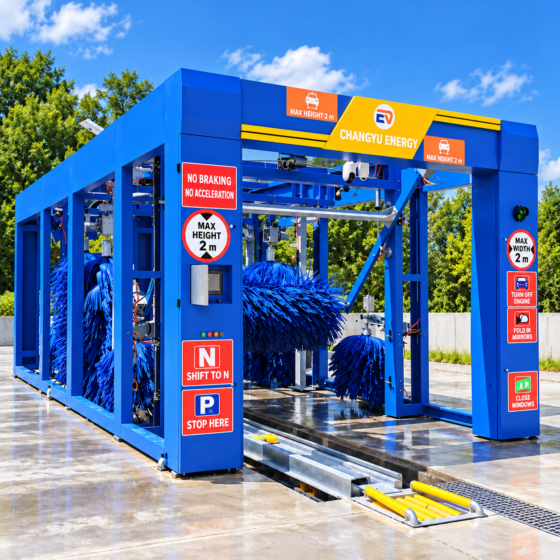
Tunnel Car Wash Machine
Water supply conditions directly affect washing performance.
However, buyers sometimes focus only on water pressure.
The machine also needs adequate water flow.
A site may have acceptable static pressure but insufficient flow when equipment is operating.
As a result, cleaning performance may suffer.
Therefore, request the machine’s required inlet pressure and flow rate.
Verify the property’s available supply under realistic conditions.
Water storage or booster systems may be necessary in some projects.
However, these additions increase installation costs.
They should be evaluated before the purchase agreement is signed.
11. Mistake: Underestimating Drainage and Wastewater Requirements
Commercial car washes generate wastewater.
The installation may require drainage channels, sediment handling, oil and grease management, and other treatment measures.
Requirements vary by location.
Therefore, buyers should not assume that existing site drainage is suitable.
Ask a qualified local professional to review wastewater discharge conditions.
The design should also address vehicle movement and standing water.
A machine may be ready to operate mechanically but unable to open because site drainage approval is incomplete.
Planning this work early helps avoid costly delays.
12. Mistake: Ignoring Water Recycling Options
Water efficiency can affect long-term costs.
Some automatic car wash systems use reclaimed water for selected washing stages.
However, the treatment required depends on how the recovered water is used.
The US Environmental Protection Agency’s November 2023 WaterSense guidance explains that water reclamation can reduce fresh-water demand in commercial vehicle washing.
It also recommends matching water treatment quality to the intended reuse stage.
Therefore, buyers should ask whether the proposed machine supports water reclamation.
Review the complete treatment system, not just the storage tank.
Consider filtration, maintenance, energy, and local discharge requirements.
13. Mistake: Believing Every Water-Saving Claim
A supplier may advertise low water consumption per wash.
However, this number needs context.
Does it refer to fresh water or total water circulated?
Does it include the selected wash program?
Was reclaimed water used?
Were all rinse stages included?
Without these details, two figures may not be comparable.
Therefore, request water consumption information under defined test conditions.
For a real installation, metering can help verify actual use.
The EPA’s WaterSense vehicle wash guidance is useful background, but historical industry averages are not guaranteed performance figures for a particular machine.
Buyers should rely on model-specific data.
14. Mistake: Ignoring Cleaning Performance

Tunnel Car Wash Machine
A machine may look impressive in a showroom.
However, a strong visual design does not prove good cleaning performance.
Cleaning depends on water delivery, chemical application, equipment movement, and the type of dirt.
Vehicle shapes also influence coverage.
Therefore, buyers should ask for a realistic cleaning demonstration.
Compare similar vehicles under similar conditions.
Inspect difficult areas such as lower panels, wheels, rear sections, and other permitted surfaces.
Ask which wash programs and chemicals were used.
A clear demonstration can reveal more than a general claim of superior cleaning.
15. Mistake: Choosing Equipment Based Only on Pump Pressure
High pump pressure is often promoted as a major technical feature.
However, pressure alone does not determine cleaning quality.
Nozzle design, water flow, spray distance, coverage, and chemistry also matter.
A narrow high-pressure spray may not provide broad surface coverage.
Likewise, incorrect nozzle placement can leave certain areas poorly cleaned.
Therefore, compare the complete water delivery system.
Ask for pump operating data and spray configuration details.
A reliable supplier should explain how the equipment is designed to clean the intended vehicles.
More pressure is not automatically better.
16. Mistake: Ignoring the Drying System
Customers judge a wash by the final appearance of the vehicle.
A machine may remove dirt successfully but leave large amounts of water behind.
Poor drying can lead to complaints.
However, dryer performance depends on more than motor power.
Blower airflow, outlet location, vehicle shape, and drying time all matter.
Therefore, buyers should review dryer configuration and realistic results.
Ask whether the machine uses fixed or moving drying outlets.
Confirm which vehicle types have been tested.
Also review electricity use and noise.
A strong drying system should balance customer expectations with operating costs.
17. Mistake: Overlooking Brush Maintenance
Brush-based machines require appropriate care.
Cleaning media can wear, collect contaminants, or become damaged.
The associated motors, bearings, and drives also need maintenance.
Therefore, buyers should review the complete brush system.
Ask which materials are used and how replacement is handled.
Check the recommended inspection intervals.
The supplier should also provide vehicle restrictions and operating instructions.
A machine with brushes is not automatically unsuitable.
However, buyers should understand the additional maintenance responsibilities before purchasing.
18. Mistake: Not Reviewing Sensors and Control Functions
Automatic washing relies on coordinated movement.
Sensors may help detect vehicle position, equipment travel, or other operating conditions.
A PLC or another control platform may coordinate the wash stages.
However, buyers should not assume that every machine includes the same intelligent features.
Ask what the sensors actually detect.
Review the fault messages available to operators.
Determine how the system responds to abnormal conditions.
Also distinguish normal process controls from validated safety-related functions.
A clear technical description is more valuable than a broad claim that a machine is fully intelligent.
19. Mistake: Ignoring Machinery Safety
Automatic car washes contain moving equipment, electricity, and pressurized systems.
Therefore, safety should be a core procurement requirement.
Buyers should review relevant guards, protective devices, operating restrictions, emergency-stop arrangements, and maintenance procedures.
However, safety requirements vary by market and application.
A machine that meets one country’s requirements may need additional assessment for another destination.
Request technical documentation and applicable conformity information.
Qualified local professionals should review the installation.
A low purchase price is not a good deal if essential safety responsibilities have not been addressed.
20. Mistake: Treating the Equipment Quote as the Total Project Cost
A machine quotation may cover only the equipment.
However, the complete project can include many additional expenses.
These may include:
- International freight
- Customs clearance
- Import duties and applicable taxes
- Site preparation
- Foundations and drainage
- Electrical installation
- Water supply improvements
- Wastewater treatment
- Installation labor
- Testing and commissioning
- Staff training
- Spare parts
- Ongoing service
Therefore, buyers should request a detailed project budget.
The scope of each supplier quotation must be clearly defined.
This is one of the most important ways to avoid unexpected spending.
21. Example: Comparing Equipment Price With Installed Cost
Consider a hypothetical commercial wash project.
The supplier quotes a machine price of $95,000.
However, the buyer must also pay for site preparation, shipping, utilities, and installation.
| Cost Item | Illustrative Amount |
|---|---|
| Equipment purchase | $95,000 |
| Freight and handling | $8,000 |
| Site preparation | $22,000 |
| Electrical and water works | $15,000 |
| Installation and commissioning | $10,000 |
| Initial spare parts and contingency | $10,000 |
| Estimated project total | $160,000 |
These are example numbers only.
They are not market quotations or typical costs for a specific machine.
The actual budget depends on the project, destination, import duties, taxes, and installation scope.
22. Mistake: Not Comparing Quotations on the Same Basis
A supplier comparison is only useful when the offers include equivalent items.
For example, one quote may include drying blowers and chemical dosing equipment.
Another may list them as optional upgrades.
A third may include commissioning but exclude international freight.
Therefore, create a side-by-side quotation table.
Use the same technical requirements for each supplier.
Confirm included components and optional items.
Ask each supplier to explain exclusions.
Also compare warranty coverage and service arrangements.
This reduces the risk of choosing a lower price that does not include everything the business needs.
23. Mistake: Ignoring Freight and Delivery Terms
International equipment orders require careful logistics planning.
A large wash machine may need container shipping, special handling, or local unloading equipment.
Therefore, buyers should confirm packaging dimensions and weight.
They should also understand the agreed Incoterms.
For example, EXW, FOB, CIF, and DAP define different delivery responsibilities and cost allocations.
However, an Incoterm does not by itself establish every aspect of customs, taxation, or installation responsibility.
The purchase contract should clearly state the agreed version and named place.
Buyers should confirm freight insurance, unloading, and customs arrangements before shipment.
24. Mistake: Not Checking Import Duties and Taxes
Import costs can change the final equipment budget.
However, duties and taxes depend on the destination country, product classification, origin, and applicable rules.
Therefore, buyers should not rely on a generic tariff estimate.
For United States imports, the importer of record has important responsibilities for customs declarations, classification, and valuation.
Other countries have their own import requirements.
A qualified customs broker can help clarify the process.
Buyers should confirm their likely landed cost before placing an order.
Tariffs can change, so calculations should use current information for the expected import date.
25. Mistake: Assuming Export Experience Guarantees Local Compliance
A manufacturer may have supplied equipment internationally for years.
However, that experience does not automatically establish compliance for every destination market.
Buyers should review the rules applicable to their project.
In the European Union, the machinery framework includes relevant conformity assessment, documentation, and safety obligations.
Regulation (EU) 2023/1230 generally applies from 20 January 2027, subject to provisions with different dates.
UK requirements must be checked separately.
North American projects may also involve electrical certification, workplace safety, and local permitting.
Therefore, ask the supplier which documents it can provide.
Local professionals should confirm any remaining obligations.
26. Mistake: Not Checking the Manufacturer’s Background
A website can look professional without proving manufacturing capability.
Therefore, buyers should verify the supplier.
Ask whether the company manufactures the equipment or acts as a trading business.
Request company information, technical documents, and evidence of relevant manufacturing experience.
A factory visit or independent inspection may help for a major order.
However, photographs and videos alone do not prove every claim.
Buyers should also compare the supplier’s technical answers with its product specifications.
Consistent documentation and clear communication are useful indicators.
Avoid basing a large purchase only on promotional material.
27. Mistake: Choosing a Supplier Without After-Sales Support
Support arrangements are important for commercial equipment.
A machine may work well at installation but eventually require parts, adjustments, or service.
Therefore, ask what happens after delivery.
Will the supplier provide technical manuals?
Are troubleshooting documents available?
Is remote support offered?
Can replacement parts be shipped quickly?
Are local technicians available?
Does support involve extra fees?
Get these answers in writing.
A broad promise of lifetime support is less useful than clear warranty terms, service channels, and spare-parts procedures.
28. Mistake: Ignoring Spare-Parts Availability
Even well-maintained machines may need replacement components.
Common service items vary by system.
They may include sensors, valves, seals, brushes, pumps, or selected drive components.
However, compatibility is essential.
Buyers should ask for the manufacturer’s spare-parts list.
Check whether key parts are proprietary or available through recognized component suppliers.
Confirm expected availability and purchasing procedures.
For overseas installations, shipping time can affect downtime.
Therefore, consider which critical parts should be kept locally.
A clear maintenance and spare-parts plan can reduce the risk of long service interruptions.
29. Mistake: Failing to Clarify Warranty Terms
A warranty should describe what the supplier is actually responsible for.
However, buyers sometimes focus only on the warranty duration.
Coverage details are equally important.
For example, a warranty may exclude consumable parts, incorrect installation, or damage caused by unsuitable operation.
Labor and international freight may also be treated separately.
Therefore, review the terms before ordering.
Ask when the warranty starts.
Confirm how a claim is submitted and what evidence is required.
Also determine whether the buyer or supplier pays for replacement shipping.
Written details reduce the chance of disputes.
30. Mistake: Skipping Installation and Commissioning Planning
A machine is not ready for commercial operation simply because it has arrived.
It must be installed correctly.
The site may need civil works, utility connections, alignment, and control setup.
The machine must then be commissioned and tested.
Therefore, clarify who is responsible for each stage.
Does the supplier provide on-site technicians?
Will installation be completed by a local contractor?
Who checks the protective functions?
Who trains operators?
What documents are signed at handover?
A complete commissioning plan reduces uncertainty.
Buyers should also reserve enough time for inspection and correction before opening the wash to customers.
31. Mistake: Not Planning Staff Training
Automatic equipment still needs trained operators.
Staff should understand normal operating procedures, vehicle restrictions, fault messages, and emergency response.
However, they should also know which tasks require a qualified technician.
For example, a staff member may be allowed to record an alarm but not to open an electrical cabinet or clear a moving mechanism.
Therefore, operator training should form part of commissioning.
Ask the supplier for understandable manuals and training materials.
Create a site-specific operating checklist.
Good training helps protect customers, staff, and equipment.
32. Mistake: Ignoring Maintenance Costs
Maintenance is a continuing operating expense.
The actual cost depends on machine design, usage, environment, and service arrangements.
Therefore, buyers should request the recommended maintenance schedule.
Ask which parts require routine inspection or replacement.
Consider labor costs.
Check whether service tasks require specialist technicians.
Also review the cost and availability of consumables.
A machine with a low purchase price may still create higher total costs if servicing is complex.
However, these differences should be verified through written specifications and operating evidence.
33. Mistake: Not Calculating Total Cost of Ownership
Total cost of ownership, or TCO, includes more than equipment purchase and installation.
It also covers relevant operating costs across the expected ownership period.
These may include water, electricity, chemicals, maintenance, parts, repairs, and downtime.
A simple planning formula is:
Total Cost of Ownership = Installed Cost + Operating Costs + Maintenance and Repairs + Other Ownership Costs − Residual Value
This is a simplified model.
Financing, taxes, inflation, and the time value of money may also matter.
Therefore, buyers should calculate several scenarios.
The best investment is not always the machine with the lowest initial cost.
34. Mistake: Believing Unrealistic Profit Promises
Some equipment advertisements emphasize high monthly income or very short payback periods.
However, machine ownership does not guarantee sales.
Revenue depends on location, customer demand, prices, marketing, weather, and competition.
Therefore, buyers should examine the assumptions behind any profitability claim.
How many vehicles must use the machine each day?
What is the average wash price?
How much does each wash cost to deliver?
How many days will the facility operate?
What fixed expenses remain?
A realistic financial model should include low-demand conditions, not only the best-case scenario.
35. Example: Estimating Monthly Car Wash Revenue
Consider a hypothetical car wash business.
Assume the machine completes 40 paid washes per day.
The average selling price is $12.
The site operates 26 days per month.
Monthly gross wash revenue would be:
40 × $12 × 26 = $12,480
Now suppose variable costs average $3.50 per wash.
Monthly variable costs would be:
40 × $3.50 × 26 = $3,640
The remaining contribution before fixed costs is:
$12,480 − $3,640 = $8,840
However, this is not net profit.
Rent, staff, insurance, maintenance, financing, and other expenses still need to be included.
All values are illustrative.
36. How to Estimate Simple Payback
Suppose the total installed project cost is $160,000.
Assume the business generates $48,000 per year in incremental cash contribution after relevant operating costs.
A simple payback estimate would be:
$160,000 ÷ $48,000 ≈ 3.3 years
However, this estimate is not a guaranteed return.
It does not account for financing, taxes, major future repairs, or the time value of money.
The model also assumes that demand remains stable.
Therefore, buyers should calculate conservative, expected, and optimistic scenarios.
For large investments, a detailed cash flow assessment may be more appropriate.
37. Mistake: Forgetting Seasonal Demand
Vehicle washing demand can change throughout the year.
Rain, snow, local driving conditions, and customer behavior may influence wash frequency.
For example, winter road salt may create washing demand in some regions.
However, freezing weather may also limit operation if the site is not properly equipped.
Other markets may experience different seasonal patterns.
Therefore, buyers should review local demand instead of using a fixed daily wash estimate throughout the year.
A realistic business plan should include quieter months.
This helps determine whether the project can cover fixed costs during periods of lower sales.
38. Mistake: Ignoring Competitor Research
A new machine does not guarantee a competitive business.
Customers may already have several wash options nearby.
Therefore, buyers should research local competitors before investing.
Review their locations, wash packages, pricing, customer experience, and operating models.
However, do not assume that a competitor’s advertised machine capacity reflects its real sales volume.
Use multiple sources of evidence.
The purpose of research is to understand customer expectations and market gaps.
For example, a convenience store may attract customers through fuel-and-wash packages.
A dedicated wash facility may compete through speed, quality, or membership services.
Equipment selection should support the chosen strategy.
39. Mistake: Buying More Features Than the Business Needs
Additional functions may look attractive.
However, every feature can affect the price, maintenance requirements, or operating process.
Some customers may value premium drying, underbody washing, or multiple wash programs.
Other sites may need a simpler service.
Therefore, buyers should separate essential functions from optional upgrades.
Start with the expected customer demand.
Then select features that support a realistic business case.
Avoid buying expensive accessories only because they appear in a competitor’s machine.
A suitable equipment configuration should match the site and target market.
40. Mistake: Not Planning for Future Expansion
A business may begin with modest wash volume and grow over time.
Therefore, it can be useful to consider future equipment needs.
However, future expansion should not justify unnecessary spending today.
Ask whether the installation allows practical upgrades.
For example, can the payment system support additional service packages?
Is there space for supporting equipment?
Can selected components be replaced or expanded?
The answers depend on the machine and site.
Buyers should request information about compatible upgrades.
A flexible plan may reduce future disruption while keeping the initial investment reasonable.
41. How to Build a Supplier Comparison Scorecard
A weighted scorecard can help buyers compare offers.
The importance of each factor depends on the project.
| Evaluation Area | Example Weight |
|---|---|
| Technical suitability | 25% |
| Cleaning performance | 20% |
| Installed project cost | 20% |
| Maintenance and reliability | 15% |
| Supplier support | 10% |
| Documentation and compliance | 10% |
| Total | 100% |
These weights are illustrative, not an industry standard.
Buyers should score suppliers using comparable evidence.
For example, compare documented water consumption under similar programs.
Likewise, compare complete installed cost rather than equipment price alone.
This approach supports a more balanced purchasing decision.
42. Buying an Automatic Car Wash Machine From China
China has manufacturers that supply automatic car wash equipment for domestic and international markets.
However, overseas buyers should approach procurement carefully.
Start by confirming the supplier’s identity and the exact machine model.
Request technical drawings, operating specifications, and a complete quotation.
Check electrical compatibility and destination-market documentation.
Clarify the manufacturing, inspection, shipping, and installation arrangements.
Buyers should also review warranty and technical support terms.
For a major purchase, a pre-shipment inspection may be useful.
However, factory inspection does not replace installation testing or local compliance assessment.
A successful import requires both suitable equipment and a clear project plan.
43. What to Check Before Paying a Deposit
Before making a deposit, confirm the purchase agreement.
The contract should identify the equipment model and included configuration.
It should also cover delivery responsibilities, payment terms, inspection, warranty, and documentation.
Ask whether the supplier will provide installation drawings before manufacturing or shipment.
Confirm the production and delivery schedule.
If custom specifications are required, they should be documented.
Buyers should also establish how disputes or changes will be handled.
A written purchase agreement reduces the risk of misunderstanding.
For international contracts, professional legal and trade advice may be appropriate.
44. Factory Inspection and Pre-Shipment Testing
A pre-shipment inspection can help confirm whether the supplied equipment matches the order.
However, the scope of testing matters.
Buyers should agree on the inspection criteria in advance.
These may include visible equipment condition, component identification, control functions, and available factory tests.
Some performance tests may require a complete operating installation.
Therefore, not every site-related requirement can be verified before shipment.
The supplier should provide test records where applicable.
Buyers should also plan for final commissioning at the destination site.
Both stages have value, but they serve different purposes.
45. Car Wash Machine Buying Mistakes for Gas Stations
Gas stations often purchase automatic washing equipment to support customer retention and additional sales.
However, several mistakes are especially relevant.
One is selecting a machine that interferes with fuel station traffic.
Another is assuming that fuel customers will automatically purchase washing services.
A third is underestimating water, drainage, or staffing requirements.
Therefore, the station should review customer demand and the available property layout.
The wash should support the site’s broader retail operations.
Compact rollover equipment may be suitable for some properties.
However, the final choice depends on verified installation and business requirements.
46. Car Wash Machine Buying Mistakes for Convenience Stores
Convenience stores often have limited space and a mix of vehicle movements.
Therefore, wash equipment must fit the location carefully.
Buyers should review queue space, payment access, and maintenance arrangements.
They should also consider the customer experience.
A complex machine may offer more features, but it may not provide better value for a small retail site.
The equipment should be straightforward to operate within its approved conditions.
After-sales support is also important because the store may not have specialist maintenance staff.
A suitable configuration balances practical service with long-term operating needs.
47. Mistakes Made by Dedicated Car Wash Investors
A dedicated wash facility may need greater capacity than a fuel retail site.
However, investors can still overestimate demand.
They may also underestimate staffing, land, utility, and construction costs.
Therefore, a tunnel system should be evaluated as a complete business.
Conveyor design, loading arrangements, drying stages, and water treatment all affect performance.
The investment should be supported by realistic customer forecasts.
Buyers should also compare maintenance requirements and service support.
A high-capacity machine creates value only when the business can attract and serve enough customers.
48. Mistakes in Fleet Washing Projects
Fleet operators often wash similar vehicle types on a regular schedule.
However, equipment selection still requires detailed planning.
Vehicle dimensions and accessories may differ from passenger car requirements.
The wash frequency may also be higher or more predictable.
Therefore, buyers should provide accurate fleet data.
Ask whether the machine is suitable for the intended vehicles.
Review cleaning objectives, utility needs, staffing, and maintenance.
A passenger-car machine should not be assumed suitable for trucks or buses.
The correct solution should match the fleet’s real operating requirements.
49. North American Car Wash Machine Buying Considerations
Buyers in the United States and Canada should review local installation requirements and technical support.
Electrical compatibility is especially important for imported equipment.
Local building, wastewater, and workplace requirements may also apply.
However, rules vary by state, province, municipality, and application.
Therefore, a qualified local professional should review the project.
For US imports, customs classification and applicable duties should be checked before shipment.
Cold-weather protection may also be important in some regions.
The supplier should provide clear operating manuals, technical documentation, and suitable after-sales support arrangements.
50. UK and EU Car Wash Machine Buying Considerations
Buyers in the UK and EU should confirm applicable machinery safety and conformity requirements.
The supplier should identify the documentation available for the destination market.
However, marking alone should not replace review of the machine’s actual requirements.
For EU projects, the machinery legislation applicable to the product depends partly on the placing-on-the-market date.
Regulation (EU) 2023/1230 generally applies from 20 January 2027.
UK requirements should be reviewed separately, including the relevant accepted conformity marking and documentation rules.
Buyers should also assess wastewater, noise, electrical supply, and site permissions.
Early compliance planning can help avoid installation delays.
51. The Complete Car Wash Machine Buying Checklist
Before ordering equipment, confirm the following.
Business Planning
- Target customer groups
- Estimated daily wash demand
- Peak-hour demand
- Local competitors
- Expected wash prices
- Planned service packages
Equipment Selection
- Machine type
- Cleaning technology
- Wash programs
- Supported vehicle dimensions
- Cycle time
- Realistic throughput
- Drying equipment
Site Requirements
- Installation drawings
- Building dimensions
- Entry and exit routes
- Electrical supply
- Water flow and pressure
- Drainage and wastewater handling
- Maintenance clearance
Supplier Review
- Manufacturer identity
- Technical specifications
- Included components
- Warranty
- Spare parts
- Installation support
- Commissioning plan
- Destination-market documentation
Financial Planning
- Equipment price
- Freight and import costs
- Construction and utility works
- Operating expenses
- Maintenance
- Contingency
- Cash flow and payback assumptions
This checklist can help prevent important purchasing details from being overlooked.
52. Frequently Asked Questions About Car Wash Machine Buying Mistakes
What is the biggest mistake when buying an automatic car wash machine?
One of the most costly mistakes is choosing equipment based only on purchase price without checking site requirements, installed costs, and operating needs.
How do I choose the right commercial car wash machine?
Start with customer demand, available space, vehicle types, utility conditions, and budget. Then compare verified technical specifications.
Is a touchless car wash better than a soft-touch system?
Neither is universally better. The choice depends on cleaning requirements, customer preferences, maintenance needs, and site conditions.
Should I buy a rollover or tunnel car wash?
A rollover system may suit a compact site. A tunnel may suit a higher-volume facility. However, the decision requires a complete business and site assessment.
How much does an automatic car wash machine cost?
Equipment and installed project costs vary by model, configuration, destination, and site work. Request itemized quotations rather than relying on broad online estimates.
What hidden costs should I consider?
Common items include freight, duties, civil works, electrical upgrades, drainage, installation, commissioning, training, and spare parts.
How much water does an automatic car wash use?
Consumption varies by machine, wash program, and water recycling system. Ask for documented fresh-water use per completed wash.
What electrical requirements should I check?
Confirm voltage, phase, frequency, connected load, and other model-specific requirements with the supplier and local electrical professional.
Can I import an automatic car wash machine from China?
Yes, subject to the destination country’s import, conformity, and installation requirements. Verify customs, technical documentation, and support before ordering.
What should be included in the machine quotation?
The quotation should identify the exact equipment, included components, optional items, delivery terms, installation scope, warranty, and support.
How do I compare different manufacturers?
Use the same technical and commercial checklist. Compare cleaning performance, installation cost, maintenance, documentation, and service support.
Are automatic car wash machines profitable?
They can be, but profitability depends on demand, wash prices, operating costs, financing, and site conditions. No equipment purchase guarantees a return.
How long does it take to recover the investment?
Payback depends on total project cost and actual incremental cash flow. A realistic calculation should include conservative scenarios.
Do I need a water recycling system?
It depends on the project, local water conditions, discharge requirements, and operating costs. A reclaim system may reduce freshwater demand.
What warranty should I request?
Review coverage, exclusions, start date, labor responsibility, replacement parts, freight costs, and claim procedures.
How important is spare-parts availability?
It can be critical because parts availability affects repair delays and long-term equipment serviceability.
Should I visit the factory before buying?
For a major purchase, a factory visit or independent inspection may help verify manufacturing capability and the agreed equipment scope.
What technical documents should I request?
Ask for drawings, electrical and water requirements, operating instructions, maintenance schedules, component lists, and applicable conformity documents.
Can an automatic car wash be upgraded later?
Some machines support selected upgrades. However, compatibility, installation space, controls, and safety requirements must be reviewed.
What makes an automatic car wash supplier reliable?
Clear specifications, consistent communication, realistic performance claims, documented service arrangements, and accessible replacement parts all matter.
53. Final Buying Strategy: Make the Decision in the Right Order
The purchasing process should follow a practical sequence.
First, define the business. Identify customers, vehicle types, demand, and service goals.
Second, assess the site. Verify space, traffic flow, water supply, electricity, and drainage.
Third, choose the machine category. Decide which layout and cleaning method fit the project.
Fourth, compare suppliers. Request complete specifications and itemized quotations.
Fifth, calculate the full investment. Include freight, installation, operating costs, and contingency.
Sixth, verify support and compliance. Review documentation, local requirements, warranty, and spare parts.
Finally, confirm commissioning. Agree on testing, training, and handover responsibilities.
This sequence helps buyers avoid choosing equipment before understanding what the project actually needs.
Conclusion: Avoid Expensive Mistakes With Better Planning
Buying a commercial car wash machine requires more than comparing equipment prices.
The best investment begins with a realistic business plan and accurate site information.
Buyers should understand the differences between rollover, tunnel, touchless, and soft-touch systems.
They should also verify water and electricity requirements, cleaning performance, maintenance needs, and vehicle compatibility.
International purchasing adds further considerations, including freight, customs, documentation, and local installation requirements.
Therefore, the complete project should be evaluated before a deposit is paid.
A reliable supplier should provide clear technical specifications, practical support, and a transparent quotation.
The goal is not to purchase the cheapest or most powerful car wash machine. It is to choose equipment that fits the business, operates reliably, and delivers sustainable long-term value.
Request an Automatic Car Wash Machine Quote
Planning to install an automatic car wash at a gas station, convenience store, commercial wash center, or fleet facility?
A qualified equipment manufacturer can help compare suitable machine configurations.
For a more accurate quotation, prepare the following project details:
- Installation country and city
- Business type
- Available site dimensions
- Intended vehicle categories
- Estimated wash volume
- Preferred washing technology
- Electrical supply
- Water supply
- Drainage conditions
- Required wash programs
- Desired installation schedule
- Approximate project budget
Ask for machine specifications, installation drawings, an itemized quotation, and written information about service and spare parts.
Request Technical Specifications | Compare Automatic Car Wash Models | Get a Customized Commercial Quote
References and Further Reading
US Environmental Protection Agency — WaterSense at Work: Vehicle Washes (November 2023)
https://www.epa.gov/system/files/documents/2023-11/ws-commercial-bmp-watersenseatwork_section5.4_vehiclewashes.pdf
US Customs and Border Protection — Official Import Information
https://www.cbp.gov/trade/basic-import-export
UK Health and Safety Executive — Buying New Machinery
https://www.hse.gov.uk/PuBns/indg271.htm
European Union — Machinery Regulation (EU) 2023/1230
https://eur-lex.europa.eu/eli/reg/2023/1230/oj
Google Search Central — Creating Helpful, Reliable, People-First Content
https://developers.google.com/search/docs/fundamentals/creating-helpful-content
Disclaimer: This article provides general purchasing and technical information. Equipment features, project costs, safety requirements, import rules, installation conditions, and operating performance vary by manufacturer and location. Financial calculations are hypothetical examples, not verified supplier quotations or guaranteed returns. Buyers should obtain model-specific technical documentation and qualified local advice before signing a purchase agreement.