 Aikeslan | Fully Automatic Car Wash Machine Manufacturer
What Makes Industrial-Grade Car Wash Machines Worth the Investment?
What Makes Industrial-Grade Car Wash Machines Worth the Investment?
2026 Industry Guide | Commercial Car Wash Equipment & Business Investment
Industrial-Grade Car Wash Machines are designed for commercial businesses that require reliable performance, efficient operation, and long-term investment value.
However, not all car wash machines are designed for the same workload.
Some machines suit small sites with limited daily demand. Others are built for frequent commercial use, longer operating hours, and more demanding conditions.
Industrial-grade car wash equipment focuses on reliable cleaning, durable construction, efficient operation, and practical maintenance.
Although these machines may require a higher initial investment, they can provide better value when their performance and service life match the needs of the business.
So, what makes industrial-grade car wash machines worth the investment?
This guide explains the technology, financial benefits, operating costs, and buying factors that matter most. It also covers the needs of businesses in the United States, Canada, and Europe.
By the end, you will know how to evaluate industrial automatic car wash systems and choose equipment that supports your business goals.
1. Why Are Industrial-Grade Car Wash Machines Worth the Investment?
Industrial-grade car wash machines can be worth the investment because they are designed for demanding commercial use, consistent cleaning, dependable operation, and long-term service.
Compared with lighter-duty equipment, a properly specified industrial system may offer stronger structural components, more suitable pumps and motors, better maintenance access, and advanced control options.
These features can help businesses manage downtime, improve service consistency, and support more frequent wash cycles.
However, a higher price does not automatically mean a better machine.
The value depends on equipment quality, local customer demand, daily washing volume, operating expenses, and after-sales support.
For example, a high-volume car wash center may benefit from a machine designed for continuous commercial operation. Meanwhile, a small dealership washing only a few vehicles each day may not need the same capacity.
Therefore, the best investment is a machine that matches real business needs.
Industrial-Grade vs. Basic Car Wash Equipment
| Factor | Basic Equipment | Industrial-Grade Equipment |
|---|---|---|
| Intended workload | Lower or moderate use | Frequent commercial operation |
| Structural design | Varies by model | Often designed for heavier duty |
| Pumps and motors | Standard configurations | Duty-rated commercial configurations |
| Control options | Basic wash functions | May include advanced automation |
| Maintenance access | Model-dependent | Serviceability is often a design priority |
| Operating capacity | Limited by cycle and design | Configured for business throughput needs |
| Initial investment | May be lower | May be higher |
| Long-term value | Depends on application | Depends on utilization and reliability |
These differences are general buying considerations, not universal specifications.
Buyers should always verify the manufacturer’s actual design and test data.
2. What Defines Industrial-Grade Car Wash Machines?
The term “industrial-grade” is often used in machinery marketing.
However, it does not automatically refer to one universal certification or fixed technical standard.
Instead, buyers should look for measurable engineering qualities.
These may include component duty ratings, structural durability, electrical protection, corrosion resistance, and maintenance requirements.
Designed for Commercial Workloads
A commercial wash machine may run many cycles each day.
Therefore, its moving parts, motors, pumps, and controls must suit the expected workload.
Ask the manufacturer about operating limits and recommended duty cycles.
Also, confirm whether the machine is designed for daily commercial operation under your expected conditions.
Suitable Industrial Components
The quality of pumps, drives, sensors, valves, and electrical parts can affect reliability.
However, a familiar component brand alone does not prove that the complete machine is reliable.
Correct sizing, assembly, wiring, and software design also matter.
Verified Technical Performance
A professional supplier should provide useful technical documents.
These may include machine drawings, pump specifications, wash cycle information, electrical requirements, and maintenance instructions.
Factory acceptance testing can also help confirm selected functions before shipment.
As a result, buyers can compare real specifications instead of relying only on marketing claims.
3.Industrial-Grade Car Wash Machine Durability and Corrosion Resistance
Industrial car wash machines operate in wet environments.
They may also face cleaning chemicals, humidity, dirt, and road salt.
Over time, these conditions can affect metal parts and mechanical components.

Aikeslan Front Desk
Therefore, structural design is an important investment factor.
Strong Machine Frames
The frame supports the washing equipment and moving systems.
A suitable frame must handle the mechanical loads created during operation.
However, heavier steel does not always mean better engineering.
The complete design, material selection, joints, and load calculations matter.
Ask for details about the frame materials and protective treatments.
Corrosion-Resistant Materials
Commercial equipment may use coated carbon steel, stainless steel, aluminum, or a combination of materials.
Each option has different cost and performance characteristics.
For example, stainless steel can offer useful corrosion resistance in selected environments.
However, the steel grade and chemical exposure must be considered.
Protective Surface Treatments
Industrial machinery may use powder coating, galvanizing, or other surface protection methods.
These treatments can help limit corrosion when correctly applied.
Therefore, ask how frames, brackets, fasteners, and exposed components are protected.
Why Durability Matters Financially
Corrosion-related repairs can increase maintenance costs.
They may also shorten the useful life of individual parts.
Consequently, durable construction can protect the long-term value of the investment.
However, no material is maintenance-free.
Regular cleaning and inspection remain necessary.
4. Cleaning Technology in Industrial-Grade Car Wash Machines
Cleaning quality is a core part of commercial car wash performance.
Customers expect consistent results.
At the same time, businesses must manage water, chemicals, energy, and wash cycle time.
High-Pressure Water Systems
Touchless industrial car wash machines use pressurized water and cleaning chemicals.
The system must deliver suitable pressure and flow to different vehicle surfaces.
However, maximum pressure is not the only factor that matters.
Nozzle position, spray pattern, chemical action, and cycle design also affect cleaning.
Therefore, compare complete washing performance rather than pump pressure alone.
Industrial Pump Reliability
Commercial pumps should match the required operating conditions.
Buyers should review pressure ratings, flow, motor power, service requirements, and recommended working cycles.
In addition, water filtration may help protect the pump and nozzles from particles.
Soft-Touch Cleaning Options
Some industrial systems use rotating brushes or soft cleaning materials.
Mechanical action can help remove stubborn road film.
However, contact materials require regular care.
The best washing method depends on local vehicle conditions and customer preferences.
Consistent Wash Programs
A professional system may support different wash options.
For example, operators may offer basic cleaning, premium foam, underbody washing, or additional drying.
Flexible programs can support different service prices.
However, each program should use suitable settings and remain within machine operating limits.
5. Industrial Car Wash Machine Automation and Smart Controls
Automatic control is one of the key benefits of modern commercial car wash equipment.

Aikesilun Reciprocating Car Wash Machine
Instead of relying on manual washing steps, the system follows programmed sequences.
This can help improve consistency.
PLC Control Systems
Many industrial machines use programmable logic controllers, known as PLCs.
A PLC can manage pumps, motors, valves, sensors, and wash stages.
It can also respond to certain operating signals and faults.
However, control reliability depends on the full electrical and software design.
Vehicle Detection Sensors
Sensors can help identify the vehicle’s position and dimensions.
Depending on machine design, these may include photoelectric, ultrasonic, or other sensing technologies.
Accurate detection can support washing coverage and controlled machine movement.
However, no detection system should replace a complete safety assessment.
Automatic Fault Reporting
Some machines display fault codes or operating warnings.
This can help technicians identify problems.
More advanced systems may also support remote monitoring.
However, remote access should use suitable cybersecurity controls.
Benefits for Operators
Automation may reduce manual process variation and support predictable wash cycles.
It can also help businesses offer a repeatable customer experience.
However, trained staff are still needed for inspection, cleaning, maintenance, and emergency response.
6. Industrial-Grade Car Wash Machine Reliability and Downtime
Reliability is one of the most important factors in commercial equipment investment.
A machine that frequently stops working can affect revenue and customer trust.
Therefore, businesses should evaluate the expected cost of downtime.
Why Downtime Is Expensive
When a car wash machine stops, the business may lose wash sales.
Customers may leave or choose another location.
Repairs may also require technician visits and spare parts.
As a result, even a small component failure can create larger business costs.
Example of Downtime Exposure
Consider a business that completes 50 washes per day at an average price of $12.
Its normal daily gross wash revenue would be $600.
If the machine is unavailable for a full trading day, the site could lose up to $600 in expected gross wash sales under these assumptions.
However, lost sales are not the same as lost profit.
The business may also avoid some variable costs while the machine is stopped.
How Better Equipment Can Help
Appropriate component selection, factory testing, protective controls, and preventive maintenance can reduce some equipment risks.
However, no supplier can guarantee zero downtime.
Therefore, review service records, spare parts lead times, and maintenance requirements.
After-Sales Support Matters
A reliable service network may reduce repair delays.
Ask whether the supplier offers remote technical support, clear error documentation, and replacement parts.
For overseas projects, confirm who handles local repairs.
7. Energy Efficiency of Industrial Car Wash Machines
Energy use can become a significant expense for commercial wash operators.
Industrial automatic car wash machines may contain pumps, motors, dryers, and heating equipment.
Therefore, energy performance deserves careful review.
Understand Energy Per Wash
Installed power is usually measured in kilowatts.
Energy use is measured in kilowatt-hours.
For financial planning, energy consumed per completed wash is often more useful than the total installed power rating.
Efficient Pump Operation
Pumps should match the required pressure and flow.
Oversized or poorly controlled equipment may waste energy.
However, pump efficiency depends on its design and operating conditions.
Drying System Efficiency
Dryers can consume substantial electricity.
A well-designed dryer should provide suitable airflow without unnecessary operating time.
Therefore, compare drying quality and energy consumption together.
Calculate Energy Cost
For example, assume a wash program uses 4 kWh and electricity costs $0.20 per kWh.
The estimated energy expense would be $0.80 per wash.
This is an illustrative calculation.
Actual consumption and local prices must be verified.
8. Water Recycling in Industrial-Grade Car Wash Machines
Water is another important operating cost.
It can also affect permit requirements and the environmental impact of a wash facility.
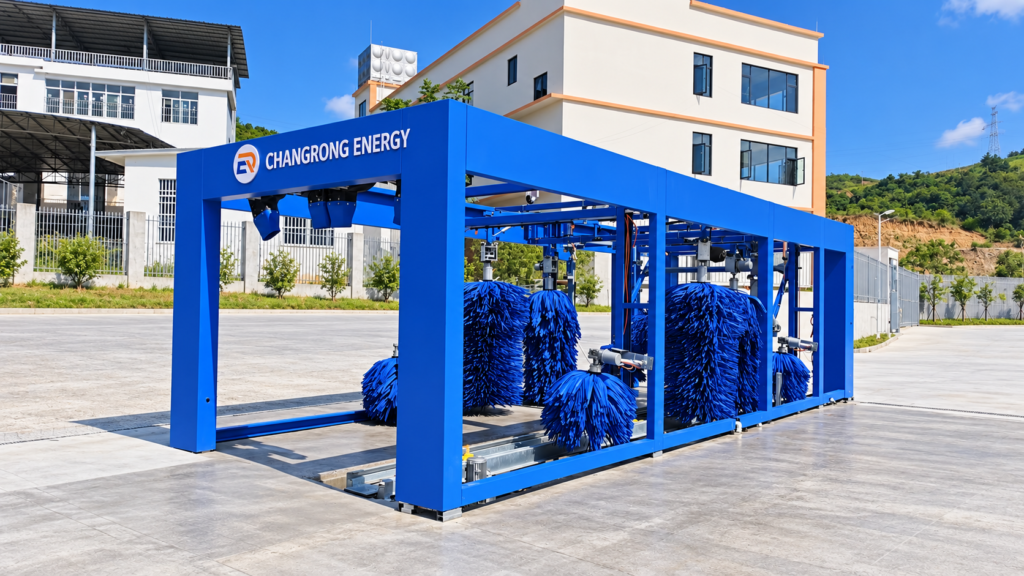
Aikesilun Tunnel-Type Car Wash Machine
Therefore, modern industrial car wash equipment should be evaluated for efficient water use.
Measure Freshwater Use
Ask how much fresh water the machine uses for each standard wash.
This helps compare operating costs.
However, the figure should be based on a defined program and test condition.
Water Reclamation Systems
Water reclamation equipment collects and treats used wash water.
Depending on the treatment process, some water can be reused during suitable washing stages.
This can reduce fresh water demand.
However, different wash stages may require different water quality levels.
Treatment Components
A recovery system may include sediment separation, oil removal, filtration, and other treatment methods.
The final rinse may require higher-quality water.
Therefore, reclamation systems should be designed for the site’s actual conditions.
Environmental and Financial Value
Reducing freshwater demand may lower water costs.
It may also help businesses meet certain local water management requirements.
However, recycling equipment adds capital and maintenance expenses.
For this reason, evaluate expected savings over the full equipment life.
9. Safety Features of Industrial-Grade Car Wash Machines
Safety should be treated as an essential requirement, not an optional upgrade.
Industrial car wash machines contain moving equipment, high-pressure water, electrical systems, and other hazards.
Therefore, buyers should request a clear description of the machine’s safety design.
Emergency Stop Functions
Appropriate emergency stop controls help operators respond to dangerous situations.
However, they are only one part of the safety system.
Other protective measures may also be required.
Vehicle Detection and Protective Controls
Vehicle sensing may help prevent certain unsafe movements.
The control system should respond safely to relevant faults.
However, buyers should verify the machine’s actual protective functions and limitations.
Electrical Safety
Wet environments require suitable electrical design and installation.
Local electrical requirements vary by country and site.
Qualified professionals should review the installation.
Maintenance Isolation
Service work may expose workers to moving parts or stored energy.
Therefore, equipment should support safe isolation and maintenance procedures.
Technical Documentation
Professional equipment should be supported by suitable operating instructions, warnings, maintenance information, and technical drawings.
For international projects, buyers should confirm relevant documentation before shipping.
10. Industrial-Grade Car Wash Machines and Total Cost of Ownership
The purchase price is only part of the investment.
For commercial equipment, total cost of ownership is often more important.
This includes the costs of buying, operating, maintaining, and eventually replacing the machine.
Main Cost Categories
Total ownership costs may include equipment price, shipping, import duties, installation, utilities, chemicals, repairs, labor, and major component replacement.

Aikesilun 14-brush tunnel-style car wash machine
Some businesses may also need software subscriptions and payment processing services.
Lower Price vs. Better Value
A cheaper machine may look attractive at first.
However, it may have higher operating costs or require more repairs.
On the other hand, a more expensive machine is not automatically better.
The premium must be supported by useful performance and reliable service.
Compare Real Operating Data
Ask suppliers for energy and water use per wash.
Also, request information about service intervals, spare parts, and component replacement.
Then, estimate costs across the expected operating period.
Example Five-Year Cost Comparison
The figures below are hypothetical and are not based on actual manufacturer performance.
| Cost Item | Machine A | Machine B |
|---|---|---|
| Equipment and installation | $65,000 | $90,000 |
| Annual operating and maintenance cost | $24,000 | $18,000 |
| Five-year operating cost | $120,000 | $90,000 |
| Five-year total before residual value | $185,000 | $180,000 |
In this example, Machine B has a higher initial price but a slightly lower five-year cost.
However, this result depends on the assumptions.
Therefore, real buying decisions should use verified supplier data.
11. How Industrial Equipment Supports Higher Wash Capacity
Washing capacity affects how many customers a business can serve.
However, capacity depends on the complete operating cycle.
In-Bay Automatic Systems
In-bay machines normally wash one vehicle at a time.
The wash frame moves around the parked vehicle.
Therefore, hourly capacity depends on wash time, payment, positioning, and vehicle exit.
Tunnel Car Wash Systems
Tunnel systems move vehicles through multiple cleaning stages.
They can support higher throughput when the full site is designed correctly.
However, tunnel equipment requires more space and investment.
Peak-Hour Demand
A business should estimate its busiest periods.
For example, a gas station may experience wash demand after work or during weekends.
High-capacity equipment may reduce queues when customer demand supports it.
Balance Capacity and Cost
Buying the largest machine is not always a good decision.
Unused capacity does not generate revenue.
Therefore, choose a system that matches realistic daily demand with room for growth.
12. Industrial Car Wash Machines for Gas Stations
Gas stations are important users of commercial automatic car wash equipment.
They may offer washing as a paid service, a loyalty benefit, or a promotion.
Compact Site Design
Many stations have limited space.
Therefore, compact in-bay equipment may be more practical than a tunnel.
However, safe vehicle access must be included in the site plan.
Customer Convenience
Simple payment, clear guidance, and consistent wash cycles can support a better customer experience.
These factors may encourage repeat visits.
Reliable Daily Operation
Gas stations may not have dedicated wash technicians on site.
Therefore, fault reporting, maintenance access, and technical support are important.
Equipment Selection
Choose a machine based on vehicle traffic, bay dimensions, operating costs, and local customer preferences.
Do not select equipment only by purchase price.
13. Equipment for Commercial Car Wash Centers
Dedicated car wash businesses often need stronger throughput and more service options.
As a result, their equipment needs may differ from those of gas stations.
Flexible Service Packages
Commercial operators may offer basic, standard, and premium wash programs.
Additional stages can help create different price levels.
However, the extra revenue should justify added operating costs.
Consistent Customer Experience
Repeat customers expect reliable cleaning.
Therefore, wash quality and machine availability matter.
Multi-Site Operations
For operators with several locations, standard equipment configurations may simplify staff training and maintenance.
However, each site still needs an appropriate layout and capacity.
Long-Term Planning
Equipment choices should support the business strategy.
For example, a company planning expansion may value common spare parts and consistent control systems.
14. Industrial Car Wash Machines for Fleet Operators
Fleet businesses may operate delivery vehicles, rental cars, taxis, or company vehicles.
These businesses often wash vehicles on a regular schedule.
Predictable Wash Cycles
A standardized automatic process can help fleet managers plan vehicle cleaning.
However, cycle time must fit operational needs.
Vehicle Compatibility
Fleet vehicles may have different dimensions and accessories.
Therefore, confirm maximum vehicle height, width, and length.
Lower Manual Work
Automation may reduce the labor needed for exterior cleaning.
However, staff may still handle vehicle movement, inspection, and maintenance.
Long-Term Reliability
Frequent fleet use places demands on equipment.
Therefore, pump ratings, mechanical durability, and spare parts support deserve special attention.
15. Industrial Equipment for Car Dealerships
Dealerships may wash vehicles before delivery, after servicing, or during fleet preparation.
For these sites, cleaning consistency can be a priority.
Professional Presentation
Clean vehicles support the dealership’s customer experience.
Therefore, suitable wash programs and rinsing quality matter.
Different Vehicle Types
A dealership may handle cars, SUVs, and larger vehicles.
The equipment must support its actual vehicle range.
Protecting Vehicle Surfaces
Cleaning methods must suit the vehicles and finishes being washed.
No automatic system guarantees zero surface risk.
Therefore, use approved chemicals and proper machine settings.
Efficient Workflow
An automatic machine may reduce repeated manual washing tasks.
However, the total benefit depends on wash volume and site operations.
16. What Should North American Buyers Consider?
Buyers in the United States and Canada should review equipment compatibility, local approvals, and service arrangements.
Electrical Requirements
Power systems differ by facility.
Therefore, confirm voltage, frequency, phase, and protection requirements before production.
Vehicle Clearance
SUVs and pickup trucks are common in many North American markets.
Therefore, maximum vehicle dimensions can be an important buying factor.
Winter Conditions
Cold weather may create freezing risks.
In certain locations, suitable drainage, heating, or freeze-protection measures may be required.
Service Availability
Overseas buyers should confirm technical support and replacement part delivery times.
Also, review how local repairs will be handled.
17. What Should European Buyers Consider?
European operators should consider energy use, water management, product conformity, and site requirements.
Machinery Compliance
Machines placed on the EU market must meet applicable product legislation.
Depending on the equipment, conformity assessment and CE marking requirements may apply.
Electrical and Safety Documentation
Buyers should request suitable technical information and operating instructions.
Local language requirements may also apply.
Energy and Water Management
Resource use affects operating costs.
Therefore, buyers should request measured water and electricity consumption figures.
Installation and Wastewater Rules
Local construction, electrical, and wastewater requirements must be reviewed before installation.
A machine’s conformity documents do not replace site permits.
18. How to Calculate Industrial Car Wash Machine ROI
Return on investment helps businesses compare equipment and project options.
However, profitability depends on the market, not only the machine.
Estimate Daily Wash Volume
Start with a realistic number of customers.
Use traffic counts, local demand, and competitor information where possible.
Estimate Revenue
Multiply the number of washes by the average selling price.
For example, 50 daily washes at $12 would generate $600 in daily gross wash revenue.
Over 30 operating days, this would equal $18,000 in monthly gross revenue.
Estimate Operating Costs
Include water, electricity, chemicals, labor, rent, insurance, maintenance, and payment fees.
Also, include financing costs where relevant.
Calculate Simple Payback
Divide the initial project investment by the monthly cash flow available to recover it.
For example, a $150,000 project generating $5,000 in monthly net cash flow would have a simple payback period of 30 months.
This is only an illustration.
Actual payback may be much shorter or longer.
Include Risks
Prepare conservative and optimistic scenarios.
Also, account for seasonal demand and possible downtime.
This makes the investment analysis more useful.
19. How to Choose an Industrial Car Wash Machine Manufacturer
A reliable manufacturer should provide more than a product brochure.
Commercial buyers need technical information and practical support.
Review Technical Specifications
Ask for machine dimensions, wash programs, motor ratings, pump performance, and utility needs.
Verify Manufacturing Quality
Review factory processes, material specifications, and quality testing.
If possible, inspect the equipment before shipment.
Request Factory Acceptance Testing
A factory acceptance test can help verify selected machine functions.
Agree on test criteria before the final production stage.
Confirm Local Compatibility
The machine must suit the destination market.
Therefore, check electrical configuration, safety requirements, and installation documentation.
Review After-Sales Service
Ask about warranty coverage, spare parts, technical assistance, and repair procedures.
For overseas purchases, clear written support terms are essential.
20. Common Mistakes When Investing in Industrial Car Wash Equipment
A poor purchasing decision can increase costs for years.
Therefore, avoid several common mistakes.
Buying Only on Price
A low quote may exclude important features or support.
Compare complete equipment packages.
Assuming Industrial-Grade Means Certified
The term industrial-grade does not itself prove regulatory compliance.
Check the actual technical documents and applicable requirements.
Ignoring Maintenance Costs
All machines need service.
Therefore, request maintenance schedules and spare parts prices.
Overestimating Customer Demand
A larger machine does not guarantee more sales.
Use realistic demand estimates.
Ignoring Local Requirements
Imported equipment may require local evaluation.
Review compliance before shipment.
Choosing Without a Service Plan
Long spare parts lead times can increase downtime.
Confirm support arrangements before buying.
21. Frequently Asked Questions
Are industrial-grade car wash machines better than basic machines?
Industrial-grade equipment may offer features suited to demanding commercial use. However, quality depends on the actual engineering and components. The best choice should match expected workload, budget, and service needs.
Do industrial car wash machines last longer?
Service life depends on design, component quality, usage, maintenance, and operating conditions. Stronger construction may help in demanding environments, but it does not guarantee a specific lifespan.
Are industrial-grade car wash machines more profitable?
They may support better financial results through suitable capacity and reliable operation. However, profitability depends on customer demand, pricing, operating expenses, and total project investment.
What is the most important feature of an industrial car wash machine?
There is no single best feature. Cleaning quality, safety, reliability, vehicle compatibility, and maintenance support all matter. Buyers should select features based on their business needs.
How much does an industrial-grade car wash machine cost?
Prices vary widely by washing method, machine size, capacity, automation features, and supplier. Request a detailed quotation and include shipping, installation, utilities, and service costs.
Can industrial car wash machines operate continuously?
Some machines are designed for frequent commercial use. However, continuous operation depends on the equipment’s rated duty cycle and service requirements. Confirm these limits with the manufacturer.
Which is better: touchless or soft-touch industrial equipment?
Touchless systems reduce routine brush contact. Soft-touch systems use mechanical cleaning action. Neither method is always better. The right choice depends on customers, road conditions, and business needs.
Can industrial car wash equipment reduce water use?
Efficient system design and suitable water reclamation may reduce freshwater consumption. However, actual savings depend on the machine, wash program, and treatment system.
Are industrial car wash machines suitable for gas stations?
Yes. Compact industrial automatic systems may suit gas stations with suitable space and utilities. The equipment should match traffic flow, customer needs, and expected wash volume.
What should overseas buyers check before ordering?
Check machine specifications, local compliance needs, electrical compatibility, installation drawings, warranty terms, spare parts, and after-sales support.
22. Final Investment Checklist
Before making your purchase, confirm the machine’s intended commercial workload.
Next, compare cleaning performance, construction quality, water use, and energy consumption.
Review safety features and destination-market requirements.
Then, check machine capacity, vehicle clearance, and site dimensions.
Also, request maintenance schedules, warranty details, and a spare parts list.
Finally, calculate the total ownership cost and projected return on investment.
This approach can help you choose a machine that fits both your technical needs and financial goals.
23. Conclusion: Why Industrial-Grade Car Wash Machines Can Be a Smart Investment
Industrial-grade car wash machines can offer long-term value for commercial businesses.
Their benefits may include durable construction, consistent cleaning, suitable automation, and easier maintenance.
However, the equipment must match the application.
A gas station may need compact and reliable washing equipment. A high-volume car wash center may require greater throughput. A fleet operator may value standardized washing and predictable operating times.
In every case, long-term value depends on more than the purchase price.
Energy consumption, water use, service support, reliability, and customer demand all affect the financial result.
Therefore, the best industrial car wash machine is not always the most expensive one.
It is the machine that delivers suitable performance, dependable operation, and strong value throughout its working life.
Request a Quote for Industrial-Grade Car Wash Equipment
Are you planning to invest in industrial-grade car wash machines for your business?
Whether your project involves a gas station, fleet facility, dealership, or commercial car wash center, choosing the right equipment starts with a clear technical review.
Our team can help you discuss suitable automatic car wash configurations based on your project requirements.
To request a quotation, please share your destination country, business type, available installation space, expected daily wash volume, and local power supply.
You can also tell us which washing method you prefer and whether you need optional water treatment or drying equipment.
Contact Us Today to Discuss Your Commercial Car Wash Equipment Investment.