 Aikeslan | Fully Automatic Car Wash Machine Manufacturer
How to Determine Whether an Existing Car Wash Machine Can Be Retrofitted?
2026 Commercial Buyer’s Guide to Car Wash Machine Retrofit Feasibility, Equipment Upgrades, Safety, Automation, Installation, Costs, and Return on Investment
Introduction: Should You Retrofit or Replace Your Existing Car Wash Machine?
An automatic car wash machine is a major investment. Over time, however, its technology, mechanical parts, and operating needs may change.
A machine that worked well several years ago may now have slower wash cycles, outdated controls, worn brushes, or high repair costs.
Meanwhile, new equipment may offer different cleaning programs, improved diagnostics, or better support for modern business operations.
As a result, many car wash owners face an important question:
Can the existing machine be upgraded, or is full replacement the better choice?
A car wash machine retrofit may help a business improve selected functions without replacing every part of the original equipment.
For example, an operator may consider replacing a control panel, upgrading sensors, improving water filtration, or installing a new chemical dosing system.
However, not every machine is suitable for modification.
A weak frame, obsolete electrical system, unsafe mechanical design, or lack of compatible parts can make an upgrade difficult or expensive.
Furthermore, major modifications may introduce new safety and compliance responsibilities.
Therefore, a retrofit decision should begin with a structured technical and financial assessment.
This guide explains how to evaluate an existing automatic car wash machine, identify practical upgrade options, estimate project costs, and compare retrofitting with full replacement.
It is designed for gas station operators, commercial car wash owners, fleet businesses, equipment distributors, and international buyers in North America and Europe.
Quick Answer: Can an Existing Automatic Car Wash Machine Be Retrofitted?
Yes. Many existing car wash machines can be upgraded when their main structure is sound, the proposed components are compatible, and the complete system can continue to operate safely.
However, retrofit feasibility depends on the machine’s actual condition.
Before approving a project, evaluate:
- Structural integrity and corrosion
- Mechanical wear and remaining service life
- Motor, pump, and drive compatibility
- PLC and electrical control systems
- Sensors and safety functions
- Water, drainage, and power capacity
- Available installation space
- Spare parts and technical documentation
- Retrofit cost and expected downtime
- Regulatory and conformity requirements
If the machine needs extensive structural repairs, a complete control redesign, and replacement of most major components, full replacement may offer better long-term value.
The best option is the one that meets the site’s future operating needs at an acceptable level of cost, risk, and reliability.
1. What Is a Car Wash Machine Retrofit?

Gas station
A car wash machine retrofit means modifying existing equipment to improve or change selected functions.
However, a retrofit can vary greatly in scope.
A simple project might replace obsolete sensors with suitable modern components.
A larger project might introduce a new control platform or redesign the water delivery system.
In some cases, the upgrade may involve several connected systems.
Therefore, the word “retrofit” does not describe one fixed package.
Buyers should define the proposed modifications before requesting quotations.
The supplier must understand what will remain, what will change, and how the upgraded parts will work together.
2. Retrofit vs. Repair vs. Refurbishment
These terms are related, but they are not identical.
A repair restores a faulty component or system to its intended operating condition.
Refurbishment generally involves restoring the condition or appearance of existing equipment.
A retrofit changes selected equipment features or capabilities.
For example, replacing a damaged seal with an approved equivalent is normally a repair.
Replacing several worn parts to restore the original machine may be refurbishment.
Installing a new control system with different operating functions may be a retrofit.
However, the legal classification depends on the changes and jurisdiction.
For this reason, buyers should describe the actual work rather than relying only on labels.
3. Why Businesses Consider Retrofitting Car Wash Equipment
Several business needs may lead to a retrofit project.
For example, an owner may want more consistent cleaning results.
Another may need to replace control components that are no longer supported.
A busy gas station may want to reduce wash cycle interruptions.
Meanwhile, an equipment operator may want improved fault diagnostics or more flexible wash programs.
Other goals can include easier maintenance and better parts availability.
However, a retrofit should solve a defined problem.
Upgrading equipment only because newer technology exists does not always create value.
The project needs clear performance objectives.
4. Start With the Machine’s Age and Condition
Machine age provides useful background, but it does not determine retrofit feasibility on its own.
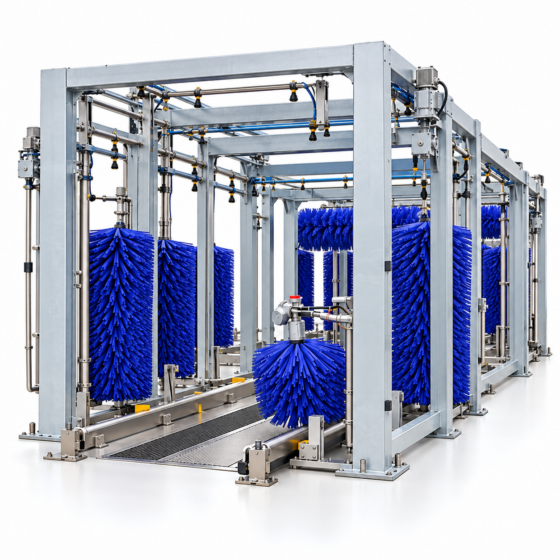
Tunnel Car Wash Machine
For example, an older machine with strong maintenance records may still have useful service life.
A newer machine operating in harsh conditions may already have serious mechanical damage.
Therefore, evaluate actual condition.
Request the machine model, serial number, installation date, and maintenance history.
Record major repairs and repeated faults.
Also, identify components that are no longer supported.
A technical inspection is more useful than assuming that every machine above a certain age must be replaced.
5. Inspect the Main Structure
The machine’s structure is a major part of the retrofit decision.
Depending on the design, it may include frames, gantries, support columns, or conveyor structures.
These parts must safely support the intended loads.
Therefore, structural condition should be examined before selecting new components.
Look for signs of corrosion, distortion, damaged joints, or previous unapproved repairs.
However, visual inspection alone may not be sufficient.
A qualified engineer may need to assess structural integrity.
Do not increase loads or change structural connections without appropriate design verification.
6. Evaluate Corrosion and Protective Coatings
Automatic car wash machines operate in wet environments.
Water, cleaning chemicals, and other substances may affect exposed materials over time.
However, corrosion resistance depends on material, protective finish, and operating conditions.
A galvanized or coated structure may remain suitable if its condition is sound.
On the other hand, extensive corrosion could make a retrofit impractical.
Therefore, inspect affected areas and determine whether repairs are possible.
Any structural repair must follow an approved engineering method.
Applying new paint over significant damage does not establish structural safety.
7. Review Mechanical Wear
A retrofit assessment should include the machine’s moving components.
These may include bearings, shafts, chains, gear reducers, wheels, and guides.
However, actual components depend on the machine design.
Repeated wear problems can indicate deeper issues.
For example, frequent bearing failures may result from poor alignment or contamination.
Therefore, do not estimate retrofit costs from individual replacement parts alone.
Inspect the complete mechanical assembly.
If most important moving components need replacement, compare the total repair scope against a new machine.
8. Check Motors and Gear Reducers

Rendering of a gas station
A motor or gear reducer may still be usable even when the control system is outdated.
However, compatibility must be verified.
A new drive may have different control requirements.
Changes in speed or loading may also affect the existing mechanical system.
Therefore, request motor and gearbox specifications.
Check electrical ratings, operating duty, mounting, and intended mechanical loads.
Do not assume a modern controller can safely operate every older motor.
Where necessary, a qualified engineer should assess whether the components can remain in service.
9. Inspect Brush Assemblies
Brush-based machines may contain top brushes, side brushes, and related drive systems.
Their suitability depends on material condition and the intended upgrade.
For example, replacing worn cleaning media may be practical when the supporting mechanism remains sound.
However, changing brush size or operating force can affect mechanical loads.
Therefore, the supplier should assess the complete assembly.
The retrofit plan should consider motors, bearings, positioning systems, and vehicle compatibility.
A brush replacement is not automatically a simple modification when it changes the machine’s operating behavior.
10. Assess the Water Pump System
Water delivery is central to cleaning performance.
An existing machine may have a suitable frame but an outdated or unreliable pump system.
However, pump replacement needs careful planning.
The new pump must match required flow, pressure, inlet conditions, and water quality.
Piping, valves, nozzles, and controls must also be compatible.
Therefore, replacing a pump without assessing the complete hydraulic system may create new problems.
Buyers should request pump performance information and site water supply data.
A properly engineered upgrade should address the cause of poor performance.
11. Can a Higher-Pressure Pump Be Installed?
A higher pressure rating does not automatically mean better cleaning.
For example, existing hoses, pipes, nozzles, and valves may have lower allowable pressure limits.
The original machine may also have specific vehicle safety requirements.
Therefore, a pressure upgrade requires a full system review.
The pump, controls, pressure protection, and spray equipment must be evaluated together.
Do not increase pressure beyond the original design without qualified engineering approval.
A retrofit should improve performance without introducing unacceptable risks.
12. Review the Chemical Dosing System

Installation Visualization
Chemical dosing systems may be practical retrofit candidates.
For example, an operator may want more accurate chemical delivery or easier maintenance.
However, chemical compatibility is essential.
Dosing pumps, seals, tubing, and fittings must suit the selected products.
The control system must also coordinate chemical application with the wash process.
Therefore, upgrading a dosing pump is not only a component replacement.
Buyers should provide chemical technical data and relevant safety information.
The manufacturer should confirm the approved arrangement before installation.
13. Water Filtration and Recycling Upgrades
Some existing wash facilities may benefit from improved filtration or water reclaim equipment.
However, the suitability of these systems depends on water quality and the intended application.
For example, treated reclaim water may be appropriate for certain wash stages but not every rinse requirement.
Therefore, water system upgrades need process design.
Check available installation space, storage capacity, drainage, and treatment requirements.
A retrofit may also affect water permits or discharge arrangements.
The operator should confirm applicable local requirements before starting work.
14. Inspect Electrical Infrastructure
Electrical compatibility is a major retrofit consideration.
An existing machine may have an outdated control cabinet or power distribution arrangement.
However, installing modern equipment may require changes to wiring, protective devices, and power capacity.
Therefore, buyers should obtain electrical drawings.
A qualified professional should inspect the current system.
Check supply voltage, frequency, grounding, enclosure condition, and relevant ratings.
Do not reuse damaged wiring simply to reduce the project cost.
Electrical upgrades must meet applicable installation and machinery requirements.
15. Can an Existing PLC Be Upgraded?
A programmable logic controller, or PLC, may control important wash functions.
Replacing an obsolete controller can improve maintainability when suitable replacement parts are unavailable.
However, PLC modernization is not always a direct substitution.
Input and output interfaces may differ.
The new controller also needs suitable software, timing, diagnostics, and integration.
Therefore, a PLC retrofit requires an engineering plan.
Buyers should ask whether the original program and electrical drawings are available.
A new PLC must not bypass existing protective functions.
All affected machine functions require appropriate testing and validation.
16. HMI and Operator Interface Upgrades
A human-machine interface, or HMI, allows operators to view and control selected machine functions.
An older interface may have limited diagnostics or poor parts availability.
Therefore, an HMI upgrade may be useful.
However, a new display must work with the existing controller.
Communication interfaces, software, and operator functions should be reviewed.
A modern screen does not automatically improve machine safety or reliability.
The upgrade should provide clear operating benefits.
For example, better fault information may help technicians diagnose recurring problems.
17. Sensor Retrofit Feasibility
Sensors support vehicle detection and machine positioning.
However, an older machine may use devices that are difficult to replace.
A retrofit may involve selecting modern sensors with suitable electrical and environmental specifications.
Important factors include sensing range, output type, response characteristics, and mounting position.
However, changing the sensing technology may affect control behavior.
Therefore, the entire detection function needs evaluation.
Safety-related sensors require additional assessment and validation.
Do not select replacement sensors based only on connector shape or physical size.
18. Communication and Remote Diagnostics
Some equipment owners want remote fault monitoring or easier technical assistance.
However, the existing controller may have limited communication capability.
Therefore, the retrofit assessment should identify available interfaces.
A supplier may propose a new controller, communication module, or monitoring device.
However, remote access creates cybersecurity and operational considerations.
Ask how connections are authorized and protected.
Also, confirm whether subscriptions or network equipment are required.
A useful upgrade should provide measurable maintenance value without creating unnecessary security risks.
19. Safety Systems Must Be Reviewed
Any significant modification can affect machine safety.
For example, changing motion control may alter stopping behavior.
Adding new equipment may introduce hazards not covered by the original design.
Therefore, the retrofit should include a formal risk assessment.
Relevant protective functions may include guards, interlocks, emergency stops, and other safeguards.
However, an emergency stop is not a substitute for every required protective measure.
Changes should be designed and validated by qualified personnel.
The original machine’s safety assumptions should not be accepted without review.
20. Why Retrofit Projects Need Proper Documentation
Old machines may have incomplete or outdated documentation.
However, technical records are important when modifying equipment.
Buyers should request mechanical drawings, electrical diagrams, component lists, and available software information.
They should also record previous modifications.
A supplier needs this information to identify compatibility risks.
If documentation is missing, an engineering survey may be required.
Do not assume that components can be connected safely through trial and error.
The final retrofit should also produce updated documentation for maintenance and future repairs.
21. Evaluate Site Dimensions and Clearance
A retrofit may preserve the existing machine footprint.
However, new components may require additional space.
For example, a larger pump cabinet may need service access.
A new water treatment system may require tanks or filtration equipment.
Therefore, review the complete installation area.
Consider machine movement, vehicle clearance, maintenance space, drainage, and emergency access.
A retrofit that fits physically may still be difficult or unsafe to service.
Updated layout drawings should be part of the feasibility study.
22. Check Foundation and Structural Support
The existing foundation may have been designed for the original machine.
However, added components or higher loads may affect its suitability.
Therefore, structural changes should be evaluated carefully.
The assessment may include anchors, floor condition, load distribution, and machine movement.
A new assembly should not be installed simply because the old foundation appears strong.
Where appropriate, a qualified engineer should verify the requirements.
The project may need additional civil work.
These costs should be included in the retrofit budget.
23. Assess Water and Electrical Capacity
Utility capacity can limit retrofit options.
For example, an upgraded pump may require a different electrical supply.
A higher-throughput wash process may need additional water flow.
Therefore, the operator should compare existing utilities with proposed requirements.
Measurements should be taken under realistic operating conditions.
Water pressure alone is not enough; flow must also be considered.
Likewise, electrical capacity should be evaluated by qualified professionals.
If major utility upgrades are required, the retrofit may become less economical.
24. Review Drainage and Wastewater Requirements
A retrofit can change water consumption and wastewater characteristics.
For example, adding new cleaning stages may increase flow to the drainage system.
Different chemicals may also affect treatment requirements.
Therefore, review the site’s discharge arrangements.
Local permits and environmental rules may apply.
However, requirements vary by jurisdiction.
The project team should confirm whether existing infrastructure remains suitable.
Any necessary improvements should be included in the full cost assessment.
25. Can Retrofit Increase Wash Capacity?
A retrofit may improve throughput in some cases.
However, the potential increase depends on the equipment and site.
For example, faster controls may have little effect if vehicle entry remains the main bottleneck.
Similarly, higher pump capacity may not reduce wash cycle time.
Therefore, identify the current limiting factor.
Measure cycle time, loading delays, and operating interruptions.
Then estimate the realistic effect of the proposed changes.
Do not promise higher throughput without considering the complete washing process.
26. Improve Cleaning Performance Without Full Replacement
Some cleaning problems can be corrected through targeted upgrades.
For example, suitable new nozzles may improve spray coverage.
A compatible chemical dosing system may provide more consistent product delivery.
Replacing worn brush materials may restore intended contact cleaning performance.
However, the underlying issue should be diagnosed first.
Poor cleaning may result from water supply, controls, chemicals, or mechanical wear.
Therefore, a retrofit should address the confirmed cause.
Replacing components without a clear performance target can waste money.
27. Rollover Car Wash Retrofit Options
Rollover machines use a moving structure to wash a stationary vehicle.
Depending on the design, practical retrofit options may include sensors, control panels, brushes, dosing equipment, or selected pumps.
However, major changes to gantry movement need careful engineering.
The supporting structure and travel system must remain suitable.
Buyers should also review vehicle clearance and safety functions.
A machine with a sound frame may be a candidate for targeted upgrades.
However, extensive structural wear may make replacement more sensible.
28. Tunnel Car Wash Retrofit Options
Tunnel car washes may include conveyors, several wash stages, brushes, blowers, and chemical systems.
Therefore, retrofit projects can be more complex.
A business may consider upgrading one wash stage or replacing selected drive equipment.
However, all connected functions must remain coordinated.
Changes to conveyor speed or vehicle tracking may affect the complete line.
Therefore, the engineering assessment should cover system integration.
A staged retrofit may reduce disruption when technically practical.
However, each stage still requires proper testing and acceptance.
29. Touchless Car Wash Retrofit Options
Touchless washing relies on water delivery, chemical application, spray movement, and controls.
Possible upgrades may include selected pumps, valves, sensors, or nozzles.
However, the cleaning process must remain compatible with the machine design.
Changing spray pressure or movement geometry can introduce new risks.
Therefore, modifications should be evaluated together.
A new control interface may improve maintenance access without changing the washing method.
However, more extensive process upgrades may require redesigning major parts of the system.
30. Gas Station Car Wash Retrofit Decisions
Gas stations often use automatic washing to attract customers or support loyalty programs.
Therefore, business continuity matters.
A retrofit that requires a long closure may affect customer experience.
However, a targeted upgrade may be attractive when the machine is structurally sound.
Owners should compare expected downtime, service support, and total project cost.
They should also consider future customer demand.
If the existing wash bay cannot support planned services, full replacement may be preferable.
The decision should reflect both technical condition and business strategy.
31. Convenience Store Car Wash Retrofits
Convenience store car washes may operate in compact spaces.
Therefore, available room can limit upgrade options.
A new control cabinet may fit easily.
A larger water treatment unit may not.
Buyers should assess installation and service clearance.
They should also review the availability of local technicians.
If a retrofit requires major building changes, the business should compare those costs with a new equipment package.
The best approach is the one that fits the property and operating model.
32. Fleet Washing Equipment Upgrades
Fleet wash sites often have specific vehicle types and operating schedules.
Therefore, retrofit planning should consider vehicle dimensions and cleaning requirements.
For example, changing a passenger-car wash to serve larger vehicles may require fundamental structural changes.
That may not be practical.
However, improving selected controls or water treatment functions may be feasible.
Buyers should define the future vehicle range before requesting engineering proposals.
A retrofit should not be used outside its approved vehicle compatibility limits.
33. Compare Partial Retrofit, Major Retrofit, and Replacement
Three basic approaches can be considered.
| Option | Typical Scope | Key Question |
|---|---|---|
| Partial retrofit | Selected components or functions | Is the remaining machine sound and compatible? |
| Major retrofit | Several mechanical and control systems | Can the integrated machine be made safe and reliable? |
| Full replacement | New machine and associated installation changes | Does replacement provide better overall value? |
However, project labels do not determine safety obligations.
A small physical change may still affect a critical protective function.
Therefore, actual technical impact matters more than the number of parts being replaced.
34. How to Estimate Car Wash Retrofit Cost
Retrofit cost should include more than replacement components.
A proper budget may include:
- Site inspection and engineering design
- Mechanical and electrical parts
- Control software and integration
- Installation labor
- Structural or utility modifications
- Safety assessment and validation
- Freight and import charges
- Commissioning and training
- Planned downtime
- Contingency allowance
However, these costs vary greatly by machine and location.
Therefore, request an itemized quotation.
Avoid relying on a general percentage of new equipment price without examining the proposed work.
35. Retrofit Cost vs. New Machine Cost
A retrofit may have a lower initial price than replacement.
However, the comparison should use the complete cost of each option.
For example, retaining an old frame may save money.
Yet extensive wiring changes and difficult component integration can increase labor costs.
A new machine may require higher initial spending but provide a more consistent technical package.
Therefore, compare total installed cost and expected operating performance.
The cheapest quotation is not always the best financial decision.
36. Calculate Return on Investment
A retrofit should create measurable value.
For example, it may reduce maintenance spending or avoid certain downtime costs.
It may also support additional wash sales if capacity increases.
However, these benefits should be estimated conservatively.
A simple payback formula is:
Simple Payback Period = Total Retrofit Investment ÷ Estimated Annual Net Benefit
Suppose a hypothetical retrofit costs $24,000.
Assume it provides $8,000 of annual net benefit after relevant additional operating costs.
The simple payback period is:
$24,000 ÷ $8,000 = 3 years
This is an illustration, not an industry benchmark.
37. Consider the Remaining Service Life
Simple payback should be compared with the expected useful life of the upgraded machine.
For example, a retrofit with a three-year payback may be unattractive if major structural replacement is likely much sooner.
However, remaining service life cannot be determined from age alone.
It requires an assessment of wear, corrosion, operating duty, and maintenance history.
Therefore, buyers should ask which major components will remain.
They should also request an explanation of the risks associated with continued use.
An upgrade is more attractive when its benefits can reasonably be realized during the machine’s remaining service life.
38. Include Downtime in the Financial Analysis
Equipment upgrades require installation and testing time.
Therefore, planned downtime should be included in the decision.
For example, a major control replacement may close the wash bay while wiring and software are completed.
However, full replacement may also require significant downtime.
The operator should estimate realistic shutdown periods for both options.
Consider scheduling work during quieter periods where practical.
Do not assume a retrofit can be completed without interrupting operations.
The project quotation should explain the expected installation sequence.
39. Example: Retrofit vs. Replacement
Consider a hypothetical business comparing two options.
| Item | Retrofit | New Machine |
|---|---|---|
| Installed project cost | $32,000 | $78,000 |
| Initial planned shutdown | 5 days | 10 days |
| Annual maintenance estimate | $5,000 | $2,500 |
| Assumed evaluation horizon | 5 years | 5 years |
Ignoring financing, energy, revenue differences, residual value, and other costs:
Retrofit five-year cost = $32,000 + ($5,000 × 5) = $57,000
Replacement five-year cost = $78,000 + ($2,500 × 5) = $90,500
However, this simplified result does not prove that retrofit is better.
The comparison must also consider reliability, safety, capacity, additional repairs, and remaining service life.
All figures are hypothetical.
40. When Retrofitting Is Usually More Attractive
Retrofitting may be attractive when the existing structure remains sound.
It may also be useful when the main problem is limited to a small number of components.
For example, a suitable PLC upgrade could improve supportability when other machine systems remain reliable.
A targeted pump or sensor replacement may address a known issue.
However, the proposed changes must be technically compatible.
The business should also have access to qualified installation and service support.
A clear project scope increases the chance of a successful outcome.
41. When Replacement May Be the Better Choice
Full replacement may be preferable when many important components are near the end of their useful life.
Extensive frame corrosion can be another concern.
Similarly, a machine may lack the space or utility capacity needed for future operations.
A retrofit may also become expensive when control software and technical documentation are unavailable.
However, replacement should not be recommended automatically.
The decision should follow an objective engineering and financial comparison.
Safety and operating requirements must be met under either option.
42. Warning Signs of a High-Risk Retrofit
Several conditions should prompt additional review.
These include serious structural damage, repeated major mechanical failures, and incomplete electrical documentation.
Obsolete controls can also create integration challenges.
Another warning sign is a proposal to increase operating speed without evaluating the machine’s safety design.
However, no single factor always rules out a retrofit.
The correct response is to investigate the associated risk.
Where risks cannot be addressed within a practical budget, replacement may become the better option.
43. Safety and Legal Duties in the United States
US car wash retrofit projects should consider relevant machinery, electrical, and workplace safety requirements.
For example, OSHA addresses machine guarding and hazardous-energy control in covered workplaces.
However, the correct requirements depend on the equipment and work being performed.
Major modifications may require reassessment of safeguards.
Electrical changes should be reviewed by qualified professionals.
Operators should also check relevant state and local obligations.
The equipment owner and project contractor should define their safety responsibilities before work begins.
44. Retrofit Compliance in Canada
Canadian retrofit projects require review of the applicable federal, provincial, territorial, and local requirements.
These may include machinery safety, electrical installations, and workplace obligations.
However, requirements vary by jurisdiction.
Therefore, buyers should involve qualified local professionals.
Imported replacement components may also require relevant approval or evaluation.
A supplier’s original equipment documents do not automatically establish that a modified machine is compliant.
The final installation and safety functions should be assessed according to the actual project.
45. EU Machinery Requirements for Retrofits
EU buyers should distinguish routine maintenance from modifications that change machinery function or risk.
A significant modification may create additional conformity obligations.
The EU Machinery Regulation (EU) 2023/1230 includes provisions addressing substantial modification.
Its general application begins on January 20, 2027.
However, projects in 2026 must be evaluated under the framework applicable at that time.
Therefore, do not assume every retrofit requires a new CE marking process.
Equally, do not assume existing CE documentation automatically covers major changes.
Qualified assessment is essential.
46. UK Machinery Retrofit Requirements
UK guidance distinguishes normal refurbishment from modifications that may effectively create new machinery.
For example, replacing parts with suitable equivalent components may be different from introducing new automated control functions.
However, the actual effect of the modification determines the obligations.
The UK Health and Safety Executive advises assessing changes to design, function, and safety.
Therefore, UK buyers should obtain appropriate technical and regulatory guidance.
A retrofit must remain safe for use.
Relevant documentation and conformity responsibilities should be reviewed before commissioning.
47. Supplier Capability and Retrofit Engineering
A retrofit supplier needs more than access to replacement parts.
It should understand the original equipment and the proposed changes.
For example, a control upgrade may require knowledge of sensors, motors, drives, and machine safety.
Therefore, buyers should ask about engineering capability.
Request examples of comparable work when available.
Also, confirm who performs design, installation, testing, and technical support.
An experienced supplier should explain both what is feasible and what should not be modified.
48. Original Manufacturer vs. Third-Party Retrofit Provider
The original manufacturer may have useful design information.
However, it may no longer support the model.
A qualified third-party specialist may offer alternative solutions.
Therefore, both options can be considered.
The buyer should compare access to drawings, software, approved parts, and engineering expertise.
However, a third party should not make undocumented changes to critical systems.
Responsibility for the completed modification must be clear.
The best choice depends on the project, technical records, and available service support.
49. Warranty and Liability After Retrofitting
A retrofit may affect the existing equipment warranty.
However, the result depends on the original terms and the proposed changes.
Buyers should confirm whether the original manufacturer will continue supporting unmodified components.
Ask who provides warranty coverage for new parts.
Also, clarify responsibility for integration faults.
For example, a new controller may affect existing drives or sensors.
The retrofit agreement should explain how such issues will be handled.
Written responsibility helps reduce later disputes.
50. Installation and Commissioning Tests
A retrofit is not complete when the new parts are physically installed.
The upgraded machine needs proper commissioning.
Tests may include checking electrical connections, sensor operation, control sequences, mechanical movement, and protective functions.
However, the exact test plan depends on the modifications.
The supplier should define acceptance criteria before work begins.
Operators should receive relevant training.
Updated maintenance documents and part lists should also be provided.
The machine should return to commercial service only after appropriate checks have been completed.
51. Building a Retrofit Feasibility Checklist
A structured checklist can help buyers compare projects.
Existing Machine
- Identify manufacturer, model, and serial number.
- Record age and maintenance history.
- Inspect structural condition.
- Review mechanical wear.
- Identify obsolete components.
Engineering Compatibility
- Check motor and drive specifications.
- Review PLC and software availability.
- Confirm sensor and control compatibility.
- Assess water and electrical capacity.
- Evaluate installation space.
Safety and Compliance
- Conduct an appropriate risk assessment.
- Review guards and safety functions.
- Confirm regulatory obligations.
- Plan commissioning and validation.
- Update technical documentation.
Financial Assessment
- Obtain itemized retrofit quotations.
- Estimate planned downtime.
- Compare ongoing maintenance costs.
- Evaluate remaining service life.
- Compare retrofit with replacement.
52. Supplier Questions Before Requesting a Retrofit Quote
Ask the supplier:
- Have you assessed this machine model before?
- Which components can remain in service?
- Which parts need replacement?
- What technical information is required?
- Can the proposed controls work with existing drives?
- Will safety functions require redesign?
- Are site utilities sufficient?
- What structural modifications are expected?
- How long will installation take?
- What tests will confirm successful commissioning?
- What warranty covers the retrofit?
- What spare parts will be available?
- Who provides local technical support?
- What costs are excluded from the quotation?
- At what point would you recommend full replacement?
These questions help buyers distinguish a realistic engineering proposal from a general sales offer.
53. Car Wash Machine Retrofit FAQs
Can an old automatic car wash machine be upgraded?
Yes, if its structure, mechanical systems, controls, and safety requirements can support the planned changes.
Is retrofitting cheaper than replacing a machine?
It may have a lower initial cost, but the full comparison must include installation, integration, maintenance, and future repairs.
Can I upgrade only the PLC?
Possibly. The project requires electrical, software, safety, and control compatibility assessment.
Can new sensors work with an old car wash machine?
Some can, but sensing range, electrical outputs, control logic, and safety functions must be verified.
Can I install a more powerful water pump?
Only when the complete water system is suitable for the changed operating conditions.
Can old brushes be replaced with new designs?
Possibly. The drive, frame, positioning system, and contact loads must remain compatible.
Can a retrofit improve wash speed?
It may, but actual throughput depends on the complete washing process and approved operating limits.
Does a retrofit require new CE marking?
Not every retrofit does. The answer depends on the changes, applicable law, and whether a new conformity assessment is required.
Can an old tunnel car wash be modernized?
Yes, in some cases. Conveyor, controls, cleaning stages, and safety systems must be assessed together.
Is a rollover machine easier to retrofit?
Not necessarily. Retrofit complexity depends on the specific machine and proposed modifications.
Can water recycling be added?
Possibly, if the site has suitable space, utilities, water quality management, and required approvals.
What is the biggest retrofit risk?
A major risk is underestimating integration problems between new components and the remaining equipment.
How long does a retrofit take?
There is no universal duration. The schedule depends on engineering scope, part availability, site work, and testing.
Does retrofitting extend machine life?
It can improve selected functions, but it does not automatically restore the remaining service life of every original component.
When should a machine be replaced instead?
Replacement may be better when the structure is unsound, major systems are obsolete, or retrofit costs and risks are too high.
Who should inspect the machine?
Qualified engineers and technicians with knowledge of the relevant equipment and safety requirements.
Can a third-party manufacturer supply retrofit parts?
Possibly, but component compatibility and integration responsibilities must be verified.
Does retrofitting affect the warranty?
It may. Review the original warranty and the retrofit contractor’s terms.
What documents should I provide for an assessment?
Share machine information, drawings, photographs, maintenance records, fault history, and site utility details.
How do I decide between retrofit and replacement?
Compare technical feasibility, safety, installed costs, downtime, future capacity, support, and expected remaining life.
Conclusion: Make the Retrofit Decision Based on Evidence
Retrofitting an existing car wash machine can be a practical way to improve selected functions and manage equipment investment.
However, a successful project requires more than compatible replacement parts.
The existing structure must be sound.
Mechanical and electrical systems need assessment.
Control upgrades must work with the complete machine.
Safety functions and regulatory responsibilities must also be addressed.
Furthermore, the financial case must consider the remaining service life and the cost of future maintenance.
For some businesses, a targeted retrofit may provide useful value.
For others, a major rebuild may cost too much or create unnecessary risk.
The best car wash machine retrofit decision is based on technical condition, safe integration, realistic project costs, and the business’s future operating needs.
Request a Car Wash Machine Retrofit Feasibility Assessment
Are you considering upgrading an existing commercial automatic car wash machine?
Before deciding, prepare the following project information:
- Machine manufacturer and model
- Installation year
- Installation country
- Machine photographs
- Current faults or limitations
- Proposed upgrade goals
- Site dimensions
- Water and electrical supply details
- Available technical drawings
- Expected daily wash volume
- Required project timeline
- Approximate budget
A qualified equipment supplier or retrofit engineer can use this information to assess possible modifications.
Request a written feasibility review that identifies reusable components, required upgrades, safety considerations, project costs, and remaining technical risks.
Request a Retrofit Assessment | Compare Upgrade and Replacement Options | Get a Commercial Car Wash Equipment Quote
Technical References
UK Health and Safety Executive — Refurbished and Modified Machinery
https://www.hse.gov.uk/work-equipment-machinery/refurbished-modified-machinery.htm
European Union — Regulation (EU) 2023/1230 on Machinery
https://eur-lex.europa.eu/eli/reg/2023/1230/oj
US OSHA — Machine Guarding
https://www.osha.gov/etools/machine-guarding
US OSHA — Control of Hazardous Energy
https://www.osha.gov/laws-regs/regulations/standardnumber/1910/1910.147
Google Search Central — Creating Helpful, Reliable, People-First Content
https://developers.google.com/search/docs/fundamentals/creating-helpful-content
Google Search Central — AI Features and Your Website
https://developers.google.com/search/docs/appearance/ai-features
Disclaimer: This article provides general engineering, purchasing, and equipment modernization guidance. It does not establish whether any particular machine is safe or suitable for modification. Technical feasibility, legal responsibilities, conformity assessment, installation requirements, and financial results depend on the specific project and jurisdiction. All modifications affecting mechanical, electrical, hydraulic, pneumatic, or safety systems must be designed and assessed by qualified personnel. All financial examples are illustrative rather than verified market quotations.